WhatsApp Business API Pricing and Usage Costs
The WhatsApp Business API charges businesses based on the type of message sent and the country of the recipient. Meta sets the rates, and the cost structure depends on whether the customer starts the conversation or…

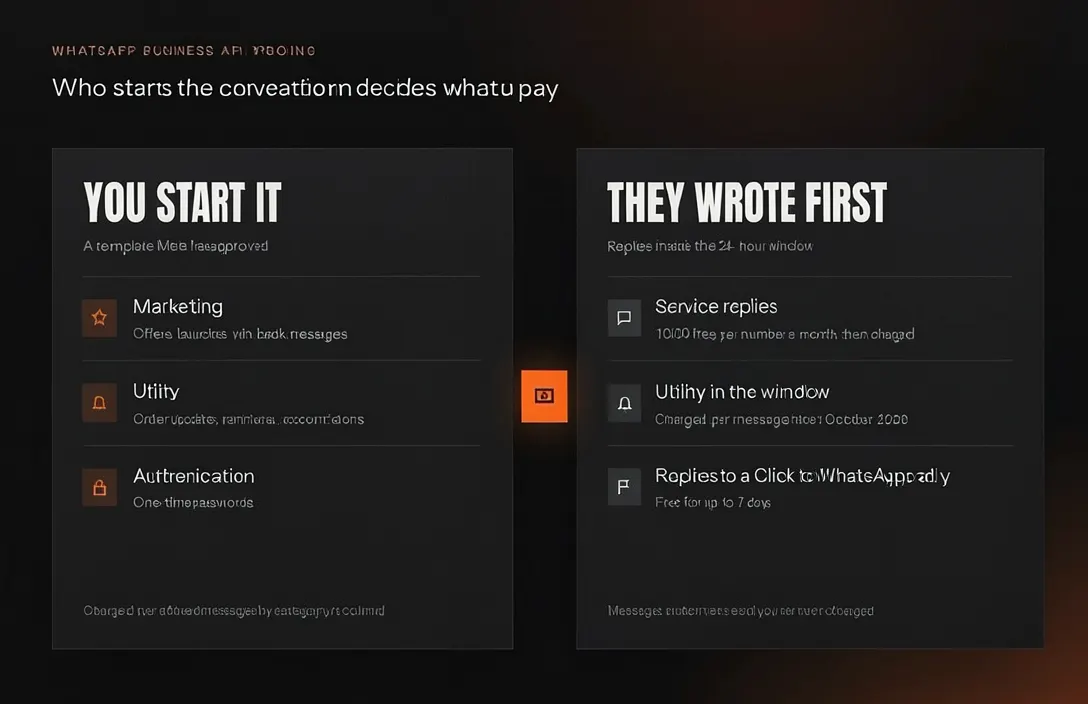

Meta charges businesses for each delivered message sent through the WhatsApp Business API, with the rate determined by the message's category and the country of the recipient's phone number. Messages initiated by the business are categorized as marketing, utility, or authentication, with varying costs per message. For example, marketing messages tend to be more expensive than utility messages, which are typically used for updates related to orders or payments. The cost per message also varies by country, with Meta publishing rates for 47 markets. A message sent to a number starting with +91 (India) is priced according to India's rate, while one to +44 (United Kingdom) follows the UK rate (Dev.to, 2026). [1]
When a customer starts the conversation, a 24-hour window opens during which businesses can reply freely without using approved templates. This is the most cost-effective approach, as replies within the window are cheaper than messages initiated by the business. Additionally, the first 1,000 service replies per month on every business number are free. However, after this allowance, businesses are charged per message. Starting from 1 October 2026, Meta also introduced a requirement that businesses must have a payment method set up in Meta's Billing Hub for service replies beyond the free allowance to be delivered (Dev.to, 2026). [1]
Messages sent by customers to the business are always free. Additionally, replies within a 7-day window following a customer's message from a Click to WhatsApp ad (such as a Facebook or Instagram ad with a 'Send message' button) are also free. Businesses can reduce costs by encouraging customers to initiate conversations through methods such as a 'Message us on WhatsApp' button on websites, QR codes, or printed numbers on invoices. These strategies turn potentially paid messages into free replies within the 24-hour window (Dev.to, 2026). [1]
Meta charges businesses for each delivered message sent through the WhatsApp Business API, with the rate determined by the message's category and the country of the recipient's phone number. As of 1 July 2025, Meta replaced conversation-based pricing with per-message pricing, where each delivered message is charged once based on its category and the recipient's location. This shift means that businesses must now consider the cost of each individual message rather than the cost per conversation, as previously described in older articles. The pricing is set by Meta and remains consistent regardless of the service provider used to set up the API (Dev.to, 2026). [1]
Advertisement
When a customer starts a conversation, a 24-hour window opens during which businesses can reply freely without using approved templates. This window is crucial for businesses, as it allows them to send service messages—such as product links, prices, and delivery dates—without incurring additional charges. This feature was introduced to encourage customer-initiated interactions, which are significantly cheaper than messages initiated by businesses. As of 1 October 2026, the first 1,000 service replies per month per number are free, and businesses must have a payment method set up in Meta's Billing Hub to ensure that messages beyond the free allowance are delivered (Dev.to, 2026). [1]
Messages sent by customers to businesses are always free, and businesses can also benefit from a 7-day free entry point window when customers initiate contact through a Click to WhatsApp ad. During this period, Meta does not charge for marketing, utility, authentication, or service messages. Businesses are advised to let customers start conversations wherever possible, such as through a "Message us on WhatsApp" button on their website or a QR code at a physical location, to minimize costs. This approach ensures that replies are sent within the free 24-hour window, reducing the need for expensive approved templates (Dev.to, 2026). [1]
Meta charges businesses for each delivered message sent through the WhatsApp Business API, with the rate determined by the message's category and the country of the recipient's phone number (Dev.to, 2026). This pricing model applies to all messages initiated by the business, with the exception of messages sent by customers to the business, which are always free. Businesses are charged based on whether the message falls into one of three categories: marketing, utility, or authentication, each with its own rate per country. This structure ensures that businesses pay different rates depending on the type of message and the location of the recipient. [1]
When a customer starts a conversation, a 24-hour window opens during which businesses can reply freely without using approved templates (Dev.to, 2026). This is the most important pricing consideration for businesses using the WhatsApp Business API, as it allows for more flexible and cost-effective communication with customers. Additionally, businesses can benefit from a 7-day free entry point window when customers initiate contact through a Click to WhatsApp ad. During this period, Meta does not charge for marketing, utility, authentication, or service messages sent to the customer. These free windows are designed to encourage businesses to let customers initiate conversations, which can significantly reduce messaging costs. [1]
Advertisement
Meta's pricing model has evolved over time, with the shift from charging per 24-hour conversation to per-message pricing since 1 July 2025 (Dev.to, 2026). The rate for each message depends on its category and the recipient's country, with Meta publishing rates for 47 markets. Businesses must be aware of these rates and plan their messaging strategy accordingly. Additionally, businesses located in India are now billed in rupees since 1 January 2026, and all messaging accounts must be moved to rupees by 31 December 2026. These changes highlight the importance of understanding and adapting to Meta's pricing structure to manage costs effectively. [1]
Meta charges businesses for each delivered message sent through the WhatsApp Business API, with the rate determined by the message's category and the country of the recipient's phone number (Dev.to, 2026). Businesses are not charged for messages sent by customers to them. The pricing model shifted from charging per 24-hour conversation to per-message pricing since 1 July 2025 (Dev.to, 2026). [1]
When a customer starts a conversation, a 24-hour window opens during which businesses can reply freely without using approved templates (Dev.to, 2026). This window allows businesses to send service replies at a lower cost, with the first 1,000 service replies per month per number being free (Dev.to, 2026). Messages sent by customers to businesses are always free, regardless of the context. [1]
Meta's pricing model includes specific free entry point windows for customers who initiate contact through a Click to WhatsApp ad, which can last up to 7 days (Dev.to, 2026). During this period, businesses do not incur charges for marketing, utility, authentication, or service messages sent to the customer (Dev.to, 2026). Businesses must ensure they have a payment method set up in Meta's Billing Hub to avoid service replies beyond the free allowance from being delivered after 1 October 2026 (Dev.to, 2026). [1]
Advertisement
The Cali Reporter newsletter
The stories worth your time.
California, the country, and what comes next. Join our free newsletter for reporting that keeps you informed.
More in Technology
- Modern Web Guidance 1.0 and Browser Compatibility
Modern Web Guidance 1.0, announced by Chrome for Developers on November 10, introduces browser compatibility data to assist coding agents in building web features. The initiative emphasizes the importance of fallback…
- Apache mod_http2 Vulnerability Detection with Nmap
A new Nmap scripting module has been developed to detect the Apache mod_http2 vulnerability (CVE-2026-119618), addressing the challenges of identifying affected systems accurately.
- Securing Remote Vendor Access in Industrial Networks
Best practices for managing remote vendor access in operational technology (OT) networks emphasize controlled access points, multifactor authentication, and time-bound sessions to reduce cybersecurity risks.