Apache mod_http2 Vulnerability Detection with Nmap
A new Nmap scripting module has been developed to detect the Apache mod_http2 vulnerability (CVE-2026-119618), addressing the challenges of identifying affected systems accurately.

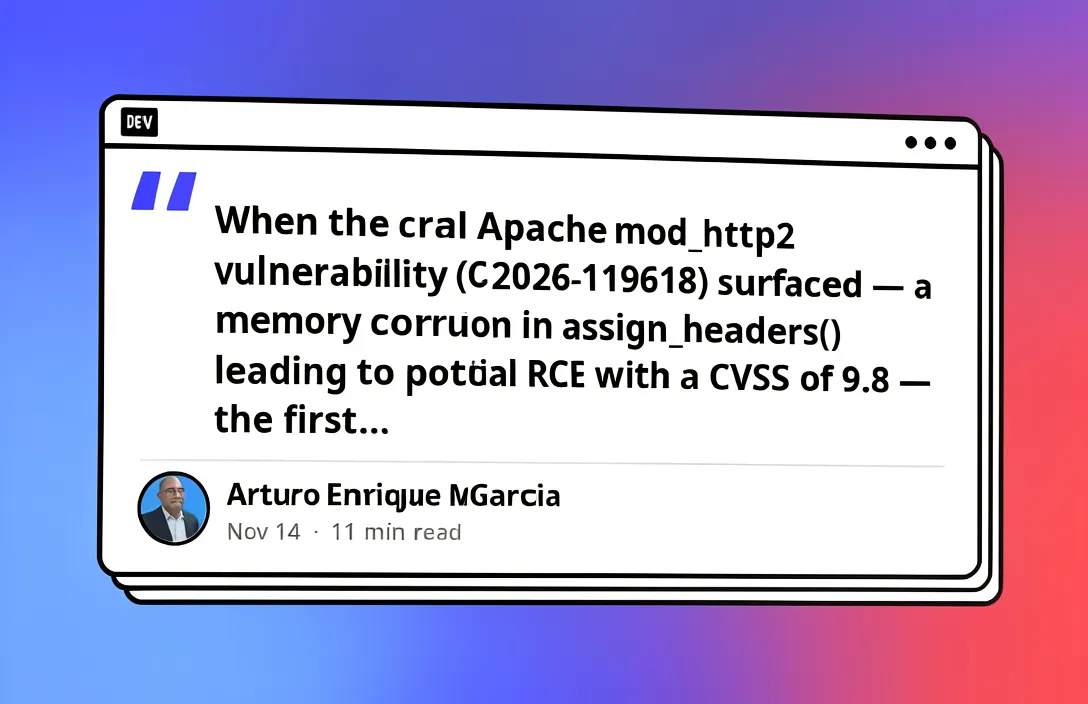

The Apache mod_http2 vulnerability (CVE-2026-119618) is a critical memory corruption issue that could lead to remote code execution (RCE) with a CVSS score of 9.8. Initial detection methods often relied on header grabbing, which can be misleading. The new Nmap Scripting Engine (NSE) module, apache-mod-http2-scanner.nse, was developed to provide a more accurate detection mechanism. This module identifies Apache HTTP Server instances affected by CVE-2026-119618 by combining version detection with actual HTTP/2 capability probing, rather than relying solely on headers (Dev.to, 2026-11-11). [1]
The vulnerability detection process involves identifying whether HTTP/2 is enabled on the target system. This is done by probing the target for HTTP/2 support using either ALPN during the TLS handshake or the h2c upgrade method. The script is designed to handle scenarios where the server's version is hidden by setting ServerTokens Prod, a configuration that prevents the server from revealing its version in the response header. In such cases, the script returns a 'LIKELY VULNERABLE' status, acknowledging the uncertainty without assuming the version is in the affected range (Dev.to, 2026-11-11). [1]
The script distinguishes between four states: VULNERABLE, LIKELY VULNERABLE, NO CONCLUYENTE, and NOT VULNERABLE. This approach ensures that the script does not silently drop hosts from reports based on inconclusive results. The 'NO CONCLUYENTE' state is explicitly shown to prevent it from being mistaken for a positive result. The script was validated on a Debian 13 VM using the official Apache 2.4.70 Docker image, confirming its accuracy in identifying vulnerable, non-vulnerable, and inconclusive cases (Dev.to, 2026-11-11). [1]
The Apache mod_http2 vulnerability (CVE-2026-119618) is a critical memory corruption issue that could lead to remote code execution (RCE) with a CVSS score of 9.8. Detecting this vulnerability requires more than simply identifying the Apache version; it also necessitates confirming whether HTTP/2 is enabled on the target system. A custom Nmap Scripting Engine (NSE) module, apache-mod-http2-scanner.nse, was developed to accurately detect the vulnerability by combining version detection with HTTP/2 capability probing (h2 over TLS and h2c over plaintext) (1). [1]
Advertisement
The script addresses the dual-protocol problem by distinguishing between h2 over TLS and h2c over plaintext. If Nmap identifies the port as TLS, the script uses ALPN to negotiate h2; if the port is plaintext, it uses h2c. If the port state is unknown, the script defaults to h2c and falls back to ALPN if inconclusive. This approach prevents false negatives by ensuring both protocols are tested (1). [1]
Another challenge arises when the ServerTokens are set to 'Prod', which hides the Apache version in the Server header. In such cases, the script returns 'LIKELY VULNERABLE' instead of 'VULNERABLE' or 'NOT VULNERABLE', acknowledging that the version is hidden but HTTP/2 is active. Users can also set the hidden_version=unknown argument to return 'NO CONCLUYENTE' if needed for stricter reporting requirements (1). [1]
The script distinguishes four states—VULNERABLE, LIKELY VULNERABLE, NO CONCLUYENTE, and NOT VULNERABLE—rather than the traditional binary approach of 'VULNERABLE' or 'NOT VULNERABLE'. This distinction is critical for accurate reporting, as 'NO CONCLUYENTE' is shown separately from the 'VULNERABLE' block to avoid misinterpretation. The script ensures that both the server version and HTTP/2 capability are confirmed before flagging a system as vulnerable (1). [1]
The Apache mod_http2 vulnerability (CVE-2026-119618) is a critical memory corruption issue that could lead to remote code execution (RCE) with a CVSS score of 9.8. Detecting this vulnerability is complicated by the dual-protocol problem, as HTTP/2 can be enabled in two fundamentally different ways: h2 over TLS (negotiated via ALPN) and h2c over plaintext (negotiated via an HTTP/1.1 Upgrade: h2c request). A scanner that only checks one protocol risks producing false negatives (1). [1]
Advertisement
Another challenge arises when the ServerTokens are set to 'Prod', which hides the Apache version in the Server header. This setting can cause traditional header-based detection methods to fail, but the script still identifies whether HTTP/2 is active, returning a state of 'LIKELY VULNERABLE' in such cases. This approach avoids false negatives by distinguishing between versions that are hidden and those that are not (1). [1]
Most NSE vulnerability scripts output only two states: 'VULNERABLE' or 'NOT VULNERABLE'. This binary approach is dangerous for a vulnerability like CVE-2026-119618, which depends on a specific version range and runtime feature flags. The script instead distinguishes four states: 'VULNERABLE', 'LIKELY VULNERABLE', 'NO CONCLUYENTE', and 'NOT VULNERABLE', ensuring that 'NO CONCLUYENTE' is not mistaken for a positive result and that users are prompted to take further action (1). [1]
The Apache mod_http2 vulnerability (CVE-2026-119618) is a critical memory corruption issue that could lead to remote code execution (RCE) with a CVSS score of 9.8. Traditional methods of detecting this vulnerability by simply checking for the Apache version in server headers have significant limitations. For example, they may falsely identify systems as vulnerable even when HTTP/2 is not enabled, or fail to detect the vulnerability when the ServerTokens are set to 'Prod' (source ID: 1). [1]
To overcome these limitations, the apache-mod-http2-scanner.nse script was developed. It distinguishes between two different ways HTTP/2 can be enabled — h2 over TLS and h2c over plaintext — and uses the appropriate method for each case to ensure accurate detection. If a system is configured with ServerTokens set to 'Prod', the script does not assume the version is outside the affected range and instead returns 'LIKELY VULNERABLE' (source ID: 1). [1]
Advertisement
The script also introduces a more nuanced approach to vulnerability detection by distinguishing four states — VULNERABLE, LIKELY VULNERABLE, NO CONCLUYENTE, and NOT VULNERABLE — rather than the traditional binary approach. This allows for more accurate reporting and avoids the risk of silently dropping potentially vulnerable hosts from reports. The script is safe and does not send exploit payloads or attempt to trigger the vulnerability (source ID: 1). [1]
Sources
Prepared with AI assistance from the cited sources.
The Cali Reporter newsletter
The stories worth your time.
California, the country, and what comes next. Join our free newsletter for reporting that keeps you informed.
More in Technology
- Modern Web Guidance 1.0 and Browser Compatibility
Modern Web Guidance 1.0, announced by Chrome for Developers on November 10, introduces browser compatibility data to assist coding agents in building web features. The initiative emphasizes the importance of fallback…
- Securing Remote Vendor Access in Industrial Networks
Best practices for managing remote vendor access in operational technology (OT) networks emphasize controlled access points, multifactor authentication, and time-bound sessions to reduce cybersecurity risks.
- WhatsApp Business API Pricing and Usage Costs
The WhatsApp Business API charges businesses based on the type of message sent and the country of the recipient. Meta sets the rates, and the cost structure depends on whether the customer starts the conversation or…