

Warning huge 8.0-magnitude earthquake could hit Japan after powerful tremors sparked tsunami and coastal evacuation
Japan's latest 7.7 quake triggered a rare magnitude-8.0 advisory and tsunami evacuations, exposing how seismic complacency still lingers despite the 2011 catastrophe that killed 18,500.
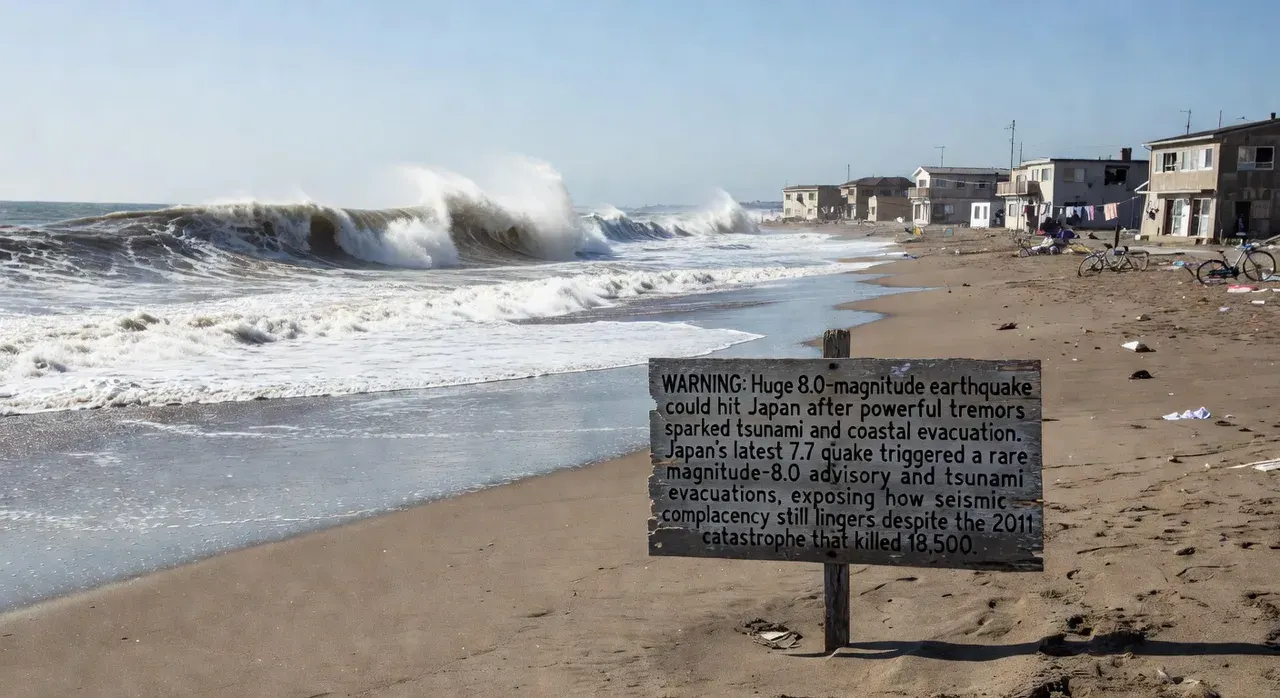
Japan’s meteorological agency didn’t mince words Monday: after a 7.7-magnitude earthquake struck off Iwate prefecture, the risk of an even larger magnitude-8.0 shock is now “relatively higher than during normal times.” Within hours, officials ordered coastal evacuations for waves up to three metres, sent soldiers to Iwate, and watched an 80cm surge hit Kuji port at 5:34 p.m. local time.
The quake, initially reported at 7.4 then revised upward twice, rattled Tokyo skyscrapers hundreds of miles south. Chief Cabinet Secretary Minoru Kihara told reporters there were no immediate reports of serious injuries or major damage. Yet Prime Minister’s Office statements confirmed “human and material damage” was being assessed, while bullet trains in Aomori halted and ships fled Hachinohe port under flashing “Tsunami! Evacuate!” alerts.
Tokyo Electric Power Company and other nuclear operators reported zero abnormalities at Fukushima, Higashidori, Onagawa, or the Aomori spent-fuel facility. That’s reassuring, yet the memory of 2011 lingers: a magnitude-9.0 event killed or left missing 18,500 people and melted down Fukushima. Monday’s tremor occurred just six miles below the Pacific floor along the Ring of Fire, where Japan sits atop four tectonic plates and absorbs 18 percent of the world’s quakes.

This isn’t isolated. The Japan Meteorological Agency issued its first “megaquake” advisory in 2024 for the Nankai Trough, warning a future event could kill 298,000 and inflict $2 trillion in damage. That alert was lifted after a week but triggered rice hoarding and mass hotel cancellations. A second advisory followed a December 2025 magnitude-7.5 quake that injured more than 40. Each time authorities stress personal responsibility: “You are responsible for your own safety.”
The pattern is clear. Japan experiences roughly 1,500 jolts annually. Most are mild, yet the government’s habit of issuing short-lived megaquake warnings then retracting them risks training citizens to treat existential threats as temporary inconveniences. Monday’s 7.7 event and the subsequent magnitude-8.0 advisory prove the ground never really settles.
What happens when the next advisory coincides with a genuine megaquake rather than a false alarm? The evacuations, the soldiers, the swaying chandeliers in Tokyo cafés, all of it is rehearsal for an inevitability Japan has never fully solved.
Original reporting: Dailymail.com.
More in California
- UC Berkeley Lab Proposes New Civic Framework for California’s Next Governor
A research-driven agenda calls for institutionalizing 'co-governance' to address low public trust and lack of resident influence in state decision-making.
- Five Tax Measures on California’s Ballot Aim to Reshape State Finances
Propositions 3, 40–43 would alter income, wealth and local taxation rules—marking the highest number of tax measures on a general election ballot since 1994.
- Catalina Helicopter Crash Highlights Risks of Island Medevac Flights
A medical evacuation chopper carrying Catalina Romero, pilot, and nurse Jessica Devries crashed into the ocean shortly after takeoff, killing all three; federal investigators are assessing causes including night flying, spatial disorientation, and the island’s challenging Pebbly Beach heliport.