Voyager 1’s Saturn Pass: Checkable Findings, Open Puzzles, and a Crowded Calendar
A Good News Network anniversary roundup supplies the mission details and many unrelated milestones. The science claims deserve celebration with caveats attached.

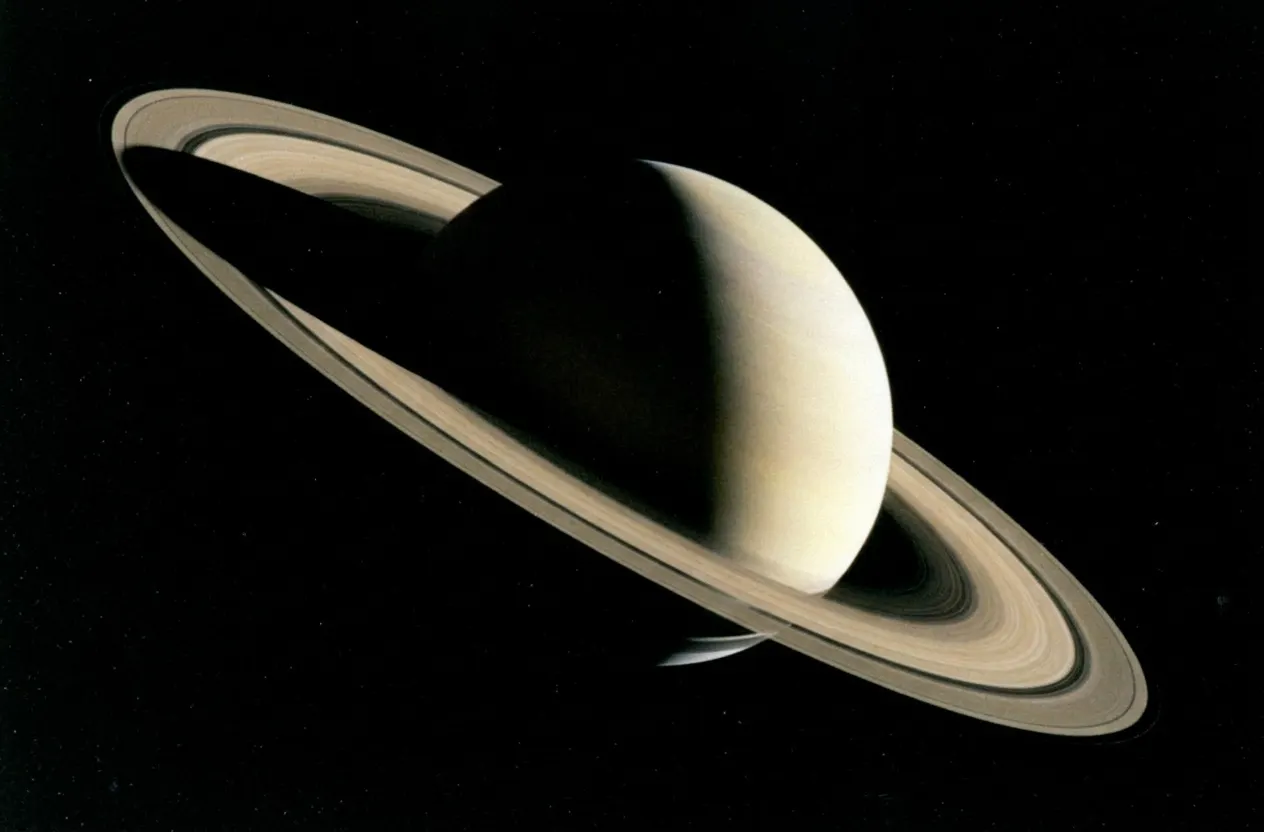

The supplied Good News Network item marks a space-science anniversary: NASA’s Voyager 1 spacecraft reached Saturn, according to the account, and returned what it describes as the first images of the planet’s rings. The item says the probe got there by way of a Jupiter gravity assist and that Voyager 2 repeated that route. It dates the close pass to Nov. 12, 1980, and says the craft closed to about 77,000 miles above Saturn’s cloud tops. [1]
At that distance, the account says, cameras detected intricate ring structures and remote-sensing instruments examined the atmospheres of Saturn and Titan, its large moon. The item gives a date, a distance and instrument categories, which makes the anniversary more useful than a bare commemorative note. It also places the mission note inside a long list of other events, so the reader has to separate detailed science claims from brief calendar entries and from cultural or civic notes that carry their own evidence burdens. [1]
The encounter matters because the item attributes concrete observations to it, not merely a dramatic photograph. The ring photographs are described as the earliest of Saturn’s rings, and the atmospheric work produced numbers that invite comparison with Jupiter. Those comparisons are the raw material of planetary science: they turn a flyby into questions about how giant planets differ and why. [1]
The item also shows why anniversaries need a sharp pencil as well as a big heart. A roundup can celebrate a landmark while blurring categories—mission findings, civic history, birthdays and cultural notes—unless the reader separates them. The strongest use of the supplied material is to keep the Voyager findings in the foreground and treat the rest of the list as context about how the date is remembered. [1]
Advertisement
According to the account, Voyager 1’s path to Saturn ran through a gravity assist at Jupiter, and Voyager 2 followed the same trajectory. The Nov. 12 pass brought the probe to roughly 77,000 miles from Saturn’s cloud tops. The cameras found complex ring structures; the remote-sensing instruments studied Saturn’s atmosphere and Titan’s. Those are the core historical claims the item supplies, and they include enough detail—date, distance and instrument type—to be evaluated. [1]
The atmospheric finding is the most quantitatively specific. The item says Voyager 1 measured about 7% helium by volume in Saturn’s upper atmosphere, against 11% in Jupiter’s, with hydrogen making up almost all the remainder. It notes that Saturn’s internal helium was expected to match Jupiter’s and the Sun’s. From that mismatch, the account says, the lower upper-atmosphere abundance may imply that heavier helium is slowly sinking through Saturn’s hydrogen; that might explain the excess heat Saturn radiates over the energy it receives from the Sun. [1]
The item also records dynamic observations. It says winds on Saturn blow at high speed and that equatorial winds were clocked at close to 500 meters per second—roughly 1,100 miles per hour—mainly eastward. It says Voyager clocked Saturn’s day at 10 hours, 39 minutes, 24 seconds. And it says the probe found auroral activity at the poles and ultraviolet signals at middle latitudes that look auroral. [1]
The helium result is an implication, not a closed case, and the source’s language reflects that. It says the lower upper-atmosphere abundance may imply sinking helium and might explain the excess heat. That is the right level of caution. A flyby measurement can generate a hypothesis; it does not by itself prove the mechanism. The value of the anniversary is that it preserves the observation and the proposed explanation together, so readers can see how planetary science moves from a number to a question. [1]
Advertisement
The comparison is specific: 7% helium in Saturn’s upper atmosphere versus 11% at Jupiter, with nearly all the rest hydrogen, and an expectation that Saturn’s internal helium should match Jupiter’s and the Sun’s. That is a testable-style contrast drawn from the flyby, not a claim that the sinking-helium mechanism is settled. The source uses cautious qualifiers, and those qualifiers should travel with the numbers. [1]
The aurora finding carries a similar lesson. The item says Voyager detected polar aurorae and aurora-like ultraviolet emissions at middle latitudes, and that these remain a puzzle because the charged-particle bombardment that produces Earth’s auroras is a high-latitude process. That is a compact statement of an unresolved problem: the observed phenomenon is real enough to report, but the familiar explanation does not fit the location. The source does not offer a solution, and this report does not invent one. [1]
The supplied item is not only a Voyager story. It lists many other anniversaries and birthdays: Elizabeth Cady Stanton’s birth in Johnstown, New York, in 1815; Austria becoming a republic in 1918; the Holland Tunnel opening in 1927; the San Francisco-Oakland Bay Bridge opening in 1936; the first drive-up bank teller windows at Exchange National Bank in Chicago in 1946; Lech Wałęsa’s release from prison in 1982; the American Medical Association’s 1987 position that a doctor’s refusal to treat a person solely because of AIDS or HIV was unethical; Tim Berners-Lee’s 1990 formal proposal for the World Wide Web; and the start of same-sex marriage in Connecticut in 2008. [1]
It also marks cultural and artistic milestones: the opening of Abbey Road Studios in 1931; the 2014 opening of the van Gogh–Roosegaarde cycle path, designed by Daan Roosegaarde; Auguste Rodin’s birth in 1840; and birthdays for Baaba Maal, Neil Young and Wallace Shawn. For a reporter, the list is a reminder that a date can carry many kinds of memory. For a reader, it is a reminder to ask which items are supported by detailed evidence and which are brief commemorative notes. [1]
Advertisement
Several questions remain open in the supplied account. The most direct is the aurora puzzle: why were aurora-like ultraviolet emissions detected at middle latitudes when the electron and ion bombardment that produces Earth’s auroras is a high-latitude process? The item says the phenomenon remains a puzzle; it does not name a mechanism. A second question is how strongly the helium abundance difference supports the sinking-helium hypothesis. The account uses cautious language, which leaves room for other interpretations. [1]
There is also a documentation question. The item says the event happened 46 years ago today and also places it on Nov. 12. The source does not reconcile that wording. This report does not resolve it either. The safe description is the one the source supports: an anniversary item marks the Nov. 12, 1980, Saturn encounter and describes its findings. Readers should watch for later accounts that clarify the dating and preserve the same caveats. [1]
What to watch next is not a predicted mission outcome but a test of how the story is told. If later anniversary coverage revisits Voyager 1 at Saturn, readers can check whether it keeps the distance, the helium percentages, the wind speed, the rotation period and the aurora puzzle intact. They can also check whether it distinguishes the mission findings from the other milestones in the roundup. Those are modest watch items, but they are the ones the supplied evidence can support. [1]
A second watch item is the language of uncertainty. The account uses cautious qualifiers for the helium-sinking idea and calls the middle-latitude aurora emissions a puzzle. Future retellings should not harden those claims into certainty without new evidence. If they do, the anniversary will have lost the very quality that makes the original useful: it shows discovery as a process, with observations, hypotheses and open questions standing side by side. [1]
Advertisement
For Cali Reporter, the lesson is editorial as much as scientific. A big heart wants to celebrate the voyager’s achievement and the many human milestones that share the date. A sharp pencil asks what exactly was measured, how far the probe came, which atmosphere was studied, and what the source actually claims about helium, winds and aurorae. The supplied account gives enough detail to do that checking without adding invented interviews or dramatic color. [1]
The result is a story with joy and rigor. Voyager 1’s Saturn pass is worth marking because it produced specific, checkable observations: ring structures, atmospheric composition, high-speed equatorial winds, a measured rotation period and auroral emissions that still need explanation. The anniversary is also worth reading carefully because it shows how easily a roundup can mix verified science with commemorative notes. Celebrating the first while checking the second is the right way to honor both the mission and the reader. [1]
The unanswered questions are not a flaw in the anniversary; they are the reason it remains interesting. A flyby that answered some questions and left others open is a more honest portrait of exploration than a tidy victory lap. The item’s own cautious wording does that work. Readers who want the full picture should keep the qualifiers attached to the claims they qualify, and should treat the rest of the date’s milestones as separate stories with their own evidence. That is not a demand for skepticism; it is a demand for clarity. The mission’s achievement can be celebrated without turning every adjacent note into a verified finding, and the source’s own cautious wording gives readers the terms to do that. [1]
Sources
Prepared with AI assistance from the cited sources.
The Cali Reporter newsletter
The stories worth your time.
California, the country, and what comes next. Join our free newsletter for reporting that keeps you informed.
More in Good News
- World's First Non-Malignant Bone Marrow Transplant Successfully Treats Aplastic Anemia
A groundbreaking medical achievement has been made with the successful use of a deceased organ donor's bone marrow to treat a non-malignant disease, offering new hope for patients with aplastic anemia.
- Preserving Kids' Art Through Collaborative Collages
An artist has found a way to help parents preserve their children's artwork while reigniting their own creativity, leading to a growing trend among families.
- Spain's Cantabrian Brown Bear Population Doubles in 20 Years
Spain has witnessed a remarkable recovery of its Cantabrian brown bear population over the last two decades, with numbers doubling to 370 individuals and their breeding range expanding significantly.