The Black Panther Party's Origins in Oakland
The Black Panther Party emerged from the social and political conditions of 1960s Oakland, shaped by the Great Migration, economic hardship, and racial discrimination.

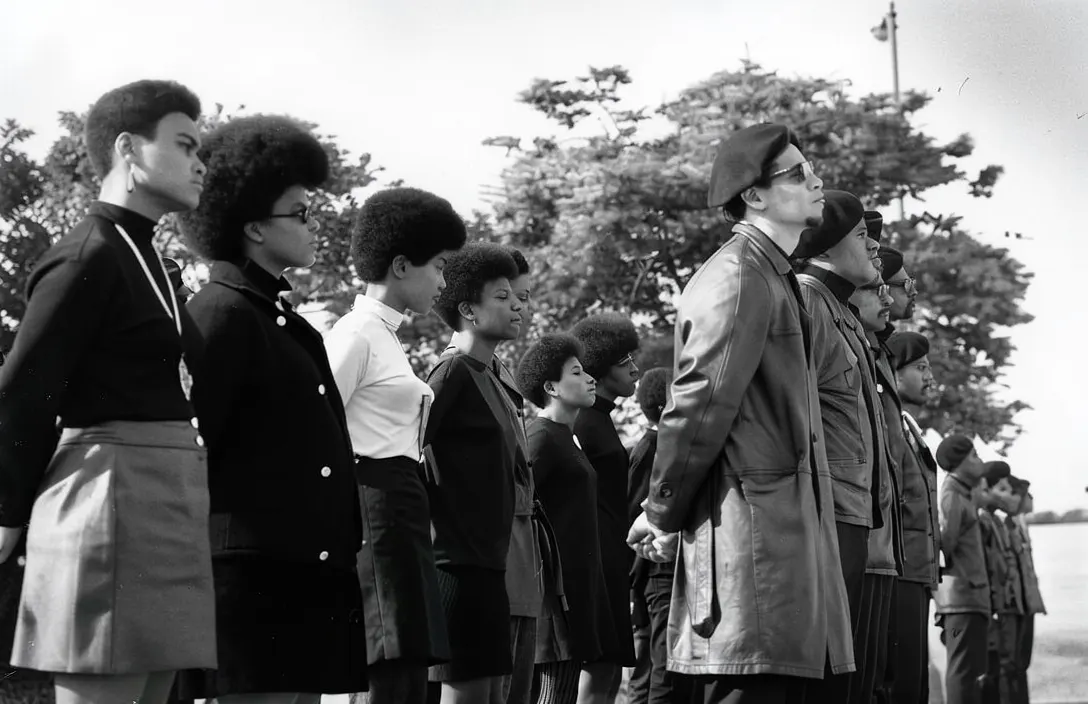

The Black Panther Party was not a gang. They grew out of a young Black intelligentsia on college campuses, as noted by Bobby Seale in 1966. The Great Migration had transformed Oakland, increasing its Black population from 8,500 in 1940 to 88,000 by 1960. However, the wartime jobs boom had turned to bust, leading to high unemployment and underemployment for African Americans, especially Black youth. West Oakland’s Black communities were being bulldozed in the name of urban renewal, and an overwhelmingly white police force was aggressively targeting Black youth, while a disciplinary regime in the public schools was criminalizing Black students (The Oaklandside). [1]
The historian Isabel Wilkerson has argued that the Great Migration was a movement of political refugees, Black families who escaped the rural South with its Jim Crow laws and widespread police brutality. That migration north and west was also driven by hope, buoyed in Oakland by a wartime economic boom that created demand for shipyard jobs. However, racial discrimination limited opportunities for Black workers, as seen in the struggles of Bobby Seale’s father, George Seale, a master carpenter who struggled to find steady work (The Oaklandside). [1]
In the 1950s, the city’s growing Black population sparked white flight from the flatlands to suburban communities, resulting in containment measures by the city’s institutional powers. Oakland’s schools, a state report found in 1964, were characterized by a “consistent emphasis on discipline, comportment, and hygiene over academic achievement.” Huey Newton, in his book “Revolutionary Suicide,” described being repeatedly disciplined and sent to juvenile hall while a student at Oakland Tech in 1959 and graduating “a functional illiterate” (The Oaklandside). [1]
The March against Fear took place in June 1966, spanning from Memphis, Tennessee, to Jackson, Mississippi. It was a pivotal event in the Civil Rights Movement, led by James Meredith, who was shot in the leg on the second day of the march, prompting the Southern Christian Leadership Conference (SCLC), Student Nonviolent Coordinating Committee (SNCC), and Congress of Racial Equality (CORE) to continue his efforts. The march occurred during a period of heightened racial tension in the South, with Greenwood, Mississippi, being a focal point of conflict on June 16, 1966, when marchers set up camp on the grounds of Stone Street Elementary School, a public school in the town. Local white officials denied the marchers permission to remain on the school’s property, leading to confrontations and the arrest of Stokely Carmichael, Robert Smith, and Bruce Bains for trespassing. [2]
Advertisement
Stokely Carmichael, then 24 years old and a recent graduate of Howard University, became a prominent figure during the march. He had previously been active with SNCC since 1961, participating in voter registration efforts in the South and facing imprisonment at Parchman State Prison Farm in Mississippi for attempting to integrate passenger trains. In 1965, Carmichael was influenced by the Lowndes County Freedom Organization (LCFO) in Alabama, which used the black panther as its symbol and advocated for 'black power for black people.' The LCFO’s militant approach and ideological stance significantly shaped Carmichael’s views, which he later expressed during the march. [2]
On June 16, 1966, after being released from jail, Carmichael addressed a rally of approximately 1,500 marchers. At the urging of SNCC member Willie Ricks, who had been preparing marchers throughout the day, Carmichael introduced the slogan 'Black Power' to the crowd. This marked a turning point in the Civil Rights Movement, shifting the focus from nonviolent protest to a call for black political and economic empowerment. The slogan was directly inspired by the LCFO’s use of the term, which emphasized black self-determination and independence. The event in Greenwood, Mississippi, is documented in National Archives case file #44-33352, which contains investigative reports and statements related to the actions of that day. [2]
The March against Fear is considered the last major march against racism in the 1960s Civil Rights era in the South. Following the march, the SCLC shifted its focus to economic inequality and the Vietnam War, while SNCC’s leadership embraced black power and Pan-Africanism. CORE also moved toward economic empowerment and black power. The event in Greenwood, Mississippi, was a critical moment in this ideological shift, as it highlighted the growing influence of black power rhetoric and the tensions between different civil rights organizations. The historical significance of the march is preserved in National Archives records, including correspondence, photographs, and transcripts that provide detailed accounts of the events and their aftermath. [2]
The historian Isabel Wilkerson has argued that the Great Migration was a movement of political refugees, Black families who escaped the rural South with its Jim Crow laws and widespread police brutality. In the 1950s, the city’s growing Black population sparked white flight from the flatlands to suburban communities, resulting in containment measures by the city’s institutional powers (1). [1]
Advertisement
The Great Migration has transformed the city. A Black population of 8,500 in 1940 has grown to 88,000 by 1960. The wartime jobs boom has long since turned to bust, leading to high unemployment and underemployment for African Americans, especially Black youth. West Oakland’s Black communities are being bulldozed in the name of urban renewal. And an overwhelmingly white police force is aggressively targeting Black youth — while a disciplinary regime in the public schools is criminalizing Black students (1). [1]
In the 1950s, when Huey Newton was a teenager, the city’s growing Black population was sparking white flight from the flatlands to suburban communities. It also resulted in a host of containment measures by the city’s institutional powers. “Racial anxieties,” Rutgers University ethnic studies professor Donna Murch writes in an essay for the journal “Souls,” often resulted in draconian responses by Oakland’s police, penal authorities, schools and recreation centers, all coordinated through a new entity called the Associated Agencies (1). [1]
Sources
rediscovering-black-history.blogs.archives.gov
Prepared with AI assistance from the cited sources.
The Cali Reporter newsletter
The stories worth your time.
California, the country, and what comes next. Join our free newsletter for reporting that keeps you informed.
More in Oakland
- Domestic Violence in Oakland: Resources and Expert Insights
Domestic violence is a pervasive issue in Oakland, with local experts and organizations providing critical support and resources for survivors. The Oakland Police Department reported handling 3,855 domestic violence…
- East Bay Thanksgiving Volunteer Opportunities Abound
As Thanksgiving approaches, numerous East Bay organizations are seeking volunteers to assist with meal preparation and distribution for those in need.
- Origins of the Black Panther Party in Oakland
The Black Panther Party was founded in Oakland by Merritt College students Huey Newton and Bobby Seale, emerging from a growing Black student movement in the East Bay. This section explores the early roots of the…