Techniques to Enhance AI Voice Quality
Developers are focusing on improving the naturalness of AI-generated voices by adjusting pitch, speed, and prosody, as outlined in a recent article on Dev.to.

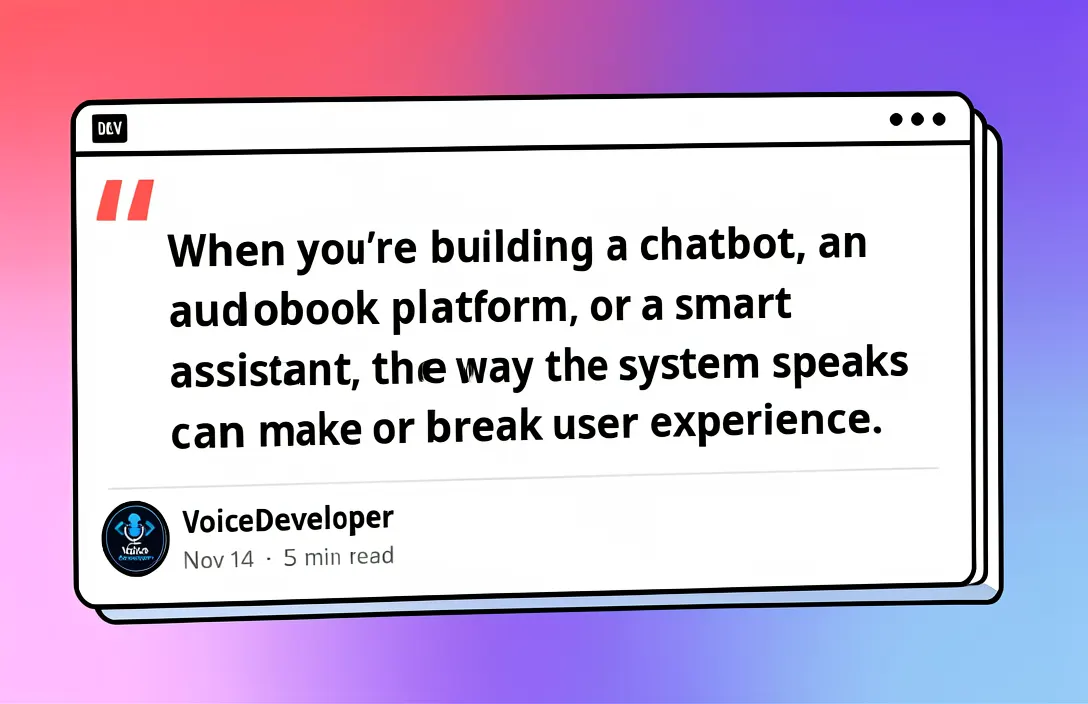

When building chatbots, audiobook platforms, or smart assistants, the way the system speaks significantly impacts the user experience. A voice that sounds flat, robotic, or off-beat can make users feel like they are interacting with a machine rather than a helpful companion. This is why many voice-AI developers prioritize voice quality as much as intent-recognition models (Dev.to, 2023). [1]
To make text-to-speech (TTS) output sound more natural, developers need to understand the core elements of natural speech, such as pitch and intonation, duration and pace, prosody, and background noise. These elements affect how sentences feel like a real conversation, prevent robotic stutter, add emotion and emphasis, and influence perceived authenticity (Dev.to, 2023). [1]
A good base engine is essential for achieving natural-sounding AI voices. While there are many TTS engines available, such as Google Cloud, Amazon Polly, and Azure Cognitive Services, developers often find that default voice parameters are not perfectly natural. Configurable engines like ElevenLabs’ API, which allow tweaking of pitch, speed, and prosody, provide a more human-like voice (Dev.to, 2023). [1]
Fine-tuning the voice involves adjusting pitch and speed to mimic natural conversation, adding prosody and pauses, and using emotion parameters to influence the tone of the voice. These adjustments help create a more relatable and human-like experience for users (Dev.to, 2023). [1]
Advertisement
ElevenLabs' API is built on a neural-network backbone, which allows for detailed customization of voice parameters such as pitch, speed, and prosody on a per-utterance basis. This level of control is essential for developers aiming to create more natural and human-like speech outputs. The platform supports the use of SSML tags, enabling developers to embed pauses and adjust prosody directly within the text. This feature is particularly useful for adding natural breaks and varying emphasis to mimic human speech patterns. The API also provides a trial period, allowing developers to test different voices and settings before committing to a full integration. This trial period is ideal for small-scale experimentation and ensures that developers can find the optimal voice settings for their specific use case without incurring costs upfront. The trial access includes multiple voices and settings, which helps in evaluating the platform's capabilities and suitability for different applications. [1]
ElevenLabs offers a voice-cloning feature that allows developers to upload a short voice sample (5–10 seconds) and train a new voice model based on that sample. This process involves generating a sample ID from the uploaded audio and then using that ID to train a new voice model. Once trained, the cloned voice can be used to generate speech from text, providing a personalized and dynamic voice experience. This feature is particularly useful for applications that require a specific voice, such as personalized assistants or audiobooks. The platform handles all the heavy lifting on their servers, which means developers can focus on the user experience without worrying about the technical complexities of voice cloning. This approach ensures that the cloned voice maintains the natural speech patterns and characteristics of the original sample, making it suitable for a wide range of applications. [1]
The platform also supports advanced customization through neural voice layers, which can be used to enhance the realism of the generated speech. For example, an emotion layer can be added to detect sentiment in the text and adjust voice settings accordingly, making the speech more expressive and contextually appropriate. A prosody layer can generate a prosody map from a natural speech corpus and feed it into SSML, ensuring that the generated speech has natural variations in pace and emphasis. A background layer can add subtle room reverb to make the voice sound like it's coming from a specific environment, which is particularly useful for long-form content such as podcasts or e-learning modules. These layers are optional but can significantly improve the realism and engagement of the generated speech, making it more suitable for applications that require a high level of naturalness and emotional expression. [1]
When building chatbots, audiobook platforms, or smart assistants, the way the system speaks significantly impacts the user experience. A voice that sounds flat, robotic, or off-beat can make users feel like they're talking to a machine instead of a helpful companion. Understanding the core elements of natural speech, such as pitch and intonation, duration and pace, prosody, and background noise, is crucial for developers aiming to create more natural-sounding AI voices (Dev.to). [1]
Advertisement
A good base engine is essential for achieving natural-sounding AI voices. There are numerous TTS engines available, including Google Cloud, Amazon Polly, Azure Cognitive Services, and the open-source Festival. However, most developers find that the default voice parameters are 'good enough' but never perfectly natural. Instead, they seek a configurable engine that allows for fine-tuning of pitch, speed, and prosody on a per-utterance basis (Dev.to). [1]
Fine-tuning the voice involves adjusting pitch and speed to mimic natural conversation, adding prosody and pauses, and using emotion parameters to influence the tone of the voice. For example, developers can use SSML tags to control prosody and pauses, as well as emotion parameters such as stability and similarity boost to push the voice toward a particular emotional tone (Dev.to). [1]
Sources
Prepared with AI assistance from the cited sources.
The Cali Reporter newsletter
The stories worth your time.
California, the country, and what comes next. Join our free newsletter for reporting that keeps you informed.
More in Technology
- Modern Web Guidance 1.0 and Browser Compatibility
Modern Web Guidance 1.0, announced by Chrome for Developers on November 10, introduces browser compatibility data to assist coding agents in building web features. The initiative emphasizes the importance of fallback…
- Apache mod_http2 Vulnerability Detection with Nmap
A new Nmap scripting module has been developed to detect the Apache mod_http2 vulnerability (CVE-2026-119618), addressing the challenges of identifying affected systems accurately.
- Securing Remote Vendor Access in Industrial Networks
Best practices for managing remote vendor access in operational technology (OT) networks emphasize controlled access points, multifactor authentication, and time-bound sessions to reduce cybersecurity risks.