

States Across Wildfire-Prone West Are Using AI for Early Detection
AI cameras caught the Diamond Fire at 7 acres in Arizona, yet California’s wildfire problem keeps growing because detection alone can’t fix what fuels the flames.
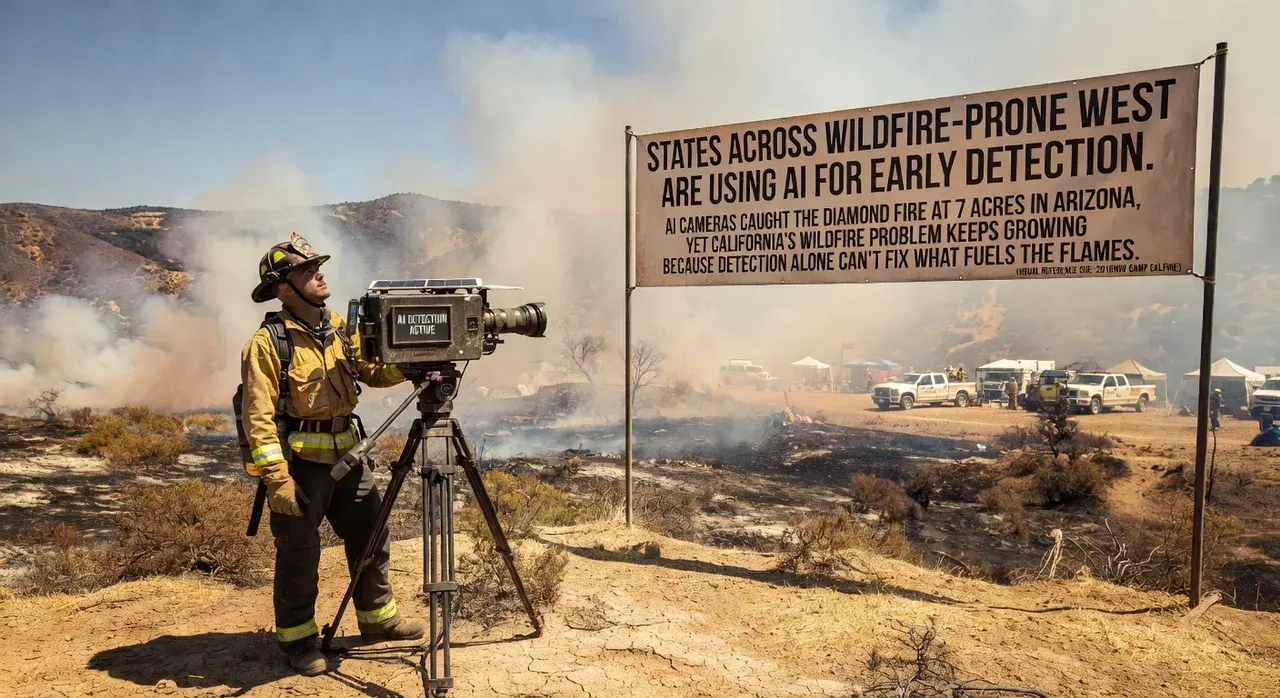
Artificial intelligence spotted smoke in Arizona’s Coconino National Forest on a March afternoon. Analysts ruled out clouds and dust, then alerted firefighters who contained the Diamond Fire before it exceeded seven acres. That early win came from one of Arizona Public Service’s nearly 40 AI smoke-detection cameras, part of a broader push across the West to use technology where human eyes are scarce.
States like Arizona and California are racing to expand these networks as record heat and dismal snowpack heighten wildfire fears. Arizona Public Service plans 71 cameras by summer’s end; Xcel Energy has already installed 126 and intends to cover seven of its eight states by year’s end. ALERTCalifornia operates 1,240 AI-enabled cameras, and its founder, UC San Diego professor Neal Driscoll, claims the system is now beating 911 calls to fires in remote areas.
Cal Fire battalion chief Brent Pascua says the real value shows up where a blaze might burn unnoticed for a long time. “In many cases, we’ve started a response before 911 was even called,” he told reporters, “and in a few cases, we’ve actually started a response, went there, put the fire out, and never received a 911 call.” Pano AI, whose cameras combine high-definition feeds with satellite data, detected 725 wildfires across the U.S. last year and charges about $50,000 annually per unit including 24/7 monitoring.

Yet the technology’s limits are obvious. It offers no guidance on whether to dispatch crews immediately, monitor, evacuate, or ignore a detected fire. RAND senior researcher Patrick Roberts notes that decision-making still rests entirely with people and support systems. In densely populated zones, humans usually report fires quickly anyway. During extreme wind events like last year’s Los Angeles fires, rapid shifts overwhelm any camera network.
Proponents argue climate change, driven by fossil fuels, is making fires hotter, faster and more frequent, and that AI provides a critical head start. Pano AI co-founder Arvind Satyam says stakeholders credit the system with preventing blazes from reaching hundreds or thousands of acres. An Arizona Public Service meteorologist claims the cameras deliver alerts 45 minutes faster than the first 911 call on average. Still, false alarms drain time and attention, and the price tag remains a barrier to wider adoption.
The deeper problem is that detection is only the first mile. AI can suggest where to thin vegetation or forecast smoke plumes, as George Mason University professor Chaowei “Phil” Yang is attempting with partners in Los Angeles and at NASA’s Jet Propulsion Laboratory. But Roberts, who recently studied wildfire innovation, is blunt: “AI in wildfires, it’s no longer just speculative. It’s really being used.” The question California must answer is whether layering more cameras on a landscape already primed for catastrophe actually changes the outcome, or merely documents the next disaster faster.
Original reporting: Insurance Journal.
More in California
- UC Berkeley Lab Proposes New Civic Framework for California’s Next Governor
A research-driven agenda calls for institutionalizing 'co-governance' to address low public trust and lack of resident influence in state decision-making.
- Five Tax Measures on California’s Ballot Aim to Reshape State Finances
Propositions 3, 40–43 would alter income, wealth and local taxation rules—marking the highest number of tax measures on a general election ballot since 1994.
- Catalina Helicopter Crash Highlights Risks of Island Medevac Flights
A medical evacuation chopper carrying Catalina Romero, pilot, and nurse Jessica Devries crashed into the ocean shortly after takeoff, killing all three; federal investigators are assessing causes including night flying, spatial disorientation, and the island’s challenging Pebbly Beach heliport.