

Sparks Fly in Final California Governor Debate
Seven candidates bickered over housing, taxes, and crime in LA with no breakout star, revealing how California's primary has become a contest of performative outrage rather than serious solutions.
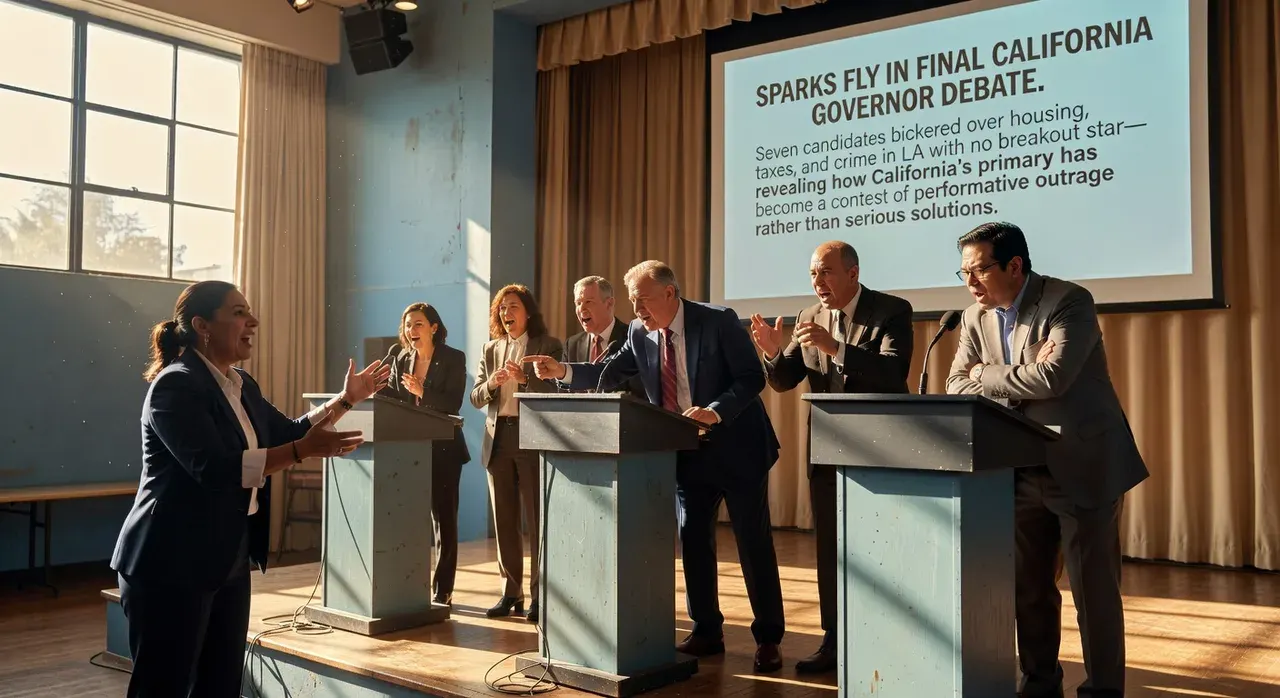
Seven candidates took the stage in Los Angeles Wednesday for California's last debate before the June 2 primary, and the sparks that flew revealed more about entrenched divisions than any path forward. Housing shortages, proposed taxes on the richest residents, and the state's persistent crime problems dominated, yet no single contender seized the moment to break from the pack.
The exchanges underscored how California's gubernatorial race has splintered along predictable lines: progressives pushing aggressive wealth taxes and rent controls against moderates warning that such moves would accelerate the exodus of businesses and high earners already fleeing the state. One candidate after another traded accusations without landing a decisive blow, leaving viewers with the familiar spectacle of California politics, plenty of heat, little light.
Buried in the back-and-forth was the reality that the primary, once expected to produce a clear frontrunner, has instead highlighted the Democratic Party's internal fractures. With turnout likely to decide the outcome in this heavily blue state, the inability of any candidate to articulate a compelling, unifying vision suggests voters will once again choose from a menu of half-measures on the state's most pressing failures.

The debate's lack of a breakout moment wasn't an anomaly; it was the logical endpoint of a system where ideology too often crowds out pragmatism. Candidates spent more time scoring points on symbolic tax-the-rich rhetoric than detailing how they would actually build housing or restore public safety in cities still reeling from post-pandemic disorder.
What viewers witnessed was less a contest of ideas than a contest of positioning, each hoping to appeal to a narrow slice of the electorate rather than confront the broader governance crisis that has made California both the nation's innovation hub and its cautionary tale.
The real question now is whether any of these divisions will matter in November, or if the primary's noise simply previews another election where California's deepest problems remain untouched.
Original reporting: Newser.
More in California
- UC Berkeley Lab Proposes New Civic Framework for California’s Next Governor
A research-driven agenda calls for institutionalizing 'co-governance' to address low public trust and lack of resident influence in state decision-making.
- Five Tax Measures on California’s Ballot Aim to Reshape State Finances
Propositions 3, 40–43 would alter income, wealth and local taxation rules—marking the highest number of tax measures on a general election ballot since 1994.
- Catalina Helicopter Crash Highlights Risks of Island Medevac Flights
A medical evacuation chopper carrying Catalina Romero, pilot, and nurse Jessica Devries crashed into the ocean shortly after takeoff, killing all three; federal investigators are assessing causes including night flying, spatial disorientation, and the island’s challenging Pebbly Beach heliport.