SpaceX Successfully Catches Starship in Historic Achievement
SpaceX's Starship made history on Saturday with the first-ever midair capture of a spacecraft returning from space, marking a significant step toward full reusability for future lunar and Martian missions.

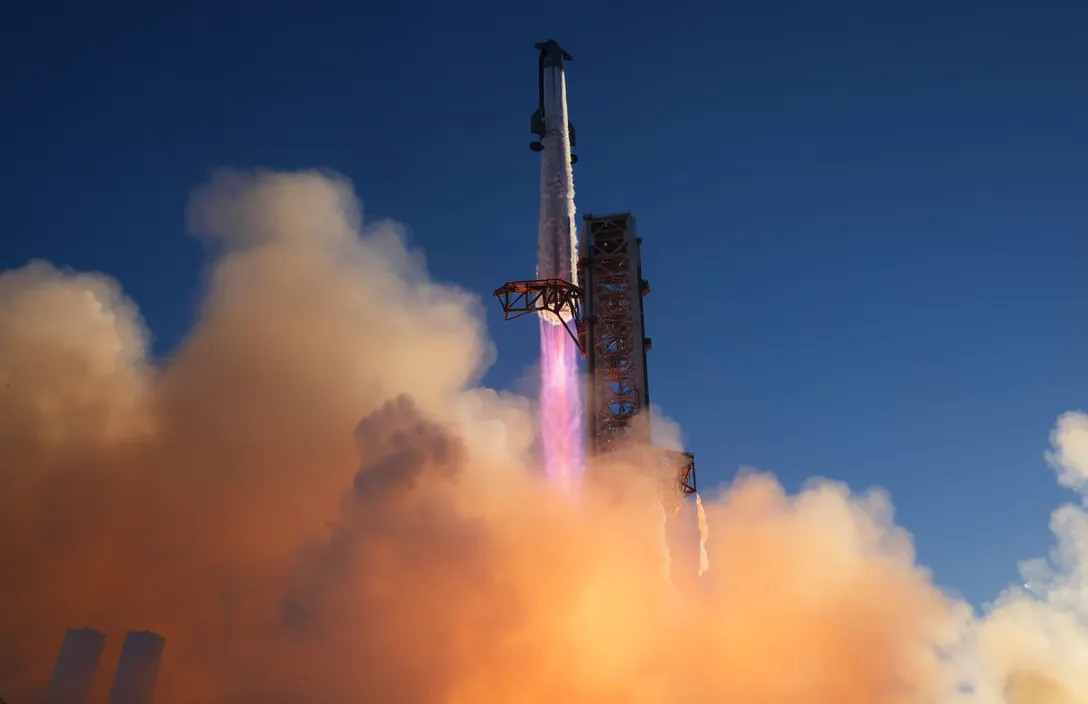

SpaceX's Starship made a triumphant return to Earth on Saturday, caught in midair by giant mechanical arms where its journey began 22 hours earlier (Source ID: 1). This achievement marked the first-ever capture of a Starship flying back from space, demonstrating the full reusability of the spacecraft, which is intended for moon and Mars travel. Although the first-stage booster exploded shortly after Friday's liftoff from Texas, the company had already made three previous booster catches, validating the technique. NASA welcomed the news, as the space agency is paying billions of dollars for Starship to land Artemis astronauts on the moon later this decade and help build a permanent lunar base. [1]
The spacecraft completed 14 laps around Earth, outshining the previous mission's one to two laps (Source ID: 1). It was SpaceX's 15th flight of a full-scale Starship since 2023 and its only second trip to orbit. SpaceX reported that everything on the spacecraft, including its vital heat shield, appeared to work well. The dramatic, sci-fi-like capture helped blot out the booster's messy miss, with SpaceX commentator Dan Huot exclaiming, "Can you believe it?" The company expects to begin launching Starships from Florida's Kennedy Space Center within the next few months, which is the starting point for NASA's next Artemis mission. [1]
The booster's guidance system sensed it wasn't in the right position and automatically initiated the watery detour and self-destruction (Source ID: 1). Engineers are still investigating the cause of the failure. SpaceX's Kate Tice said its engines stopped firing too soon on the way back down. The world's largest and most powerful rocket — a 407-foot (124-meter) behemoth — blasted off late Friday afternoon from SpaceX's Starbase near the U.S.-Mexican border. Separating neatly from its booster before things went awry, the upper-stage spacecraft soared into orbit and released 26 advanced Starlink satellites. [1]
The test flight took place at SpaceX's Starbase near the U.S.-Mexican border in Texas, where the Starship lifted off on Friday, November 12, 2026. The spacecraft successfully completed its journey, reaching an altitude of 165 miles (265 kilometers) above Earth and completing 14 orbits, a significant increase from the previous mission's one to two orbits. The flight marked the 15th full-scale Starship test since 2023 and only the second trip to orbit. The mission launched 26 advanced Starlink satellites, showcasing the spacecraft’s dual capability for both scientific and commercial purposes. The spacecraft was captured midair by mechanical arms at the same location where the flight originated, a milestone in demonstrating Starship’s full reusability for future lunar and Martian missions. [1]
Advertisement
The first-stage booster, however, failed during its return to Earth, exploding shortly after liftoff. The wreckage from the booster was found in the Gulf of Mexico, marked by buoys to prevent interference. SpaceX’s guidance system detected an improper position during descent, leading to an automatic abort and the booster’s self-destruction. This incident, though a setback, did not detract from the success of the spacecraft’s recovery, which was hailed as a historic achievement. SpaceX has previously achieved three successful booster recoveries, confirming the viability of the technique. The company aims to begin launching Starships from Florida's Kennedy Space Center in the near future, serving as the launch point for NASA’s Artemis missions. [1]
NASA is investing heavily in Starship, with the goal of using it to land Artemis astronauts on the moon later this decade and to construct a permanent lunar base. The Artemis III mission, planned for the future, will involve four astronauts attempting to dock with both Starship and Blue Origin’s Blue Moon spacecraft, with both companies alternating in delivering crews to the lunar surface. NASA's Artemis IV mission is targeted for as early as 2028, marking the first moon landing since the Apollo era over 50 years prior. SpaceX’s success in recovering the Starship highlights its role in these ambitious lunar and interplanetary goals, despite the setback with the first-stage booster. [1]
SpaceX's Starship made a triumphant return to Earth on Saturday, caught in midair by giant mechanical arms where its journey began 22 hours earlier (Source ID: 1). This marked the first-ever capture of a Starship flying back from space, highlighting a major step toward full reusability of the spacecraft, which is intended for future missions to the moon and Mars (Source ID: 1). [1]
The spacecraft completed 14 laps around Earth, outshining the previous mission's one to two laps (Source ID: 1). It was SpaceX's 15th flight of a full-scale Starship since 2023 and its only second trip to orbit (Source ID: 1). During the flight, the spacecraft released 26 advanced Starlink satellites and streamed live views of itself and Earth via Starlink (Source ID: 1). [1]
Advertisement
Despite the success of the Starship's return, the first-stage booster exploded shortly after Friday's liftoff from Texas (Source ID: 1). The booster's guidance system sensed it wasn't in the right position and automatically initiated the watery detour and self-destruction (Source ID: 1). Engineers are still investigating the cause of the booster's failure, though SpaceX had already made three previous booster catches, validating the recovery technique (Source ID: 1). [1]
Sources
Prepared with AI assistance from the cited sources.
The Cali Reporter newsletter
The stories worth your time.
California, the country, and what comes next. Join our free newsletter for reporting that keeps you informed.
More in San Diego
- New Mexico's Universal Childcare Program Faces Capacity Challenges
New Mexico's universal childcare initiative, the first of its kind in the U.S., has been transformative for many families but is grappling with significant capacity constraints that leave thousands on waitlists.
- GOP Officials Push to Revive Trump's Mail Voting Restrictions for 2028 Election
Republican state attorneys general are appealing a court order that blocked the U.S. Postal Service from implementing Trump-era mail voting restrictions for the 2028 election.
- Alaska Voters Reject Repeal of Ranked Choice Voting System
Alaskans have once again rejected efforts to repeal their nonpartisan primary and ranked choice voting system, according to an Associated Press race call.