Smart Footwear Turns Ordinary Steps into Checks of Blood Flow to Feet
A new smart footwear system called CapWear uses walking to monitor peripheral perfusion, offering a non-invasive way to assess blood flow in real time.

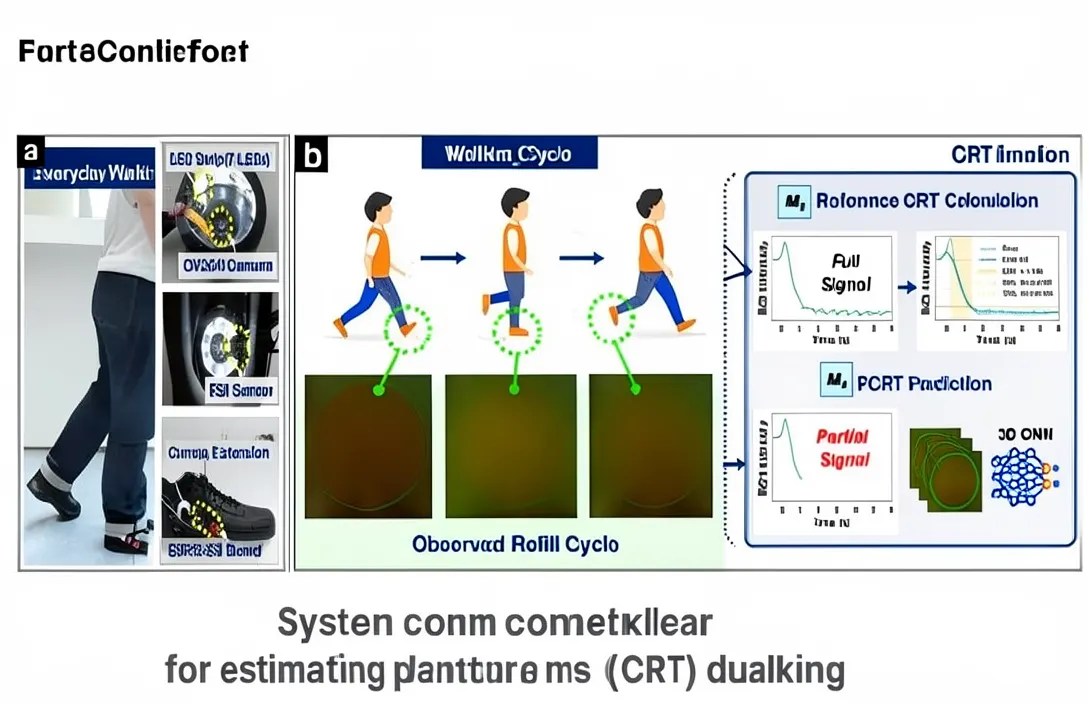

A research team from POSTECH has developed CapWear, a smart footwear system that assesses peripheral perfusion during everyday walking (1). The system uses a compact optical module beneath the heel, which contains a light source, a miniature camera, and a pressure sensor (1). This module illuminates the skin at a consistent brightness, allowing it to capture subtle changes in skin color (1). [1]
The pressure sensor detects when the foot touches the ground and lifts off. As the wearer steps down, pressure causes the skin on the heel to briefly turn pale, and when the foot lifts, blood returns, and the skin regains its color (1). CapWear analyzes this change to estimate capillary refill time (CRT), which is an indicator of how well blood reaches the body's extremities (1). [1]
To address the challenge of capturing the full recovery process, the researchers conducted separate measurement sessions and used these values to train personalized models (1). These models can estimate CRT from short video clips available during walking (1). The system was evaluated using clinician-measured CRT values as a reference, and the results showed a strong correlation with a correlation coefficient of 0.71 (1). [1]
CapWear, a smart footwear system developed by a research team at POSTECH, uses a compact optical module beneath the heel to monitor peripheral perfusion during walking. The module includes a light source, a miniature camera, and a pressure sensor, which work together to capture subtle changes in skin color as the foot touches the ground and lifts off (1). This process mimics the capillary refill time (CRT) assessment typically performed in hospitals, where clinicians press on the skin and observe how quickly it regains its color after pressure is released (1). [1]
Advertisement
One of the challenges in developing CapWear was capturing the full recovery process of skin color during walking, as the foot quickly returns to the ground, leaving only about one second to observe the recovery (1). To address this, the researchers conducted separate measurement sessions to obtain full CRT values, which were then used to train personalized models that can estimate CRT from short video clips captured during walking (1). [1]
The accuracy of CapWear was validated by comparing its CRT estimates with measurements made manually by an emergency medicine physician who reviewed videos of the heel (1). The two sets of measurements showed a strong correlation, with a correlation coefficient of 0.71, indicating that CapWear can reliably estimate CRT during everyday walking without requiring a separate measurement procedure (1). [1]
CapWear utilizes a compact optical module beneath the heel to monitor peripheral perfusion by estimating CRT. The system captures brief color changes in the skin caused by the pressure of each step, mimicking the process of a manual CRT assessment (1). This technology enables the automatic and repeated measurement of CRT during walking, eliminating the need for a separate measurement procedure (1). [1]
One of the primary challenges in developing CapWear was capturing the full recovery process of skin color during walking. The foot quickly returns to the ground, leaving only about one second to observe the recovery, which is often too short to fully observe the skin color returning to normal (1). To address this challenge, the researchers conducted separate measurement sessions, allowing enough time to observe the full recovery process (1). [1]
Advertisement
The accuracy of CapWear was validated by comparing its CRT estimates with manual measurements made by an emergency medicine physician who reviewed videos of the heel. The two sets of measurements showed a strong correlation, with a correlation coefficient of 0.71, indicating that CapWear's estimates align closely with clinician measurements (1). [1]
CapWear, developed by a research team at POSTECH, is a smart footwear system that assesses peripheral perfusion during everyday walking by estimating plantar capillary refill time (CRT) (1). The system uses a compact optical module beneath the heel, which contains a light source, a miniature camera, and a pressure sensor. The pressure sensor detects when the foot touches the ground and lifts off, enabling the system to capture the brief changes in skin color that occur during each step (1). [1]
One of the challenges in developing CapWear was capturing the full recovery process of skin color during walking, as the foot quickly returns to the ground, leaving only about one second to observe the recovery (1). To address this, the researchers conducted separate measurement sessions that allowed enough time to observe the full recovery process. These sessions were used to train personalized models that can estimate CRT from the short video clips available during walking (1). [1]
The accuracy of CapWear was validated by comparing its CRT estimates with measurements made manually by an emergency medicine physician who reviewed videos of the heel. The two sets of measurements showed a strong correlation, with a correlation coefficient of 0.71 (1). This indicates that CapWear can reliably estimate CRT, similar to how a pedometer counts steps during walking (1). [1]
Advertisement
The Cali Reporter newsletter
The stories worth your time.
California, the country, and what comes next. Join our free newsletter for reporting that keeps you informed.
More in Health & Medicine
- Understanding Fascia and the Evidence Behind Fascia Release
Fascia is a connective tissue that plays a structural role in the human body, but evidence supporting specific exercises or tools for 'fascia release' remains limited.
- Antidepressant Effectiveness and Long-Term Use
A new review suggests that some antidepressants may be more effective than others in helping people manage depression symptoms over the long term, according to a study published in The Lancet Psychiatry.
- Experimental Weight-Loss Drug Shows Promise for Knee Osteoarthritis Pain
A new study suggests that an experimental weight-loss drug, retatrutide, may significantly reduce knee pain in people with osteoarthritis and obesity.