

Shocking cost to fuel world’s largest flying firefighting fleet as California wildfire season looms
California's wildfire budget balloons past $4 billion while jet fuel prices jump over 100% in three months, yet Cal Fire refuses to cut its record aerial fleet or rethink the all-in strategy.
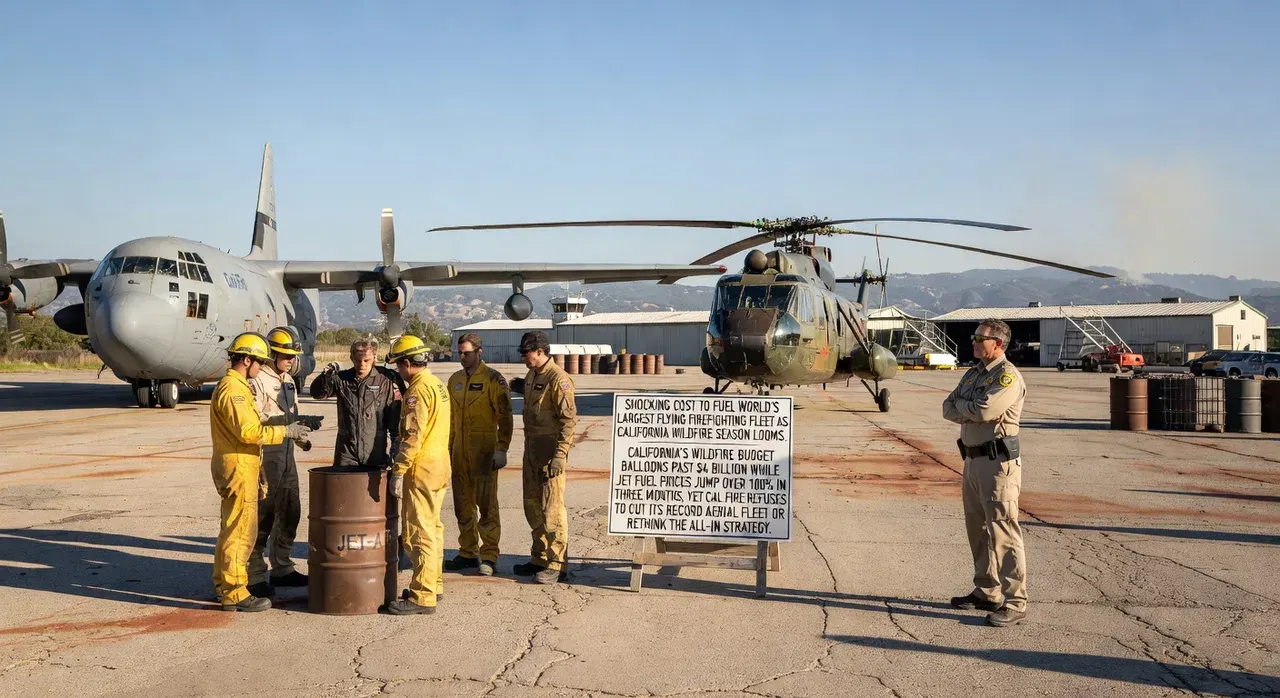
California is doubling down on the most expensive aerial firefighting armada on earth even as jet fuel prices have exploded between 82 and 110 percent in the past three months. Cal Fire has declared it will not scale back operations heading into wildfire season, a stance that locks in massive costs at a time when state budgets are already stretched by nearly $4 billion in wildfire and forest resilience spending since 2021.
Gavin Newsom’s proposed 2026, 27 budget pours another $457 million into the effort, including $315 million from a climate bond and $142 million from the Greenhouse Gas Reduction Fund. The state also commits $770.4 million annually to support a 66-hour workweek for firefighters and a plan to hire more than 2,000 additional personnel by 2028, 29. On top of that, roughly $380 million has already gone into an aerial fleet now boasting 16 advanced helicopters, officially the largest flying firefighting force anywhere.
Recent fires in the Palisades and Altadena prompted officials to redraw high-severity fire maps across Los Angeles County, pulling in 15,000 to 20,000 more properties. Homeowners north of Ventura Boulevard now face new rules: grass and brush kept under three inches, trees trimmed away from structures, branches at least 10 feet from chimneys. Inspections in these expanded zones began May 1. The maps are expanding faster than prevention can keep up.

Yet the state’s answer remains more technology and more aircraft. Another $3.5 million a year goes to fire detection cameras and satellite mapping, plus $37.1 million for AI-powered intelligence systems. When fuel costs became impossible to ignore, Cal Fire turned not to fewer flights but to flight simulators. Battalion Chief of Training Philip Mateer told KCRA the simulators “pay for themselves” by improving safety and avoiding environmental hazards, adding that “flying aircraft is safe, but it’s very unforgiving if there is a mishap.”
The approach reveals a deeper contradiction: California keeps expanding its high-risk footprint and its airborne response while fuel prices surge and more residents are ordered to harden homes that sit deeper in the fire zone. Prevention grants and prescribed burns receive funding, but the overwhelming emphasis stays on dramatic aerial intervention once flames appear.
Whether simulators and ever-larger budgets can outrun both nature and economics is the test coming this fire season. So far the state shows no interest in finding out what a smaller, leaner strategy might achieve.
Original reporting: New York Post.
More in California
- UC Berkeley Lab Proposes New Civic Framework for California’s Next Governor
A research-driven agenda calls for institutionalizing 'co-governance' to address low public trust and lack of resident influence in state decision-making.
- Five Tax Measures on California’s Ballot Aim to Reshape State Finances
Propositions 3, 40–43 would alter income, wealth and local taxation rules—marking the highest number of tax measures on a general election ballot since 1994.
- Catalina Helicopter Crash Highlights Risks of Island Medevac Flights
A medical evacuation chopper carrying Catalina Romero, pilot, and nurse Jessica Devries crashed into the ocean shortly after takeoff, killing all three; federal investigators are assessing causes including night flying, spatial disorientation, and the island’s challenging Pebbly Beach heliport.