Security Controls for Storybook After CVE-2026-114125
Following the resolution of CVE-2026-114125, organizations managing multiple repositories must implement durable security controls to prevent regressions in Storybook configurations. This includes defining secure…

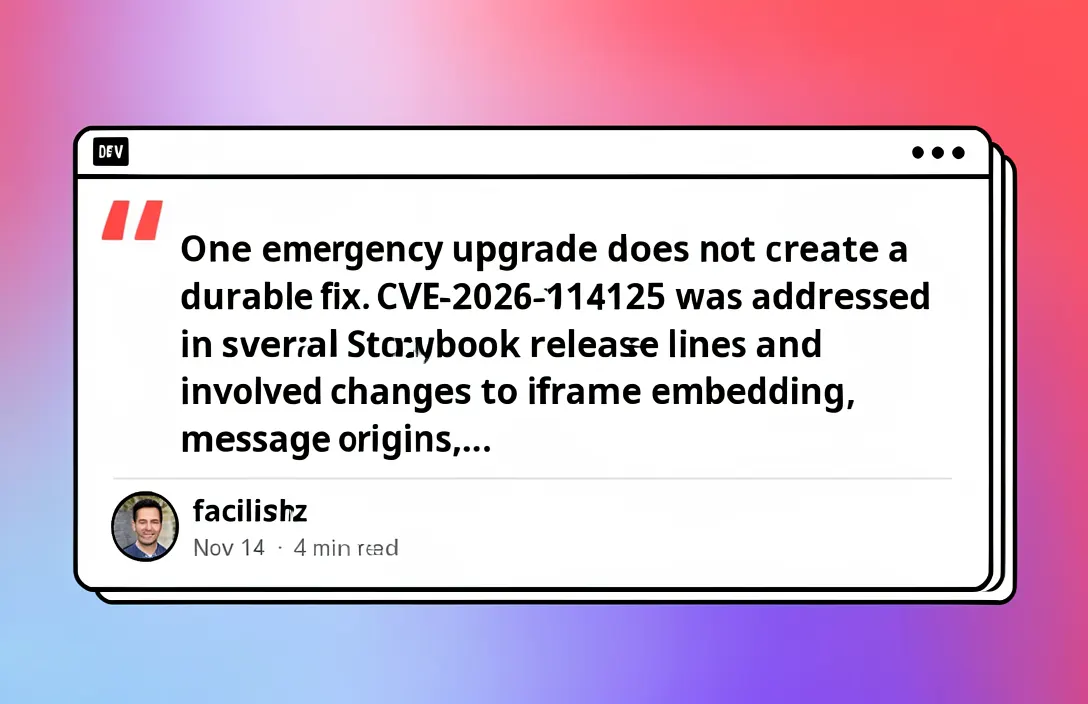

CVE-2026-114125 was addressed in several Storybook release lines, including versions 8.6.19, 9.1.21, 10.6.2, and 11.0.0-alpha.6. These updates involved changes to iframe embedding, message origins, file-writing requests, an event API, and the default network listener. Organizations that manage many repositories need controls that preserve these safer defaults after the initial patch (Dev.to, 2026). [1]
The development server in Storybook is a browser-accessible local application with access to project files. This description should be reflected in the software catalog, secure configuration baseline, and endpoint inventory. The advisory rates CVE-2026-114125 9.4 Critical under CVSS v4, with CVSS:4.0/AV:N/AC:L/AT:N/PR:N/UI:P/VC:H/VI:H/VA:H/SC:H/SI:H/SA:H. The worst case requires user interaction and multiple weaknesses, but successful execution can inherit the developer's privileges (Dev.to, 2026). [1]
A dependency policy should inspect lockfiles and generated SBOMs, not just direct declarations. Internal starter repositories should receive the same update, because they propagate versions and configuration to many teams. An alert should identify the repository, resolved package, owner, and whether the package is used only for static builds or also for an interactive dev server (Dev.to, 2026). [1]
Recent Chrome and Firefox versions may ask before a site connects to a localhost service, and the advisory recommends not granting access to untrusted sites. Enterprise browser policy can reduce accidental permission grants, but it does not substitute for the patched server-side origin checks. Test behavior, not only version numbers, by adding a development-environment smoke test that confirms an unrelated origin cannot embed the Storybook UI or send a message to it (Dev.to, 2026). [1]
Advertisement
CVE-2026-114125 was addressed in several Storybook release lines, including versions 8.6.19, 9.1.21, 10.6.2, and 11.0.0-alpha.6. The development server in Storybook is a browser-accessible local application with access to project files. This description should be reflected in the software catalog, secure configuration baseline, and endpoint inventory, as noted in the Dev.to article (source ID 1). [1]
A dependency policy should inspect lockfiles and generated SBOMs, not just direct declarations. This is necessary because the fixed versions include multiple packages such as @storybook/core, @storybook/core-server, and others, which have varying ranges. The Dev.to article (source ID 1) emphasizes that internal starter repositories should receive the same updates to propagate secure configurations across teams. [1]
Recent Chrome and Firefox versions may ask before a site connects to a localhost service, and the advisory recommends not granting access to untrusted sites. This aligns with the Dev.to article (source ID 1), which highlights the importance of browser permissions and enterprise policies to reduce accidental permission grants, though they do not replace server-side origin checks. [1]
The advisory rates CVE-2026-114125 9.4 Critical under CVSS v4, with CVSS:4.0/AV:N/AC:L/AT:N/PR:N/UI:P/VC:H/VI:H/VA:H/SC:H/SI:H/SA:H. This rating underscores the need for ongoing monitoring and testing of development environments to ensure that secure defaults are not inadvertently overridden. The Dev.to article (source ID 1) emphasizes the importance of runtime defaults and policy enforcement to reduce exposure risks. [1]
Advertisement
CVE-2026-114125 was addressed in multiple Storybook release lines, including versions 8.6.19, 9.1.21, 10.6.2, and 11.0.0-alpha.6. The development server in Storybook is a browser-accessible local application with access to project files, which necessitates stricter security boundaries. This description should be reflected in the software catalog, secure configuration baseline, and endpoint inventory (Source ID: 1). [1]
A dependency policy should inspect lockfiles and generated SBOMs, not just direct declarations. This ensures that all potentially affected packages, such as @storybook/core, @storybook/core-server, and others, are included in dependency reviews. Internal starter repositories should also receive the same updates to propagate secure versions and configurations across teams (Source ID: 1). [1]
Recent Chrome and Firefox versions may prompt users before allowing a site to connect to a localhost service. The advisory recommends not granting access to untrusted sites. Enterprise browser policy can reduce accidental permission grants, but it does not replace the necessity of patched server-side origin checks (Source ID: 1). [1]
A completion dashboard should track fixed package coverage, active affected servers, unsafe host flags, exception count, and unverified developer environments. These metrics should be presented individually to avoid misleading aggregation. The dashboard should also ensure that future dependency refreshes or template updates do not reintroduce vulnerabilities (Source ID: 1). [1]
Advertisement
CVE-2026-114125 was addressed in several Storybook release lines, including versions 8.6.19, 9.1.21, 10.6.2, and 11.0.0-alpha.6 (1). The development server in Storybook is a browser-accessible local application with access to project files (1). To ensure security, the dev server should be treated as a security boundary and reflected in the software catalog, secure configuration baseline, and endpoint inventory (1). [1]
A dependency policy should inspect lockfiles and generated SBOMs, not just direct declarations (1). This includes reviewing packages such as @storybook/core, @storybook/core-server, and others with differing version ranges (1). Internal starter repositories should receive the same updates to prevent propagation of vulnerable versions across teams (1). [1]
Recent Chrome and Firefox versions may prompt users before allowing a site to connect to a localhost service (1). The advisory recommends not granting access to untrusted sites (1). Enterprise browser policy can reduce accidental permission grants, but it does not substitute for the patched server-side origin checks (1). [1]
A completion dashboard should track fixed package coverage, active affected servers, unsafe host flags, exception count, and unverified developer environments (1). This helps organizations monitor progress and ensure that security controls remain effective over time (1). [1]
Advertisement
The Cali Reporter newsletter
The stories worth your time.
California, the country, and what comes next. Join our free newsletter for reporting that keeps you informed.
More in Technology
- Modern Web Guidance 1.0 and Browser Compatibility
Modern Web Guidance 1.0, announced by Chrome for Developers on November 10, introduces browser compatibility data to assist coding agents in building web features. The initiative emphasizes the importance of fallback…
- Apache mod_http2 Vulnerability Detection with Nmap
A new Nmap scripting module has been developed to detect the Apache mod_http2 vulnerability (CVE-2026-119618), addressing the challenges of identifying affected systems accurately.
- Securing Remote Vendor Access in Industrial Networks
Best practices for managing remote vendor access in operational technology (OT) networks emphasize controlled access points, multifactor authentication, and time-bound sessions to reduce cybersecurity risks.