

Safer, cleaner MacArthur Park still struggles. Will closing a major Los Angeles boulevard make a difference?
Los Angeles spent millions to revive MacArthur Park from open-air drug markets, yet the same boulevard that bisects it keeps the problems in place.
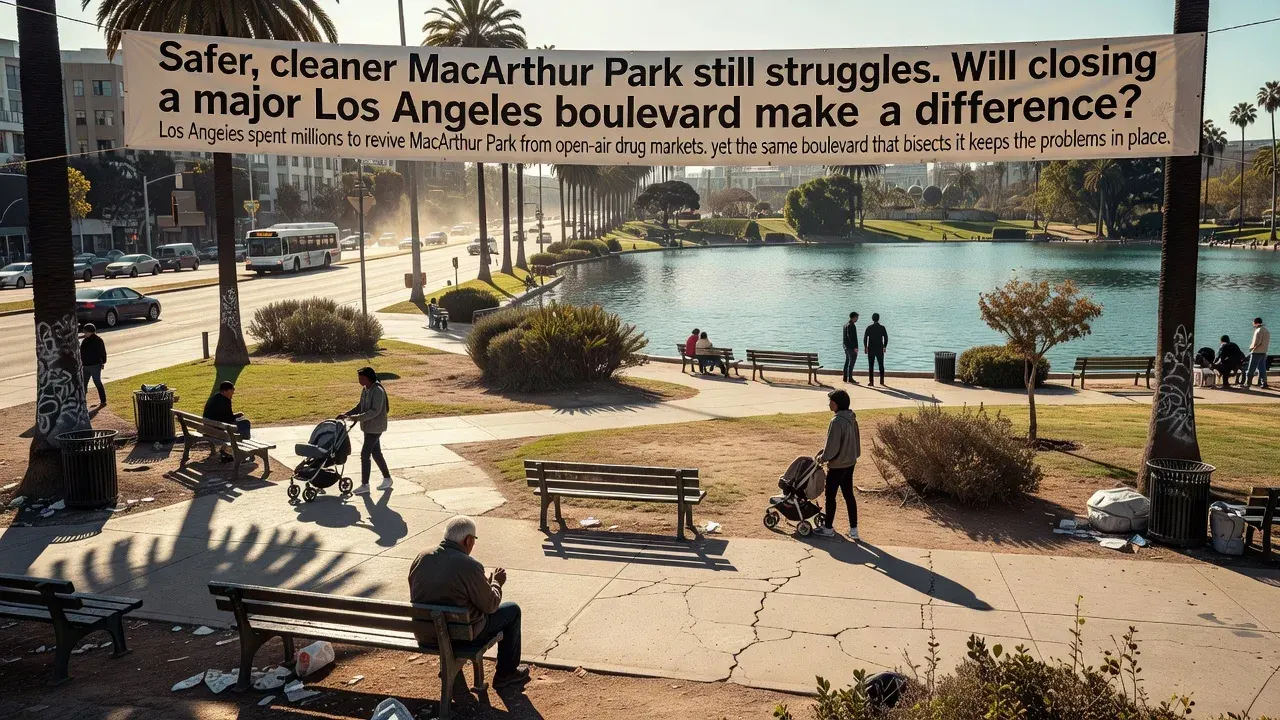
MacArthur Park was supposed to be Los Angeles’ comeback story. After years of being overrun by open drug dealing and violence, city officials poured resources into cleaning it up. The result is a visibly safer, cleaner park. Yet the core problem remains untouched: Wilshire Boulevard still slices the green space in two, splitting the very area the revival was meant to unify.
The revival effort has produced measurable progress. Drug activity has dropped, encampments have been cleared, and families have begun returning to the once-notorious landmark. But that progress feels precarious precisely because the six-lane arterial road continues to act as a physical and symbolic barrier, preventing the park from functioning as a single, coherent public space.
Now city leaders are weighing a radical step: permanently closing a major stretch of Wilshire Boulevard through the park. The proposal is not cosmetic. It would reconnect the divided halves, eliminate a daily conduit for transient crime, and give the entire area room to breathe. Whether it actually happens will test whether Los Angeles is serious about finishing what it started.

Critics of the closure argue it will snarl traffic across an already congested corridor and inconvenience thousands of daily commuters. Supporters counter that the boulevard itself became part of the park’s pathology, channeling drugs, transients, and chaos directly into the heart of a residential neighborhood. The data on the revival so far shows reduced crime, but those gains have not erased the sense that the park remains two separate, uneasy zones divided by asphalt and inertia.
MacArthur Park’s story is larger than one green space. It reflects a recurring pattern in Los Angeles: visible cleanups that stop short of structural changes. Clearing tents and chasing dealers produces photo-ops, yet infrastructure decisions that enabled the disorder are left untouched. Closing Wilshire isn’t a guarantee of lasting safety, but leaving the boulevard open virtually ensures the park can never fully heal.
The coming debate will reveal whether city officials treat the boulevard as sacred transit infrastructure or as the final unfinished piece of a troubled park’s rehabilitation. The numbers on crime are moving in the right direction, but the road that cuts through the middle still tells a different story.
Original reporting: CalMatters.
More in California
- UC Berkeley Lab Proposes New Civic Framework for California’s Next Governor
A research-driven agenda calls for institutionalizing 'co-governance' to address low public trust and lack of resident influence in state decision-making.
- Five Tax Measures on California’s Ballot Aim to Reshape State Finances
Propositions 3, 40–43 would alter income, wealth and local taxation rules—marking the highest number of tax measures on a general election ballot since 1994.
- Catalina Helicopter Crash Highlights Risks of Island Medevac Flights
A medical evacuation chopper carrying Catalina Romero, pilot, and nurse Jessica Devries crashed into the ocean shortly after takeoff, killing all three; federal investigators are assessing causes including night flying, spatial disorientation, and the island’s challenging Pebbly Beach heliport.