Refit and Obfuscation: Safe Practices for HTTP Clients
Refit is a friendly library for obfuscation, as long as certain practices are followed, particularly regarding parameter names and aliasing.

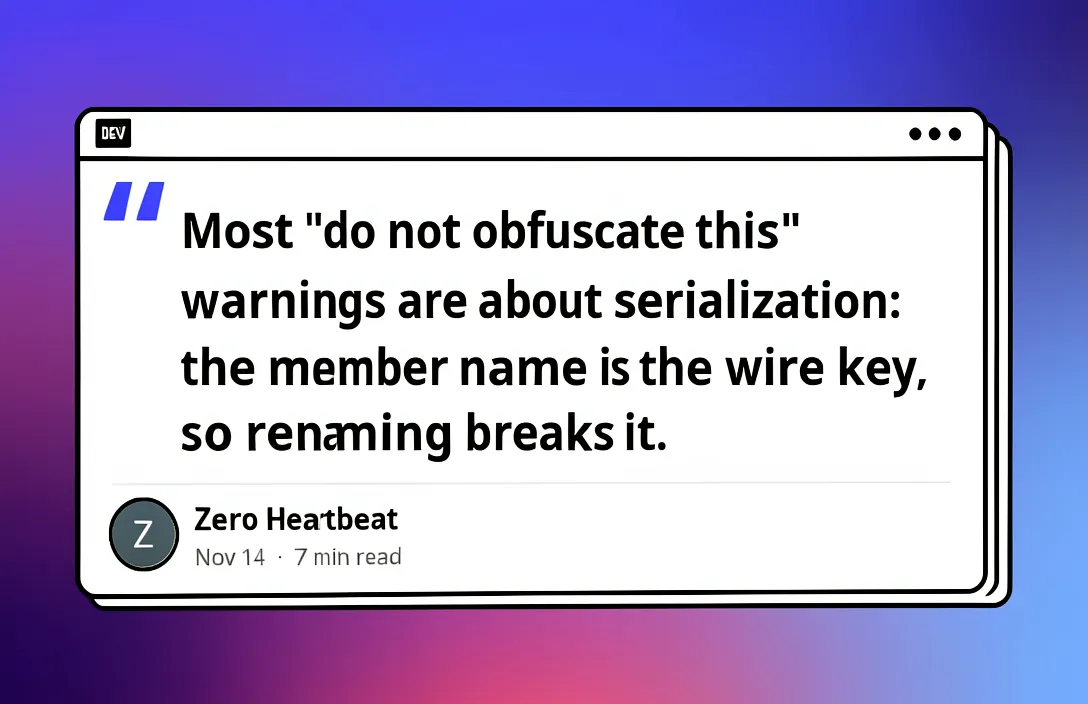

Refit is a library that generates HTTP clients from C# interfaces decorated with HTTP attributes. The HTTP contract is defined in attributes and string literals, not in CLR identifiers such as interface or method names. This means that the interface type name, method names, and the generated implementation can be renamed and string-encrypted without affecting the HTTP requests produced. The separation of the HTTP contract from CLR identifiers makes obfuscation safe for these elements (Dev.to, 1). [1]
The most important consideration for obfuscation safety is the handling of parameter names. Parameters involved in URL path placeholders or query keys bind to the HTTP request based on their CLR names. If these names are renamed without explicitly defining the wire name using [AliasAs], the HTTP requests may become incorrect. For example, renaming a parameter named 'page' to 'a' in the method [Get("/users")] Task<Page<User>> ListUsers(int page, int pageSize); would change the query key from 'page' to 'a', potentially breaking the server's ability to interpret the request (Dev.to, 1). [1]
To ensure obfuscation safety, [AliasAs] should be used on every bound parameter to explicitly define the wire name. This decouples the wire name from the CLR parameter name, allowing the parameter names to be renamed freely. The HTTP request remains unaffected as long as the [AliasAs] string literals are preserved. This is the most important habit for an obfuscation-friendly Refit client, as it ensures the HTTP contract remains consistent even after renaming (Dev.to, 1). [1]
Refit generates HTTP clients from C# interfaces decorated with HTTP attributes. The HTTP contract is defined in attributes and string literals rather than in the type and method names, making it more obfuscation-friendly than many other libraries. The interface type name, method names, and generated implementation can be freely renamed and string-encrypted without affecting the HTTP requests (Dev.to, 2023). [1]
Advertisement
The method names, such as GetUser, ListUsers, and CreateUser, are labels that do not influence the HTTP request. The HTTP verb and path are derived from attributes and string literals, so renaming these method names does not alter the request. The generated implementation is internal plumbing and can be renamed or encrypted without issue (Dev.to, 2023). [1]
The most critical consideration for obfuscation safety is the handling of parameter names. Parameters used in path placeholders or query strings bind to the URL by their CLR names. If these names are renamed without explicit aliasing, the HTTP requests can become corrupted, leading to unexpected behavior on the server (Dev.to, 2023). [1]
To ensure obfuscation safety, the [AliasAs] attribute should be used on every bound parameter to explicitly define the wire name. This decouples the wire name from the CLR name, allowing parameter names to be freely renamed without affecting the HTTP requests. This practice is essential for maintaining the integrity of the HTTP contract during obfuscation (Dev.to, 2023). [1]
Refit generates HTTP clients by interpreting C# interfaces decorated with HTTP attributes. According to the Dev.to article, the method names, such as GetUser or ListUsers, are not involved in the construction of HTTP requests. Instead, the HTTP verb, path, and headers are derived from attributes like [Get], [Post], and [Headers]. This separation ensures that obfuscation is generally safe, as the interface and method names can be freely renamed without affecting the HTTP contract (source ID: 1). [1]
Advertisement
However, the use of parameter names in path placeholders and query parameters introduces a potential risk during obfuscation. If a parameter name is not explicitly aliased using [AliasAs], an obfuscator that renames parameters may silently break the HTTP request. For example, a parameter named page in a method like ListUsers(int page, int pageSize) may be renamed to a by an obfuscator, resulting in a query key that the server does not recognize (source ID: 1). [1]
To mitigate this risk, the Dev.to article emphasizes that [AliasAs] should be used on every bound parameter. This attribute explicitly defines the wire name, decoupling it from the parameter's CLR name. Once all bound parameters are aliased, the parameter names can be freely renamed without affecting the HTTP request. This practice ensures that obfuscation does not compromise the integrity of the HTTP contract (source ID: 1). [1]
Refit generates HTTP clients from C# interfaces decorated with HTTP attributes. The method names, such as GetUser, ListUsers, and CreateUser, are labels that do not influence the HTTP request. The most critical consideration for obfuscation safety is the handling of parameter names. To ensure obfuscation safety, the [AliasAs] attribute should be used on every bound parameter to explicitly define the wire name (Dev.to). [1]
The contract for Refit clients is defined in the attributes and string literals, not in the type and method names. This means that the interface type name, method names, and generated implementation can be renamed and string-encrypted without affecting the HTTP requests. However, the use of parameter names in path placeholders and query parameters introduces a potential risk during obfuscation (Dev.to). [1]
Advertisement
When a method parameter is not explicitly aliased, its CLR name is used for binding to path placeholders and query parameters. If an obfuscator renames these parameters, the resulting HTTP requests may fail silently because the server expects the original parameter names. To mitigate this risk, the [AliasAs] attribute must be used on every bound parameter to explicitly define the wire name (Dev.to). [1]
Sources
Prepared with AI assistance from the cited sources.
The Cali Reporter newsletter
The stories worth your time.
California, the country, and what comes next. Join our free newsletter for reporting that keeps you informed.
More in Technology
- Modern Web Guidance 1.0 and Browser Compatibility
Modern Web Guidance 1.0, announced by Chrome for Developers on November 10, introduces browser compatibility data to assist coding agents in building web features. The initiative emphasizes the importance of fallback…
- Apache mod_http2 Vulnerability Detection with Nmap
A new Nmap scripting module has been developed to detect the Apache mod_http2 vulnerability (CVE-2026-119618), addressing the challenges of identifying affected systems accurately.
- Securing Remote Vendor Access in Industrial Networks
Best practices for managing remote vendor access in operational technology (OT) networks emphasize controlled access points, multifactor authentication, and time-bound sessions to reduce cybersecurity risks.