RAMP3 Linked to Immune Suppression in Breast Cancer
A study in mice suggests that RAMP3 may contribute to immune suppression in breast tumors, potentially influencing response to immunotherapy.

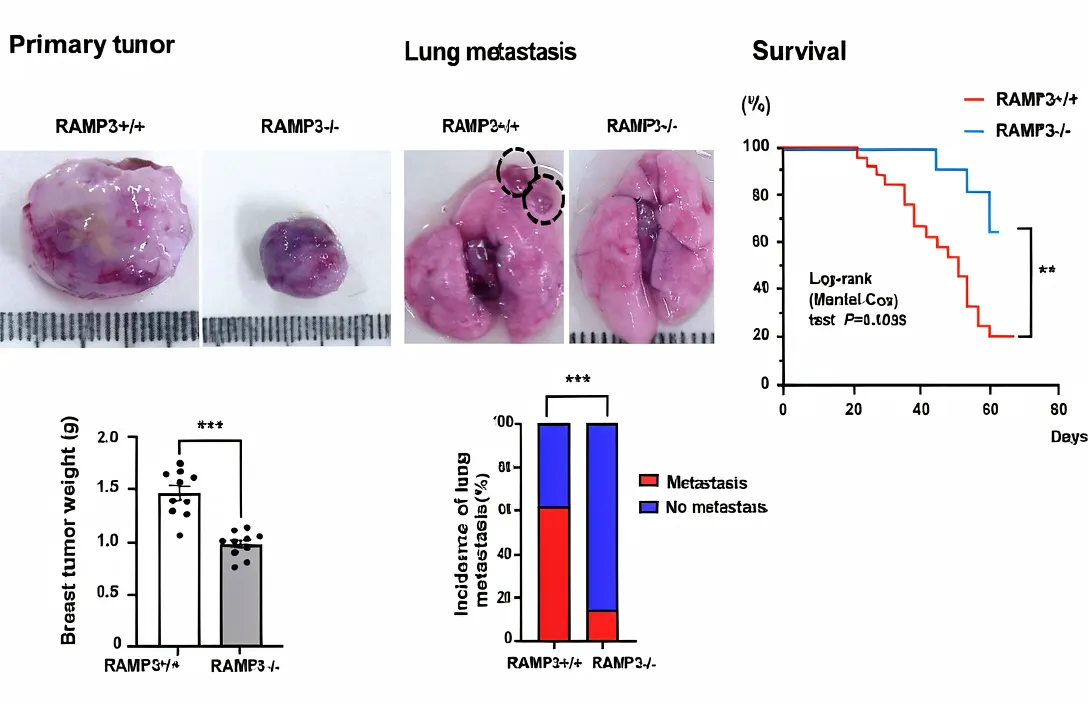

Researchers found that mice lacking RAMP3 had lower primary breast tumor weights, a lower percentage of mice with lung metastases, and longer survival compared to wild-type mice (source ID: 1). The study, published in the Journal of Translational Medicine, compared tumor growth, lung spread, survival, immune cells, and response to anti-PD-1 treatment in mouse models with and without RAMP3. Tumors in mice lacking RAMP3 contained fewer immune-suppressing macrophages and more CD8⁺ T cells, which can attack cancer cells. [1]
Further analyses indicated that without RAMP3, macrophages were less likely to adopt an immune-suppressing state. The researchers found reduced activity in the IL-4/STAT6 signaling pathway and lower levels of CCL8, a molecule associated with immune suppression (source ID: 1). In laboratory experiments, inhibiting MCP-family chemokine production reduced the tumor-promoting effect of macrophages on breast cancer cells, supporting a role for RAMP3-associated chemokine signaling in tumor progression. [1]
The team also tested anti-PD-1 treatment, which helps immune cells attack cancer. In a small exploratory experiment with five mice per group, mice lacking RAMP3 showed a greater survival benefit from treatment. However, this result is preliminary and needs confirmation (source ID: 1). The researchers also analyzed data from The Cancer Genome Atlas breast cancer cohort, finding that a risk score combining RAMP3, CD163, and CD8A was associated with poorer overall survival, though this does not prove that targeting RAMP3 would help patients or predict immunotherapy benefit. [1]
A study published in the Journal of Translational Medicine found that mice lacking RAMP3 developed smaller primary tumors, had less spread to the lungs, and lived longer than mice with the gene (source ID: 1). These findings suggest that removing RAMP3 changed the tumor environment in ways that supported immune activity. The research team compared tumor growth, lung spread, survival, immune cells, and response to anti-PD-1 treatment when RAMP3 was present or genetically removed. [1]
Advertisement
Further analyses indicated that without RAMP3, macrophages were less likely to adopt an immune-suppressing state. The researchers found reduced activity in the IL-4/STAT6 signaling pathway, which is involved in this process, and lower levels of CCL8, a molecule associated with immune suppression (source ID: 1). In laboratory experiments, inhibiting MCP-family chemokine production reduced the tumor-promoting effect of macrophages on breast cancer cells, supporting a role for RAMP3-associated chemokine signaling in tumor progression. [1]
The team also tested anti-PD-1 treatment, which helps immune cells attack cancer. In a small exploratory experiment with five mice per group, mice lacking RAMP3 showed a greater survival benefit from treatment (source ID: 1). However, this result is preliminary and needs confirmation. The researchers also analyzed data from The Cancer Genome Atlas breast cancer cohort, finding that a risk score combining RAMP3, CD163, and CD8A was associated with poorer overall survival. [1]
A study published in the Journal of Translational Medicine found that mice lacking RAMP3 developed smaller primary tumors, had less spread to the lungs, and lived longer than mice with the gene (source ID: 1). Further analyses indicated that without RAMP3, macrophages were less likely to adopt an immune-suppressing state. The team also tested anti-PD-1 treatment, which helps immune cells attack cancer. [1]
The researchers found reduced activity in the IL-4/STAT6 signaling pathway, which is involved in immune suppression, and lower levels of CCL8, a molecule associated with immune suppression (source ID: 1). In laboratory experiments, inhibiting MCP-family chemokine production reduced the tumor-promoting effect of macrophages on breast cancer cells, supporting a role for RAMP3-associated chemokine signaling in tumor progression. [1]
Advertisement
In a small exploratory experiment with five mice per group, mice lacking RAMP3 showed a greater survival benefit from anti-PD-1 treatment (source ID: 1). However, this result is preliminary and needs confirmation. The researchers also analyzed data from The Cancer Genome Atlas breast cancer cohort, finding that a risk score combining RAMP3, CD163, and CD8A was associated with poorer overall survival. [1]
The study highlights that RAMP3 may play a role in immune suppression within breast tumors. Researchers found that mice lacking RAMP3 had smaller primary tumors and lived longer than wild-type mice (source ID: 1). These findings suggest that RAMP3 may influence the tumor environment in ways that impact immune activity. The research team also analyzed single-cell and spatial data, as well as public breast cancer patient data, to support their findings (source ID: 1). [1]
Further analyses indicated that the absence of RAMP3 led to reduced activity in the IL-4/STAT6 signaling pathway, which is involved in immune suppression. Additionally, lower levels of CCL8, a molecule associated with immune suppression, were observed in mice lacking RAMP3 (source ID: 1). In laboratory experiments, inhibiting MCP-family chemokine production reduced the tumor-promoting effect of macrophages on breast cancer cells, supporting a role for RAMP3-associated chemokine signaling in tumor progression (source ID: 1). [1]
The researchers also tested anti-PD-1 treatment, which helps immune cells attack cancer. In a small exploratory experiment with five mice per group, mice lacking RAMP3 showed a greater survival benefit from treatment (source ID: 1). However, this result is preliminary and needs confirmation. The study also analyzed data from The Cancer Genome Atlas breast cancer cohort, finding a risk score combining RAMP3, CD163, and CD8A associated with poorer overall survival (source ID: 1). [1]
Advertisement
The Cali Reporter newsletter
The stories worth your time.
California, the country, and what comes next. Join our free newsletter for reporting that keeps you informed.
More in Health & Medicine
- Understanding Fascia and the Evidence Behind Fascia Release
Fascia is a connective tissue that plays a structural role in the human body, but evidence supporting specific exercises or tools for 'fascia release' remains limited.
- Antidepressant Effectiveness and Long-Term Use
A new review suggests that some antidepressants may be more effective than others in helping people manage depression symptoms over the long term, according to a study published in The Lancet Psychiatry.
- Experimental Weight-Loss Drug Shows Promise for Knee Osteoarthritis Pain
A new study suggests that an experimental weight-loss drug, retatrutide, may significantly reduce knee pain in people with osteoarthritis and obesity.