Protein Could Help Isolate Particles in Blood That Carry Clues About Neurons
Scientists have identified a protein that may enable the isolation of extracellular vesicles (EVs) in blood and cerebrospinal fluid (CSF), which could provide insights into neuronal activity and potentially aid in the…

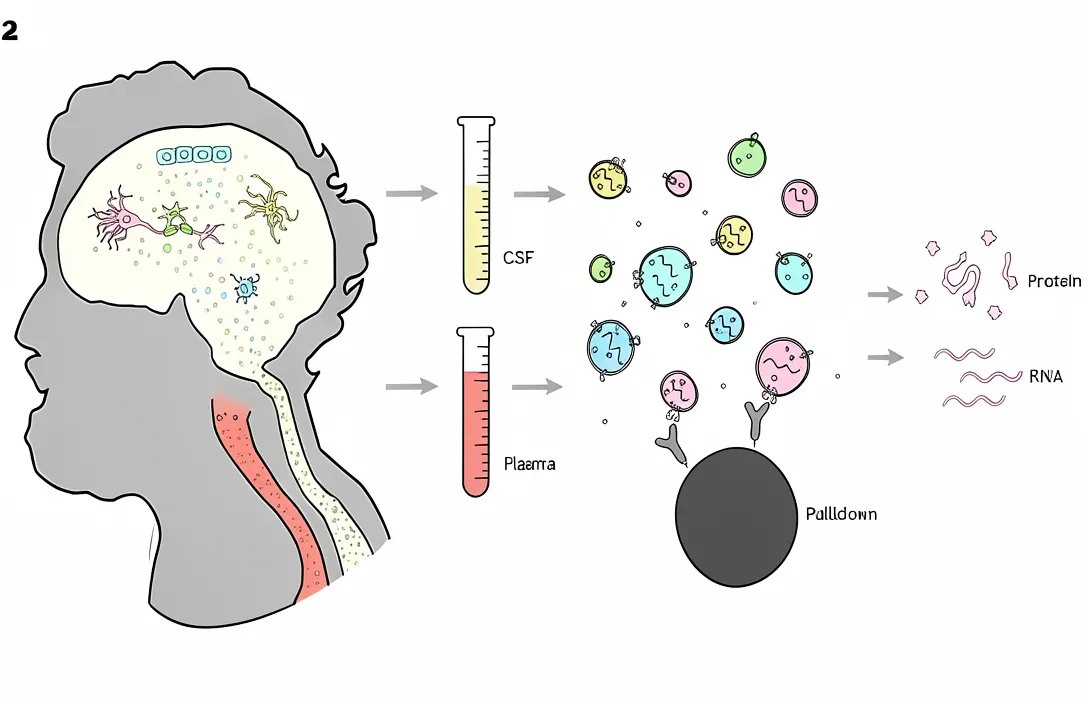

Cells release tiny particles called extracellular vesicles (EVs), which carry proteins and RNA from the cells that produced them. These membrane-enclosed packets are found in bodily fluids such as blood and cerebrospinal fluid (CSF), and they may carry clues about cells that are difficult to sample directly, such as neurons. However, determining which cells released specific vesicles has been challenging. Researchers at the Wyss Institute for Biologically Inspired Engineering, MIT, and other institutions recently found a protein strongly associated with neurons on the surface of some EVs in human blood plasma and CSF (Evidence 1). [1]
The researchers introduced a new framework to identify neuron-associated proteins by searching for those that span the vesicle membrane, are predicted to be produced mainly by neurons, and are present on the surface of some vesicles in CSF, blood plasma, or both. The team analyzed bulk RNA-Seq datasets and used single-cell RNA sequencing tools to compare patterns of gene activity across individual cells. This approach helped them identify candidate proteins that met their initial criteria (Evidence 1). [1]
To enable unbiased analysis, the researchers developed a new high-purity EV isolation method called multi-mode resin (MMR) slurry, which uses porous beads to trap smaller free proteins like albumin while leaving EVs in the sample. They then developed highly sensitive antibody tests, called Simoa assays, to test whether three of the candidate proteins were present on EVs. These methods allowed them to derive a list of potential markers for isolating EVs associated with neurons (Evidence 1). [1]
The researchers demonstrated that a neuron-related protein, NRXN3, was present on some EVs in CSF and blood plasma, and they successfully isolated these vesicles. However, they have not yet confirmed that the captured vesicles came from neurons. Their long-term goal is to determine whether vesicles released by neurons and found in the blood could offer signs of neurodegenerative disease before symptoms appear (Evidence 1). [1]
Advertisement
Cells release extracellular vesicles (EVs), which carry proteins and RNA from the cells that produced them. These membrane-enclosed particles are found in bodily fluids such as blood and cerebrospinal fluid (CSF), and may carry molecular clues about cells that are difficult to access directly, such as neurons. However, determining which cells released specific EVs has been a challenge. A new framework has been introduced to identify neuron-associated proteins by searching for those that span the vesicle membrane, are predicted to be produced mainly by neurons, and are present on the surface of some EVs in CSF, blood plasma, or both (source ID: 1). [1]
To enable unbiased analysis, researchers developed a new high-purity EV isolation method called multi-mode resin (MMR) slurry. This method uses porous beads to trap smaller free proteins, such as albumin, while leaving EVs in the sample. The MMR slurry method is crucial for removing high-abundance proteins that can overwhelm the EV protein signal, allowing for more accurate detection of EV-associated proteins (source ID: 1). [1]
The researchers tested their framework by identifying a protein strongly associated with neurons, called NRXN3, which was present on some EVs in CSF and blood plasma. They then developed highly sensitive antibody tests, called Simoa assays, to confirm the presence of this protein on EVs. Using these methods, the team successfully isolated EVs containing NRXN3, although they have not yet confirmed that these EVs originated from neurons (source ID: 1). [1]
Cells release extracellular vesicles (EVs), which carry proteins and RNA from the cells that produced them. These membrane-enclosed packets are found in blood and other bodily fluids and could carry clues about cells that are difficult to sample and study directly, such as neurons. However, determining which cells released specific vesicles has so far proved difficult (source ID: 1). [1]
Advertisement
To address this challenge, researchers introduced a new framework to identify neuron-associated proteins by searching for those that span the vesicle membrane, are predicted to be produced mainly by neurons, and are present on the surface of some vesicles in cerebrospinal fluid, blood plasma, or both (source ID: 1). [1]
The researchers developed a new high-purity EV isolation method called multi-mode resin (MMR) slurry, which uses porous beads to trap smaller free proteins like albumin while leaving EVs in the sample. This method enables unbiased analysis and helps remove contamination from high-abundance proteins in biofluids (source ID: 1). [1]
Using these methods, the researchers identified a protein strongly associated with neurons, called NRXN3, which was present on some EVs in cerebrospinal fluid and blood plasma. Their findings could inform the development of new diagnostic tests and provide valuable clues about specific cell types from proteins on the surface of EVs (source ID: 1). [1]
Sources
Prepared with AI assistance from the cited sources.
The Cali Reporter newsletter
The stories worth your time.
California, the country, and what comes next. Join our free newsletter for reporting that keeps you informed.
More in Health & Medicine
- Understanding Fascia and the Evidence Behind Fascia Release
Fascia is a connective tissue that plays a structural role in the human body, but evidence supporting specific exercises or tools for 'fascia release' remains limited.
- Antidepressant Effectiveness and Long-Term Use
A new review suggests that some antidepressants may be more effective than others in helping people manage depression symptoms over the long term, according to a study published in The Lancet Psychiatry.
- Experimental Weight-Loss Drug Shows Promise for Knee Osteoarthritis Pain
A new study suggests that an experimental weight-loss drug, retatrutide, may significantly reduce knee pain in people with osteoarthritis and obesity.