

Primary 2026: Read This Before You Fill Out Your California Ballot (or Need to Correct a Mistake)
California’s mail-ballot system traps voters in signature mismatches and spoiled forms, but officials quietly admit the fix is simple: just vote in person.
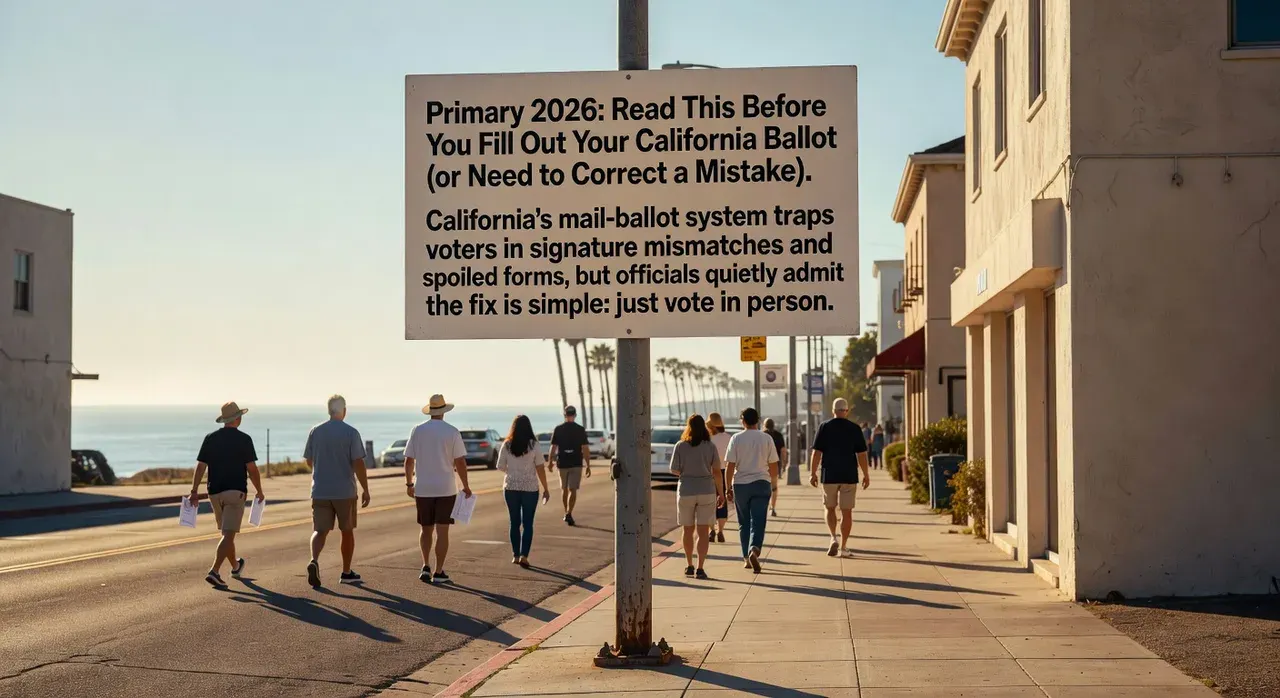
California’s 2026 primary ballot arrives in mailboxes by default, yet thousands risk having their votes discarded over a signature that no longer matches the one they scribbled on a DMV screen years ago. The state insists it is not an “exact match” jurisdiction, but the ritual of curing mismatched envelopes still creates unnecessary anxiety for voters who simply want their ballot counted.
Kim Alexander, president of the nonpartisan California Voter Foundation, cut through the confusion in 2021: if signature worries keep you up at night, “go and vote in person.” Early voting centers open May 23 in some counties and May 30 in others; on Election Day, June 2, there is no envelope at all. The ballot drops straight into the box. That straightforward advice is buried in the fine print while counties mail out replacement ballots and spend staff time remaking damaged ones.
Common errors keep elections offices busy. Voters forget to sign the return envelope entirely. Others sign in a style that diverges from their original registration, especially if they registered young or used a stylus at the DMV. The signature on a current driver’s license or state ID is the one county computers actually pull, yet many Californians never check it. When mismatches are caught, officials mail cure letters, a process that also kicks in when one household member accidentally signs for another, a frequent occurrence in families with multiple voters.

Marking mistakes on the ballot itself triggers another layer of bureaucracy. Counties differ on procedure; Alameda asks voters to contact them immediately for a replacement if the wrong candidate was selected. Elsewhere, officials working in teams of two will remake ballots according to the voter’s crossed-out corrections, provided the signature first clears. The entire system assumes voters will read dense instructions that many ignore until panic sets in after the envelope is sealed.
Even the date field on the envelope is less critical than advertised. Election officials primarily rely on the postmark to prove timeliness. John Gardner, assistant registrar of voters for Solano County, explained in 2020 that only late-arriving ballots trigger close scrutiny of the handwritten date. A simple cross-out and correction suffices if the envelope has not yet been mailed.
The quiet truth is that California’s convenience-focused mail-ballot regime has built a parallel apparatus of verification, curing, and replacement precisely because the convenience creates new failure points. Voters who want certainty can still walk their ballot into a polling place or early voting center and watch it disappear into the box untouched by signature algorithms. The system works best when people stop trusting the mailbox.
Original reporting: KQED.
More in California
- UC Berkeley Lab Proposes New Civic Framework for California’s Next Governor
A research-driven agenda calls for institutionalizing 'co-governance' to address low public trust and lack of resident influence in state decision-making.
- Five Tax Measures on California’s Ballot Aim to Reshape State Finances
Propositions 3, 40–43 would alter income, wealth and local taxation rules—marking the highest number of tax measures on a general election ballot since 1994.
- Catalina Helicopter Crash Highlights Risks of Island Medevac Flights
A medical evacuation chopper carrying Catalina Romero, pilot, and nurse Jessica Devries crashed into the ocean shortly after takeoff, killing all three; federal investigators are assessing causes including night flying, spatial disorientation, and the island’s challenging Pebbly Beach heliport.