

‘Pretty sure he’s wet:’ Immigration agents used racial slurs during LA sweeps, court records show
Court records reveal immigration agents deployed slurs like “wet” and “beaner” while sweeping Los Angeles streets, exposing the gap between official denials and on-the-ground conduct in a racial-profiling lawsuit.
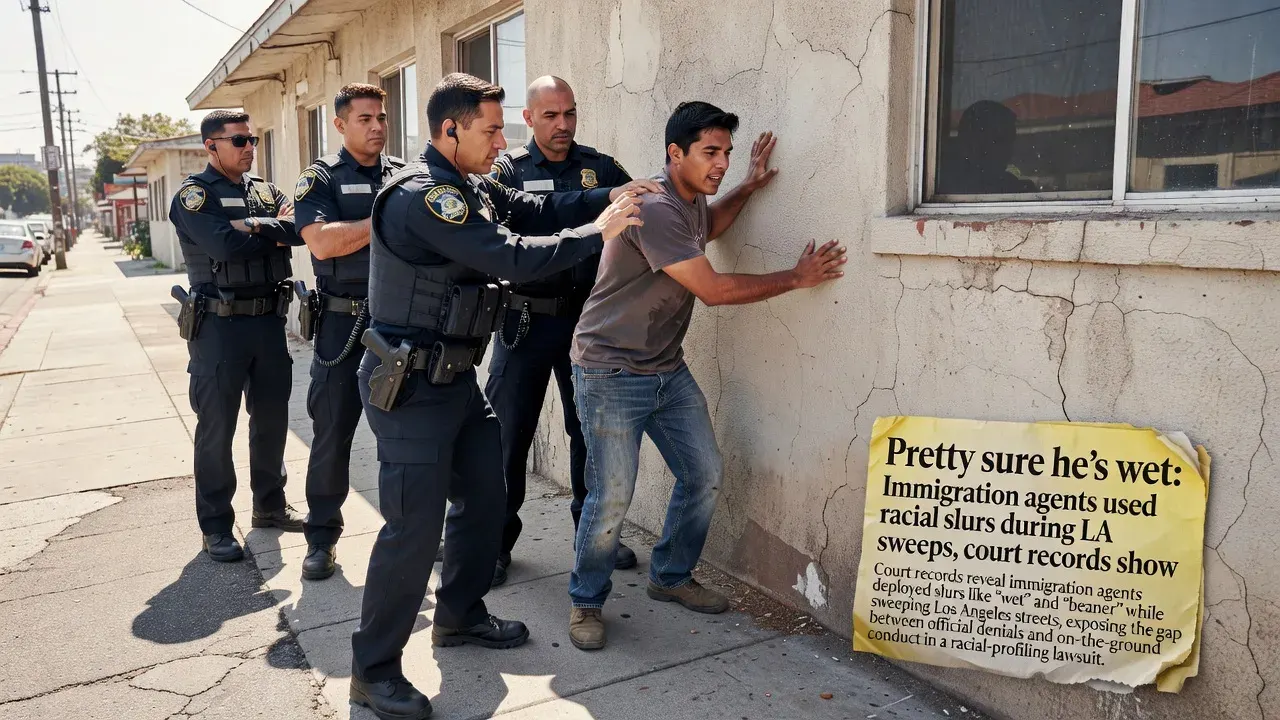
Federal immigration agents in Los Angeles traded text messages laced with racial slurs as they hunted for targets during street sweeps, according to court records unsealed in a lawsuit that accuses them of systematic racial profiling against Latinos.
The messages, obtained through the litigation, show agents casually identifying people as “wet” and “beaner” while coordinating operations. One agent wrote “Pretty sure he’s wet,” using a derogatory term for undocumented immigrants that references crossing the Rio Grande. Another referred to Latinos with the slur “beaner” in operational chatter.
These disclosures land amid broader claims that agents relied on appearance, language, or location rather than individualized suspicion. The lawsuit argues the pattern amounts to unconstitutional targeting based on ethnicity, turning routine enforcement into something closer to ethnic sweeps.

Plaintiffs’ attorneys pulled the texts from government records turned over in discovery. The messages offer a rare, unfiltered look at how some agents communicated when they believed no one outside their circle would see the exchange. Federal officials have not disputed the authenticity of the texts but maintain that enforcement actions complied with the law.
Buried deeper in the filings is evidence that the language was not isolated. Multiple agents participated in the exchanges during active operations, suggesting the slang formed part of an internal shorthand that blurred the line between crude humor and operational bias. The records surfaced as the case moves toward potential class-action status for affected Latino residents in Los Angeles.
The contradiction is glaring: while federal immigration policy is sold as color-blind rule of law, the agents entrusted with it were texting each other in the language of the border vigilante. What remains is whether judges will treat these messages as proof of unconstitutional intent or dismiss them as locker-room talk that changes nothing on the ground.
Original reporting: CalMatters.
More in California
- UC Berkeley Lab Proposes New Civic Framework for California’s Next Governor
A research-driven agenda calls for institutionalizing 'co-governance' to address low public trust and lack of resident influence in state decision-making.
- Five Tax Measures on California’s Ballot Aim to Reshape State Finances
Propositions 3, 40–43 would alter income, wealth and local taxation rules—marking the highest number of tax measures on a general election ballot since 1994.
- Catalina Helicopter Crash Highlights Risks of Island Medevac Flights
A medical evacuation chopper carrying Catalina Romero, pilot, and nurse Jessica Devries crashed into the ocean shortly after takeoff, killing all three; federal investigators are assessing causes including night flying, spatial disorientation, and the island’s challenging Pebbly Beach heliport.