PhysLoop 2026: AI Learns Physics on Its Own in Video Generation
PhysLoop, a novel system unveiled in November 2026, integrates a large-language model with a video-generation engine through a differentiable physics teacher, enabling self-correcting, physics-aware video synthesis.

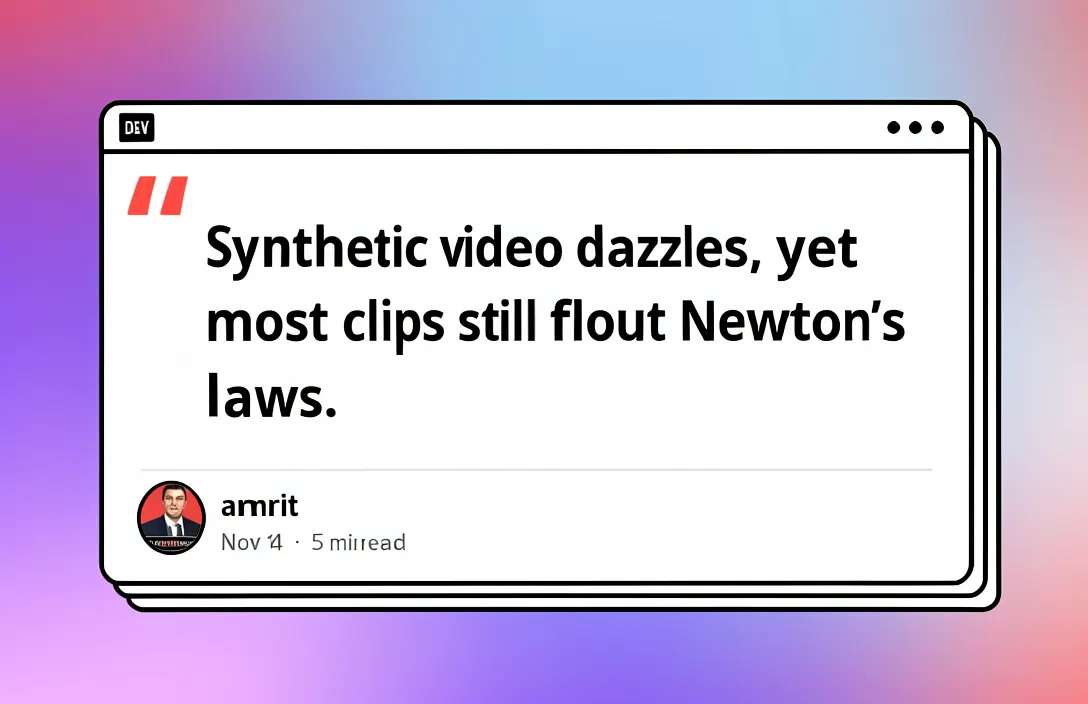

PhysLoop 2026 introduces a closed-loop architecture that couples a large-language model (LLM) with a video-generation engine, allowing the system to generate videos that obey the laws of motion. The LLM, pre-fine-tuned on physics textbooks and simulation logs, acts as a physics-aware supervisor that continually corrects the video generator until every frame adheres to physical principles (Dev.to, 2026). This system does not merely add a post-hoc filter but injects physics reasoning during synthesis, enabling the generator to self-correct and store each correction as a new training example (Dev.to, 2026). [1]
In a case study, a visual-effects artist requested a clip of a steel ball rolling down a ramp and hitting a wooden block. A vanilla diffusion model produced a flawed video where the ball moved incorrectly, and the block did not topple as expected. PhysLoop expanded the prompt into a chain-of-thought, identifying objects, forces, and computing expected motion, then injected this reasoning into the video generator's latent space (Dev.to, 2026). The system then evaluated the output, detected inconsistencies, and provided feedback to refine the video until it met physical expectations (Dev.to, 2026). [1]
The system's iterative refinement process increased the Physics Consistency Score from 0.41 to 0.89 over four iterations, with the final clip achieving 16 fps on a single RTX 4090-class GPU. This improvement demonstrates how PhysLoop transforms ambiguous text prompts into physically coherent videos without requiring human-written annotations or hand-crafted constraints (Dev.to, 2026). The replay buffer, which stores correction pairs, enriches the dataset for future fine-tuning, reducing the need for large annotated video collections (Dev.to, 2026). [1]
PhysLoop 2026 introduces the first closed-loop architecture that couples a large-language model (LLM) with a video-generation engine through a differentiable physics teacher. The system does not merely add a post-hoc filter; it injects physics reasoning during synthesis, lets the generator self-correct, and stores each correction as a new training example. The result is a self-improving video model that produces physically plausible motion at real-time speeds on a single RTX 4090-class GPU (Dev.to, 2026). [1]
Advertisement
In a case study, a visual-effects artist requested a clip of a steel ball rolling down a ramp and hitting a wooden block. The system's iterative refinement process increased the Physics Consistency Score from 0.41 to 0.89 over four iterations, with the final clip achieving 16 fps on a single RTX 4090-class GPU. The LLM, pre-fine-tuned on physics textbooks and simulation logs, expands the prompt into a chain-of-thought that includes object identification, force calculation, and collision prediction (Dev.to, 2026). [1]
The system's Physics Evaluation Module (PEM) parses the frames, extracts the ball’s trajectory, and computes a physics loss, including energy loss and contact violation. The PEM returns a Physics Consistency Score of 0.41 (scale 0–1, where 1 denotes perfect physics). The LLM-mediated feedback then revises the chain-of-thought and emits a new physics-guidance vector, leading to iterative refinement and a final Physics Consistency Score of 0.89 (Dev.to, 2026). [1]
One of the key risks associated with PhysLoop 2026 is the potential for LLM hallucination of physics. The model may generate plausible but incorrect physical forces that do not match the visual scene, leading to inaccurate physics loss calculations. According to the 2026 analyst brief, this risk can be mitigated by running a secondary verification pass with a symbolic physics engine and flagging high-uncertainty corrections for human review. This step ensures that the generator receives accurate feedback, preventing the system from reinforcing incorrect physics reasoning. [1]
Another challenge is loop divergence, where the physics loss landscape may contain local minima, causing the system to oscillate without converging on a correct solution. The 2026 analyst brief outlines mitigation strategies, including capping the number of iterations, decaying the guidance-vector learning rate, and early-stopping based on the Physics Consistency Score. These measures help stabilize the iterative refinement process, ensuring that the system converges efficiently and reliably. [1]
Advertisement
Compute overhead is another concern, as the addition of the Physics Evaluation Module (PEM) and LLM feedback increases latency for longer clips. The 2026 analyst brief suggests parallelizing PEM across frames, caching recurrent calculations, and using distilled LLM variants for inference. These optimizations help reduce the computational burden, enabling real-time video generation on a single RTX 4090-class GPU while maintaining physical realism. [1]
Sources
Prepared with AI assistance from the cited sources.
The Cali Reporter newsletter
The stories worth your time.
California, the country, and what comes next. Join our free newsletter for reporting that keeps you informed.
More in Technology
- Modern Web Guidance 1.0 and Browser Compatibility
Modern Web Guidance 1.0, announced by Chrome for Developers on November 10, introduces browser compatibility data to assist coding agents in building web features. The initiative emphasizes the importance of fallback…
- Apache mod_http2 Vulnerability Detection with Nmap
A new Nmap scripting module has been developed to detect the Apache mod_http2 vulnerability (CVE-2026-119618), addressing the challenges of identifying affected systems accurately.
- Securing Remote Vendor Access in Industrial Networks
Best practices for managing remote vendor access in operational technology (OT) networks emphasize controlled access points, multifactor authentication, and time-bound sessions to reduce cybersecurity risks.