PHP 8.6 Features for Laravel Developers
PHP 8.6 introduces several features that will change how Laravel developers write code, including partial function application, clamp(), Time\Duration, SortDirection enum, and the Polling API.

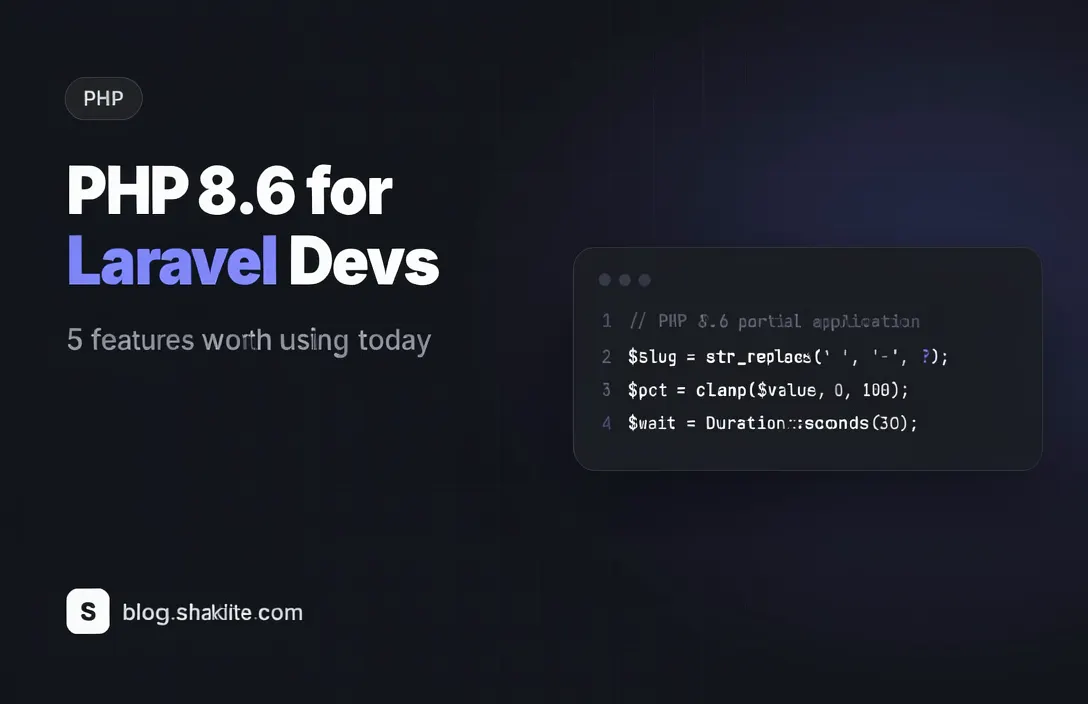

PHP 8.6 introduces partial function application, a feature that allows developers to create closures by filling in some arguments of a function and leaving others as placeholders. This is particularly useful in Laravel, where it can simplify code that involves the pipe operator (|>). Instead of writing multiple one-line closures, developers can use partials to create more readable and concise code. For example, the slugify function can be written more efficiently using partials, which retain the original function's parameter names and types, ensuring compatibility with static analysis and IDE autocompletion (source ID: 1). [1]
The clamp() function in PHP 8.6 provides a straightforward way to keep a value within a specified range. This is especially useful in Laravel applications when handling user input, such as capping the number of items per page or ensuring discount values fall within acceptable limits. The native clamp() function is faster and more versatile than previous implementations, and it can handle various data types, including strings and DateTime objects. This function replaces the common min(max($value, $min), $max) pattern, making code cleaner and more maintainable (source ID: 1). [1]
PHP 8.6 also introduces the Time\Duration class, a readonly value object that represents a duration with nanosecond precision. This is the first step toward a modernized date and time API in PHP. Laravel developers can use this class to make the unit of time explicit in their code, improving clarity and reducing errors. While Laravel's APIs do not yet fully support Duration, it can still be used in logging and timing operations. The class supports arithmetic methods and comparison operators, making it a powerful tool for managing time intervals (source ID: 1). [1]
The SortDirection enum in PHP 8.6 provides a standardized way to represent sorting directions, such as ascending or descending. This is particularly useful in Laravel applications where sorting is a common requirement. The enum is unbacked, allowing developers to map it to different representations at the boundary, such as query parameters or SQL clauses. This feature promotes type safety and consistency across different parts of an application, and it is expected to be adopted by Laravel in future versions (source ID: 1). [1]
Advertisement
PHP 8.6 is scheduled to be released on November 19, 2026, and is currently in the release candidate stage. This version introduces several features that will influence how Laravel developers write their code, including partial function application, clamp(), Time\Duration, SortDirection enum, and the Polling API. These features are designed to improve code readability, performance, and integration with Laravel’s ecosystem. The release timeline and current status of PHP 8.6 are confirmed in the Dev.to article, which highlights the significance of these updates for Laravel developers. [1]
Partial function application allows developers to create closures by partially applying arguments to a function, with placeholders for the remaining parameters. This feature simplifies the use of the pipe operator (|>) in Laravel, enabling a more readable and concise syntax for function chaining. For example, a closure that was previously written as $slugify = fn (string $s) => str_replace(' ', '-', $s); can now be expressed as $slugify = str_replace(' ', '-', ?);, which maintains static analysis and IDE compatibility. This change is particularly useful in Laravel contexts, such as when using helpers like Str::limit(?, 100); in collection methods. The Dev.to article provides a detailed example of this feature in action within Laravel code. [1]
The clamp() function is a new utility in PHP 8.6 that ensures a value stays within a specified range. It replaces the common min(max($value, $min), $max) pattern and is especially useful in Laravel for handling user input, such as limiting the number of items per page in an index route. For instance, $perPage = clamp($request->integer('per_page', 15), min: 1, max: 100); ensures that the per_page value is always between 1 and 100. The Dev.to article explains how this function can be used in Laravel form requests to sanitize input values before processing, ensuring data integrity and preventing out-of-range errors. [1]
Time\Duration is a new readonly value object in PHP 8.6 that represents a length of time with nanosecond precision. It supports arithmetic operations and comparison, making it ideal for precise timing in Laravel applications. This feature is particularly relevant for Laravel developers who need to manage time-based configurations, such as retry delays or timeouts, with clear units. The Dev.to article describes how Time\Duration can be used in queued jobs for exponential backoff calculations, even though Laravel’s current APIs still require conversion to native types. This is expected to change as Laravel adopts the new Time\Duration class in future updates. [1]
Advertisement
The SortDirection enum in PHP 8.6 provides a standardized way to represent sorting order, with two cases: Ascending and Descending. This enum is unbacked, allowing developers to map it to different string representations (e.g., 'asc' or 'desc') at the application boundary. The Dev.to article shows how this enum can be used in Laravel to improve type safety in query builders, such as in a ListPosts class that uses SortDirection to control the sorting order of Eloquent queries. The enum is also easy to polyfill, making it a practical choice for Laravel developers looking to adopt this feature before Laravel itself supports it directly. [1]
The Polling API (Io\Poll) in PHP 8.6 provides native access to operating system polling mechanisms like epoll, kqueue, and WSAPoll, offering a more efficient alternative to the slower stream_select() function. This feature is particularly relevant for Laravel developers who use tools such as Laravel Reverb (WebSockets) or long-running servers under Octane, as these tools rely on event loops built on polling mechanisms. The Dev.to article notes that while most Laravel developers may not directly interact with the Polling API, its impact will be felt through performance improvements in underlying libraries like ReactPHP and Amp, which are expected to adopt the new API for faster execution. [1]
Before upgrading a Laravel application to PHP 8.6, the Dev.to article recommends following a checklist to ensure a smooth transition. This includes waiting for Laravel’s official PHP 8.6 support, adding PHP 8.6 to the CI matrix, checking third-party package compatibility, and addressing potential name clashes with new PHP functions like clamp() and SortDirection. Developers are also advised to update Docker images, Forge or Cloud runtimes, and Composer’s PHP constraints to align local, CI, and production environments. These steps help avoid unexpected issues and ensure that Laravel applications are ready for PHP 8.6 when it is officially released. [1]
Sources
Prepared with AI assistance from the cited sources.
The Cali Reporter newsletter
The stories worth your time.
California, the country, and what comes next. Join our free newsletter for reporting that keeps you informed.
More in Technology
- Modern Web Guidance 1.0 and Browser Compatibility
Modern Web Guidance 1.0, announced by Chrome for Developers on November 10, introduces browser compatibility data to assist coding agents in building web features. The initiative emphasizes the importance of fallback…
- Apache mod_http2 Vulnerability Detection with Nmap
A new Nmap scripting module has been developed to detect the Apache mod_http2 vulnerability (CVE-2026-119618), addressing the challenges of identifying affected systems accurately.
- Securing Remote Vendor Access in Industrial Networks
Best practices for managing remote vendor access in operational technology (OT) networks emphasize controlled access points, multifactor authentication, and time-bound sessions to reduce cybersecurity risks.