Open-Source Tool Aims to Improve Collaboration Between AI Coding Agents
A new open-source tool called CodeRelay has been developed to help AI coding agents work more effectively across teams of developers. The tool is designed to address challenges such as conflicting modifications and…

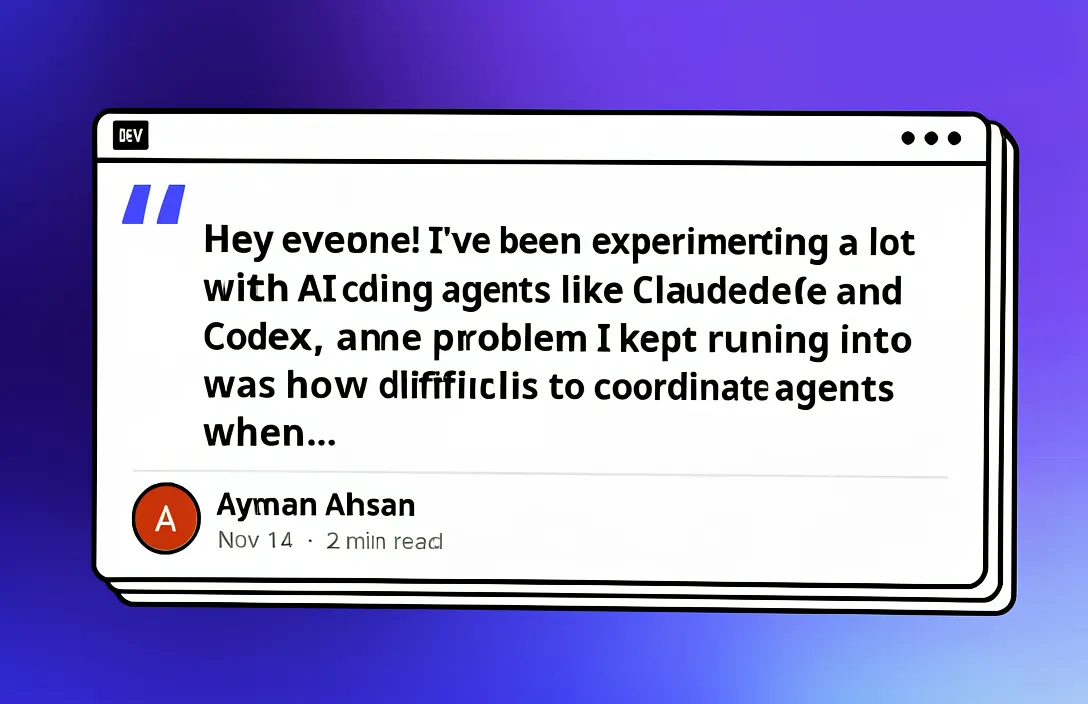

A developer has created an open-source tool called CodeRelay to help AI coding agents collaborate more effectively when multiple developers are working on the same project. The tool is built on top of T3 Code and is designed to address challenges such as agents modifying files outside a developer's responsibility or conflicting assumptions between frontend and backend agents (Dev.to). [1]
CodeRelay allows developers to join a shared Team Hub and declare which parts of a repository they own. When an agent needs to handle a task outside its owner's scope, it can propose the task to another developer's agent, including an API contract pinned to a specific Git commit (Dev.to). [1]
Once the receiving developer reviews and accepts the task, they complete the work in their own agent thread. The original developer then receives the branch, commit, and summary to integrate the changes. The goal of the tool is not to replace existing coding agents but to enhance their ability to work together across a team (Dev.to). [1]
CodeRelay was developed by a software engineer who experimented with AI coding agents such as Claude Code and Codex. The tool was created to address the challenge of collaboration between multiple developers using AI agents on the same project. It is built on top of T3 Code and is open-source, hosted on GitHub at https://github.com/AymanAhsan/CodeRelay. The project is still in its early stages, and the developer is seeking feedback from users who are already using AI coding agents in shared repositories. [1]
Advertisement
The tool operates through a shared Team Hub where developers declare which parts of a repository they own. This division of ownership helps manage tasks and responsibilities more effectively. When an agent needs to perform work outside its owner's scope, it can propose a task to another developer, including an API contract pinned to a specific Git commit. The receiving developer can then review and accept the task into their own agent thread. [1]
The project includes a local demo called Alice/Bob that allows users to test the entire handoff workflow without needing to set up a separate team. This demo is useful for understanding how CodeRelay facilitates collaboration between agents. The developer also invites users to share how they currently coordinate AI coding agents across their teams, asking whether they use worktrees, separate branches, manual handoffs, or other methods. [1]
CodeRelay was developed to address the challenges of coordinating AI coding agents in team environments, particularly when working on shared repositories. The tool is built on top of T3 Code and is designed to facilitate collaboration by allowing developers to declare ownership of specific parts of a repository. This ownership model ensures that agents only work within the defined scope of each developer, reducing conflicts and overlaps in tasks. The project is hosted on GitHub at https://github.com/AymanAhsan/CodeRelay, and a demo version is available for testing the handoff workflow without requiring a full team setup. The tool is still in its early stages, and the developer is seeking feedback from those already using AI coding agents in shared development environments. [1]
The scope of CodeRelay includes enabling agents to propose tasks to other developers, complete with API contracts pinned to specific Git commits. These proposals are reviewed and accepted by the receiving developer, who integrates the task into their own agent thread. Once the work is completed, the original developer receives the branch, commit, and summary to integrate into their own workflow. The tool does not aim to replace existing coding agents but to enhance their ability to collaborate effectively within a team. It supports a local demo environment using Alice/Bob to simulate the entire handoff process, making it easier for developers to test the tool's functionality before deploying it in a real-world setting. [1]
Advertisement
The Cali Reporter newsletter
The stories worth your time.
California, the country, and what comes next. Join our free newsletter for reporting that keeps you informed.
More in Technology
- Modern Web Guidance 1.0 and Browser Compatibility
Modern Web Guidance 1.0, announced by Chrome for Developers on November 10, introduces browser compatibility data to assist coding agents in building web features. The initiative emphasizes the importance of fallback…
- Apache mod_http2 Vulnerability Detection with Nmap
A new Nmap scripting module has been developed to detect the Apache mod_http2 vulnerability (CVE-2026-119618), addressing the challenges of identifying affected systems accurately.
- Securing Remote Vendor Access in Industrial Networks
Best practices for managing remote vendor access in operational technology (OT) networks emphasize controlled access points, multifactor authentication, and time-bound sessions to reduce cybersecurity risks.