Onset: A Stroke Monitoring System Using FaceTime and AI
A stroke monitoring system called Onset has been developed to help identify early signs of stroke recurrence using FaceTime and artificial intelligence. The system is designed to be used by patients in the critical…

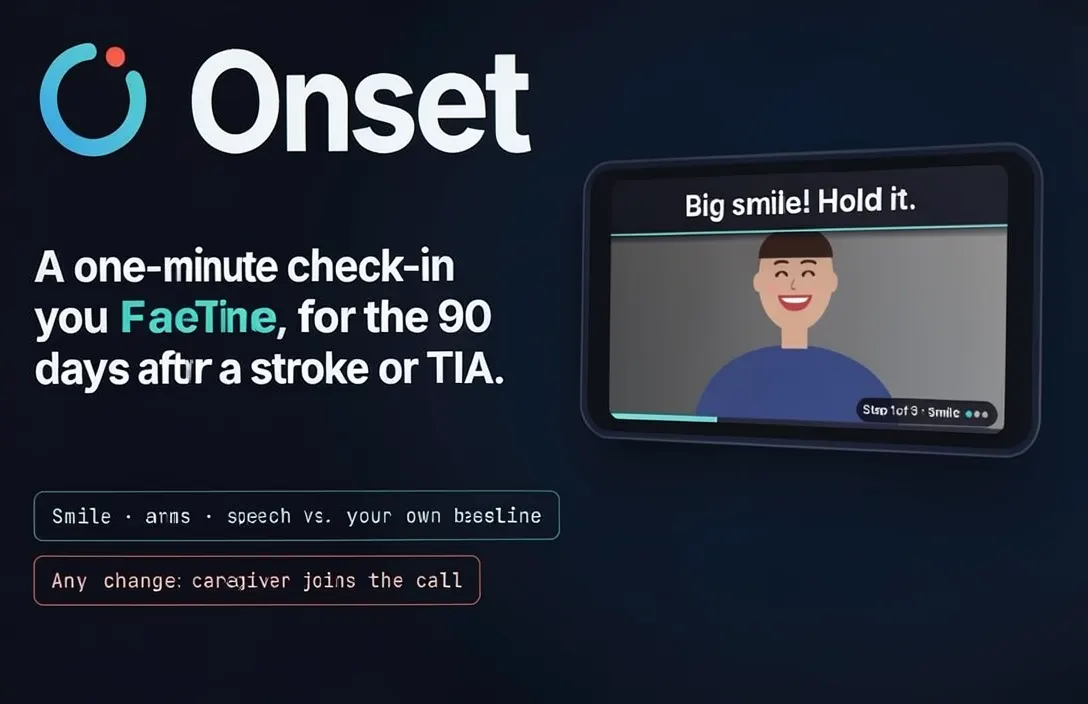

The weeks following a stroke or transient ischemic attack (TIA) are particularly risky, with the CDC reporting that nearly one in four strokes in the US occur in individuals who have already experienced one. After a TIA, 10 to 15 percent of people face a major stroke within three months, with much of this risk concentrated in the first few weeks. Family members often serve as the primary early-warning system during this period, though not all changes are noticed. To address this, Onset was developed as a one-minute daily check-in tool, prescribed by care teams for 90 days after discharge. The system uses FaceTime for check-ins, eliminating the need for an app or login (source ID: 1). [1]
Onset uses the FAST stroke recognition checklist, assessing facial symmetry, arm movement, and speech. The system relies on MediaPipe Face Landmarker to track mouth corners and measure asymmetry, and MediaPipe Pose to analyze arm movement relative to shoulder width. Speech is transcribed by ElevenLabs Scribe, with metrics like word error rate and speech rate evaluated. Onset compares each check-in to a patient’s baseline, not a population average, ensuring that pre-existing conditions do not trigger false alarms (source ID: 1). [1]
To ensure usability, Onset includes a caregiver in the call when a change is detected, rather than simply instructing the patient to call 911. This approach was refined after initial versions failed to account for the behavior of older patients who may not act on a recommendation alone. The system also includes specific instructions for users if parts of the body or face are out of frame, prompting them to adjust their position. If a persistent issue is detected, such as an arm dropping, the system escalates the alert (source ID: 1). [1]
The project, Onset, was developed during Emory Hacks 2026 and is specifically designed for use in the 90 days following a stroke or transient ischemic attack (TIA). The system is implemented as a one-minute check-in conducted via FaceTime, without the need for an app or login. It is intended for patients who have been recently discharged from the hospital, a period identified by the CDC as high-risk for recurrent strokes. The location of development was Emory University, and the project is currently in a prototype stage, with no clinical validation yet conducted. [1]
Advertisement
Onset evaluates three key indicators during each check-in: facial asymmetry, arm movement, and speech performance. Facial asymmetry is measured using MediaPipe Face Landmarker, which tracks the movement of the mouth corners and calculates an asymmetry index. Arm movement is assessed by tracking the wrists relative to the shoulder line, normalized by shoulder width to account for camera shake. Speech performance is evaluated using ElevenLabs Scribe, which transcribes speech with word timestamps and scores word error rate, words per minute, and the longest pause. Each check-in is compared to the patient’s baseline, recorded during the first call, rather than to population averages. This personalized approach is a critical design choice to avoid false alarms for patients with pre-existing asymmetry or speech issues. [1]
The system includes a set of deterministic rules for detecting changes in the patient’s condition. These rules are defined in a single dataclass with specific thresholds, such as a 10% increase in facial asymmetry, a 20% difference in arm drift, a 10% increase in speech word error rate, a 20% drop in speech rate, and a 1.0-second pause floor. These thresholds are currently provisional and were tuned based on synthetic data and one individual, indicating that further validation is needed. The project also includes a caregiver notification system, where a summary of changes is sent to the caregiver via iMessage, along with a private link to a live video room for further assessment. [1]
The technical architecture of Onset involves FaceTime calls bridged through Chert, which provides a real Apple phone line. A Python LiveKit agent handles the call, subscribes to the caller’s camera, runs MediaPipe on the CPU, and sends the camera feed back with caption overlays. Voice is handled by ElevenLabs, with fallbacks to Gemini and OpenAI TTS. The system also includes a laptop dashboard that displays live metrics and plays the agent’s voice in the room. However, the project encountered a significant bug where audio was not being passed through the Chert line, leading to the implementation of a caption-first approach to ensure functionality even without sound. [1]
The project is still in its early stages and has not yet been tested on a Chert line with fully functional audio. The current version includes a test harness built using Claude Code, which allows for parallel development of different components (face, arms, speech, decision rules, call flow, caregiver messaging, and test harness) in separate git worktrees. Each component was developed in parallel and merged as a PR with CI. The system currently has 640 passing tests, but clinical validation is pending. The project is open-source and can be accessed on GitHub, with instructions for running the check without FaceTime provided in the repository. [1]
Advertisement
The Cali Reporter newsletter
The stories worth your time.
California, the country, and what comes next. Join our free newsletter for reporting that keeps you informed.
More in Technology
- Modern Web Guidance 1.0 and Browser Compatibility
Modern Web Guidance 1.0, announced by Chrome for Developers on November 10, introduces browser compatibility data to assist coding agents in building web features. The initiative emphasizes the importance of fallback…
- Apache mod_http2 Vulnerability Detection with Nmap
A new Nmap scripting module has been developed to detect the Apache mod_http2 vulnerability (CVE-2026-119618), addressing the challenges of identifying affected systems accurately.
- Securing Remote Vendor Access in Industrial Networks
Best practices for managing remote vendor access in operational technology (OT) networks emphasize controlled access points, multifactor authentication, and time-bound sessions to reduce cybersecurity risks.