New SARS-CoV-2 Variant PJ.2.1 and Vaccine Efficacy
A new SARS-CoV-2 variant, PJ.2.1, has been spreading globally since May 2026, and research indicates that current vaccines provide protection against it.

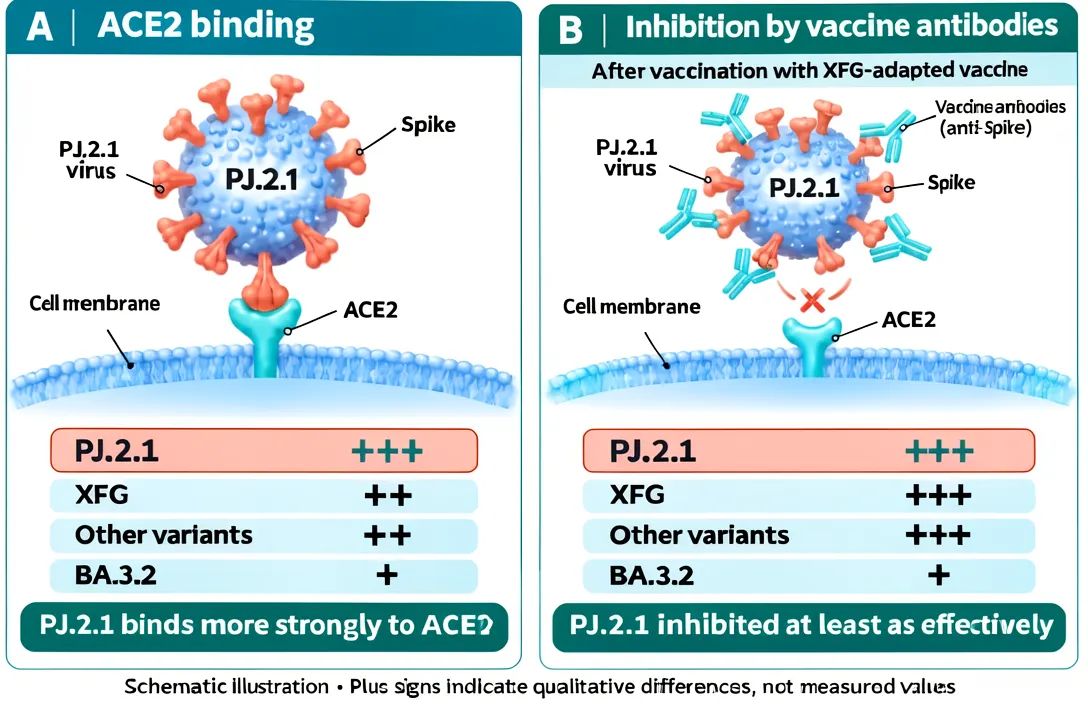

A new SARS-CoV-2 variant, PJ.2.1, has been spreading globally since May 2026. First detected in Canada, the variant has since spread to the United States, Spain, the Netherlands, and France. Researchers from the German Primate Center—Leibniz Institute for Primate Research, in collaboration with colleagues from Hannover Medical School, investigated how efficiently PJ.2.1 can penetrate human cells and how well antibodies from vaccinated individuals neutralize the new variant. The study found that PJ.2.1 binds more strongly to the ACE2 receptor, which serves as the entry point for SARS-CoV-2 into human cells, and enters certain cells that produce only small amounts of ACE2 more effectively (source ID: 1). [1]
Despite these changes, the new variant was effectively neutralized by antibodies produced following vaccination with the current booster vaccine, which has been adapted to the XFG variant. The results suggest that vaccination provides protection against PJ.2.1. However, this could change if the variant acquires additional mutations that enable it to evade the immune response (source ID: 1). [1]
The findings indicate that the XFG-adapted vaccine provides effective protection against PJ.2.1 as well as against the XFG viruses that are also circulating—at least as long as these viruses do not acquire mutations that allow them to evade the antibody response more effectively. The study also found that the SARS-CoV-2 variant BA.3.2, which is primarily detected in children, was only inadequately inhibited by these antibodies (source ID: 1). [1]
PJ.2.1 was first detected in Canada and subsequently spread to the United States, with its prevalence increasing in the Netherlands and France by May 2026. The variant is now expected to spread in Germany, given the high infection rates and the absence of travel restrictions. The virus has been detected across all age groups, indicating widespread transmission. Notably, the variant has not been associated with more severe disease progression or new symptoms compared to other SARS-CoV-2 variants. This information is supported by the study published in the Journal of Infection and The Lancet Infectious Diseases. [1]
Advertisement
The spike protein of PJ.2.1 exhibits enhanced binding affinity to the ACE2 receptor, which is critical for the virus to enter human cells. This increased binding efficiency allows the variant to penetrate cells that produce only small amounts of ACE2 more effectively than other variants. The study conducted by researchers at the German Primate Center and Hannover Medical School demonstrated that this feature may contribute to the variant's increased transmissibility and potential for global spread, as noted by Markus Hoffmann in the published research. [1]
The current XFG-adapted mRNA vaccine, Comirnaty, has been shown to effectively inhibit PJ.2.1, according to the findings of the study. However, the vaccine does not provide sufficient protection against the BA.3.2 variant, which is predominantly found in children. This discrepancy suggests that future vaccine formulations may need to include additional components tailored to variants like BA.3.2 to ensure broader immunity. The researchers emphasize the importance of monitoring for further mutations that could potentially reduce the effectiveness of current vaccines against PJ.2.1. [1]
A new SARS-CoV-2 variant, PJ.2.1, has been spreading globally since May 2026. It traces back to an older viral lineage that has largely disappeared from the infection landscape. However, the virus likely persisted in a person with a long-term infection and underwent significant changes through numerous mutations (Source ID: 1). [1]
Researchers from the Infection Biology Unit at the German Primate Center—Leibniz Institute for Primate Research, in collaboration with colleagues from Hannover Medical School, investigated how efficiently PJ.2.1 can penetrate human cells and how well antibodies from vaccinated individuals neutralize the new variant. The results show that PJ.2.1 binds more strongly than other virus variants studied to the ACE2 receptor, which serves as the entry point for SARS-CoV-2 into human cells (Source ID: 1). [1]
Advertisement
Despite these changes, the new variant was effectively neutralized by antibodies produced following vaccination with the current booster vaccine, which has been adapted to the XFG variant. The results suggest that vaccination provides protection against PJ.2.1. However, this could change if the variant acquires additional mutations that enable it to evade the immune response (Source ID: 1). [1]
Sources
Prepared with AI assistance from the cited sources.
The Cali Reporter newsletter
The stories worth your time.
California, the country, and what comes next. Join our free newsletter for reporting that keeps you informed.
More in Health & Medicine
- Understanding Fascia and the Evidence Behind Fascia Release
Fascia is a connective tissue that plays a structural role in the human body, but evidence supporting specific exercises or tools for 'fascia release' remains limited.
- Antidepressant Effectiveness and Long-Term Use
A new review suggests that some antidepressants may be more effective than others in helping people manage depression symptoms over the long term, according to a study published in The Lancet Psychiatry.
- Experimental Weight-Loss Drug Shows Promise for Knee Osteoarthritis Pain
A new study suggests that an experimental weight-loss drug, retatrutide, may significantly reduce knee pain in people with osteoarthritis and obesity.