New Framework for Understanding and Treating Endometriosis-Associated Pain
A recent review article proposes a new neuroimmune–endocrine–fibrosis framework to explain the complex mechanisms behind endometriosis-associated pain and suggests personalized treatment strategies.

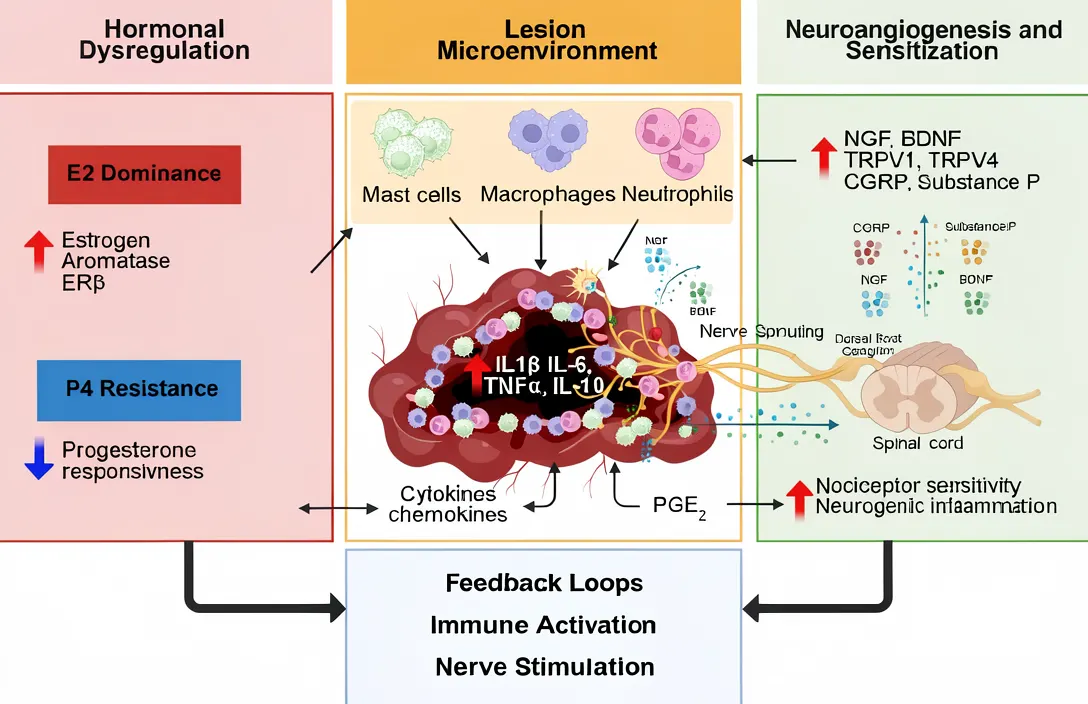

A joint research team led by professor Kyeong A So of the Department of Obstetrics and Gynecology at Korea University Guro Hospital and professors Jae-Wook Jeong and Tae Hoon Kim of the University of Missouri School of Medicine has reviewed how pain develops and persists in patients with endometriosis. The review article, selected as a featured article in the journal Endocrine Reviews, highlights the scientific significance and clinical relevance of the findings. Endometriosis is a common chronic condition among women of reproductive age, causing severe menstrual pain, chronic pelvic pain, and pain during intercourse, which significantly impacts patients' physical and mental health and quality of life (source ID: 1). [1]
The researchers noted that the size or severity of endometriotic lesions does not necessarily correlate with the severity of pain experienced by patients, indicating the limitations of explaining endometriosis-associated pain solely in terms of hormonal changes and inflammation. To develop a more comprehensive understanding, the team reviewed a wide range of clinical and basic science studies published through December 2025. These studies investigated several mechanisms, including inflammation and immune responses, hormonal changes, angiogenesis and neurogenesis around endometriotic lesions, and sensitization of the nervous system (source ID: 1). [1]
The review showed that endometriosis-associated pain involves complex interactions among hormones, the immune system, and the nervous system. Estrogen-dependent inflammation and progesterone resistance create a permissive microenvironment that promotes immune dysfunction, neurotrophic signaling, and nociceptor sensitization. These peripheral processes drive sustained afferent input to the central nervous system, leading to peripheral, central, and cross-organ sensitization that can perpetuate pain independently of lesion activity (source ID: 1). [1]
Based on these findings, the researchers proposed an integrated neuroimmune–endocrine–fibrosis framework, rather than viewing endometriosis-associated pain solely as a hormonal or inflammatory problem. Fibrosis—the stiffening and scarring of tissue around lesions due to chronic inflammation—may further aggravate pain by persistently stimulating nearby nerves. The team advocated tailoring treatment to the mechanisms underlying each patient's pain, rather than basing treatment decisions only on lesion size or location (source ID: 1). [1]
Advertisement
A joint research team led by professor Kyeong A So of the Department of Obstetrics and Gynecology at Korea University Guro Hospital and professors Jae-Wook Jeong and Tae Hoon Kim of the University of Missouri School of Medicine has reviewed how pain develops and persists in patients with endometriosis. The researchers noted that the size or severity of endometriotic lesions does not necessarily correlate with the severity of pain experienced by patients, indicating the limitations of explaining endometriosis-associated pain solely in terms of hormonal changes and inflammation (source ID: 1). [1]
The review showed that endometriosis-associated pain involves complex interactions among hormones, the immune system and the nervous system. Estrogen-dependent inflammation and progesterone resistance establish a permissive microenvironment that promotes immune dysfunction, neurotrophic signaling and nociceptor sensitization (source ID: 1). [1]
These peripheral processes drive sustained afferent input to the central nervous system, leading to peripheral, central and cross-organ sensitization that can perpetuate pain independently of lesion activity. The researchers proposed an integrated "neuroimmune–endocrine–fibrosis" framework, rather than viewing endometriosis-associated pain solely as a hormonal or inflammatory problem (source ID: 1). [1]
Fibrosis—the stiffening and scarring of tissue around lesions due to chronic inflammation—may further aggravate pain by persistently stimulating nearby nerves. The team therefore advocated tailoring treatment to the mechanisms underlying each patient's pain, rather than basing treatment decisions only on lesion size or location (source ID: 1). [1]
Advertisement
A joint research team led by professor Kyeong A So of the Department of Obstetrics and Gynecology at Korea University Guro Hospital and professors Jae-Wook Jeong and Tae Hoon Kim of the University of Missouri School of Medicine has reviewed how pain develops and persists in patients with endometriosis (source ID: 1). The researchers noted that the size or severity of endometriotic lesions does not necessarily correlate with the severity of pain experienced by patients, indicating the limitations of explaining endometriosis-associated pain solely in terms of hormonal changes and inflammation (source ID: 1). [1]
The review showed that endometriosis-associated pain involves complex interactions among hormones, the immune system and the nervous system (source ID: 1). Estrogen-dependent inflammation and progesterone resistance establish a permissive microenvironment that promotes immune dysfunction, neurotrophic signaling and nociceptor sensitization (source ID: 1). These peripheral processes drive sustained afferent input to the central nervous system, leading to peripheral, central and cross-organ sensitization that can perpetuate pain independently of lesion activity (source ID: 1). [1]
Based on these findings, the researchers proposed an integrated 'neuroimmune–endocrine–fibrosis' framework, rather than viewing endometriosis-associated pain solely as a hormonal or inflammatory problem (source ID: 1). Fibrosis—the stiffening and scarring of tissue around lesions due to chronic inflammation—may further aggravate pain by persistently stimulating nearby nerves (source ID: 1). The team therefore advocated tailoring treatment to the mechanisms underlying each patient's pain, rather than basing treatment decisions only on lesion size or location (source ID: 1). [1]
A joint research team led by professor Kyeong A So of the Department of Obstetrics and Gynecology at Korea University Guro Hospital and professors Jae-Wook Jeong and Tae Hoon Kim of the University of Missouri School of Medicine has reviewed how pain develops and persists in patients with endometriosis (source ID: 1). The review showed that endometriosis-associated pain involves complex interactions among hormones, the immune system and the nervous system (source ID: 1). The researchers emphasized that the size or severity of endometriotic lesions does not necessarily correlate with the severity of pain experienced by patients, indicating the limitations of explaining endometriosis-associated pain solely in terms of hormonal changes and inflammation (source ID: 1). [1]
Advertisement
The team proposed an integrated 'neuroimmune–endocrine–fibrosis' framework, rather than viewing endometriosis-associated pain solely as a hormonal or inflammatory problem (source ID: 1). In this framework, hormonally driven inflammation and immune responses stimulate nerves, and repeated interactions sustain pain (source ID: 1). Fibrosis—the stiffening and scarring of tissue around lesions due to chronic inflammation—may further aggravate pain by persistently stimulating nearby nerves (source ID: 1). [1]
The researchers noted that these peripheral processes drive sustained afferent input to the central nervous system, leading to peripheral, central and cross-organ sensitization that can perpetuate pain independently of lesion activity (source ID: 1). Based on these findings, the researchers proposed new research directions to translate these insights into personalized treatment (source ID: 1). [1]
Sources
Prepared with AI assistance from the cited sources.
The Cali Reporter newsletter
The stories worth your time.
California, the country, and what comes next. Join our free newsletter for reporting that keeps you informed.
More in Health & Medicine
- Understanding Fascia and the Evidence Behind Fascia Release
Fascia is a connective tissue that plays a structural role in the human body, but evidence supporting specific exercises or tools for 'fascia release' remains limited.
- Antidepressant Effectiveness and Long-Term Use
A new review suggests that some antidepressants may be more effective than others in helping people manage depression symptoms over the long term, according to a study published in The Lancet Psychiatry.
- Experimental Weight-Loss Drug Shows Promise for Knee Osteoarthritis Pain
A new study suggests that an experimental weight-loss drug, retatrutide, may significantly reduce knee pain in people with osteoarthritis and obesity.