NASA's Moon Base Construction Plan
NASA has outlined a multi-phase plan to construct the first lunar outpost, focusing on the Moon's South Pole region for its scientific and logistical advantages.

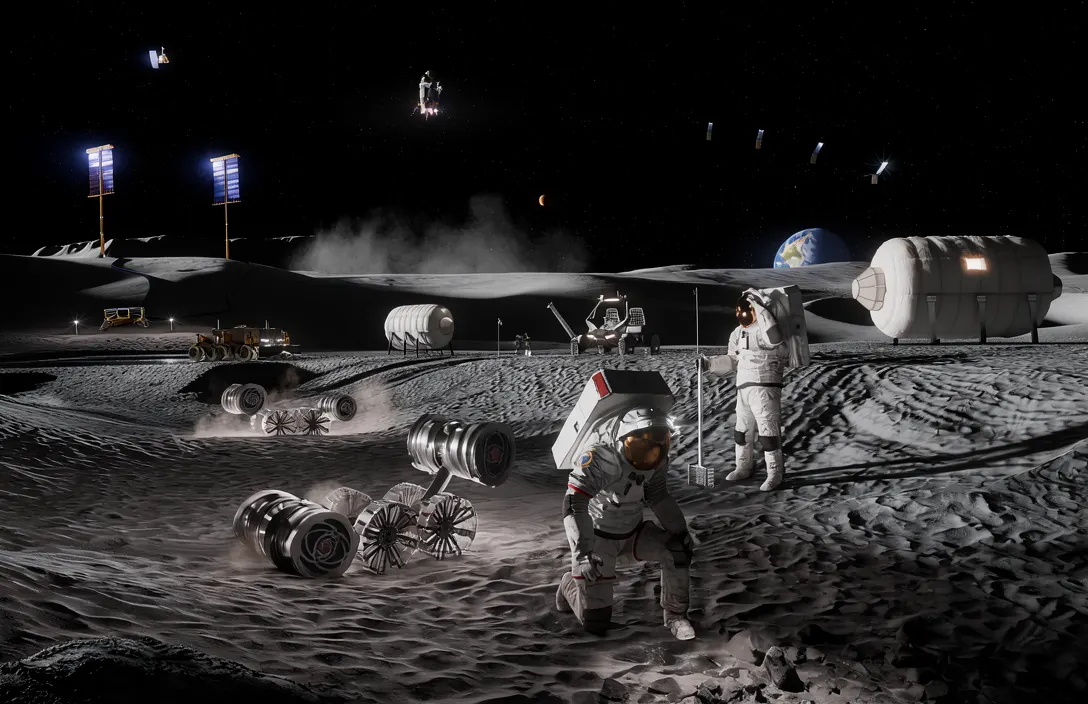
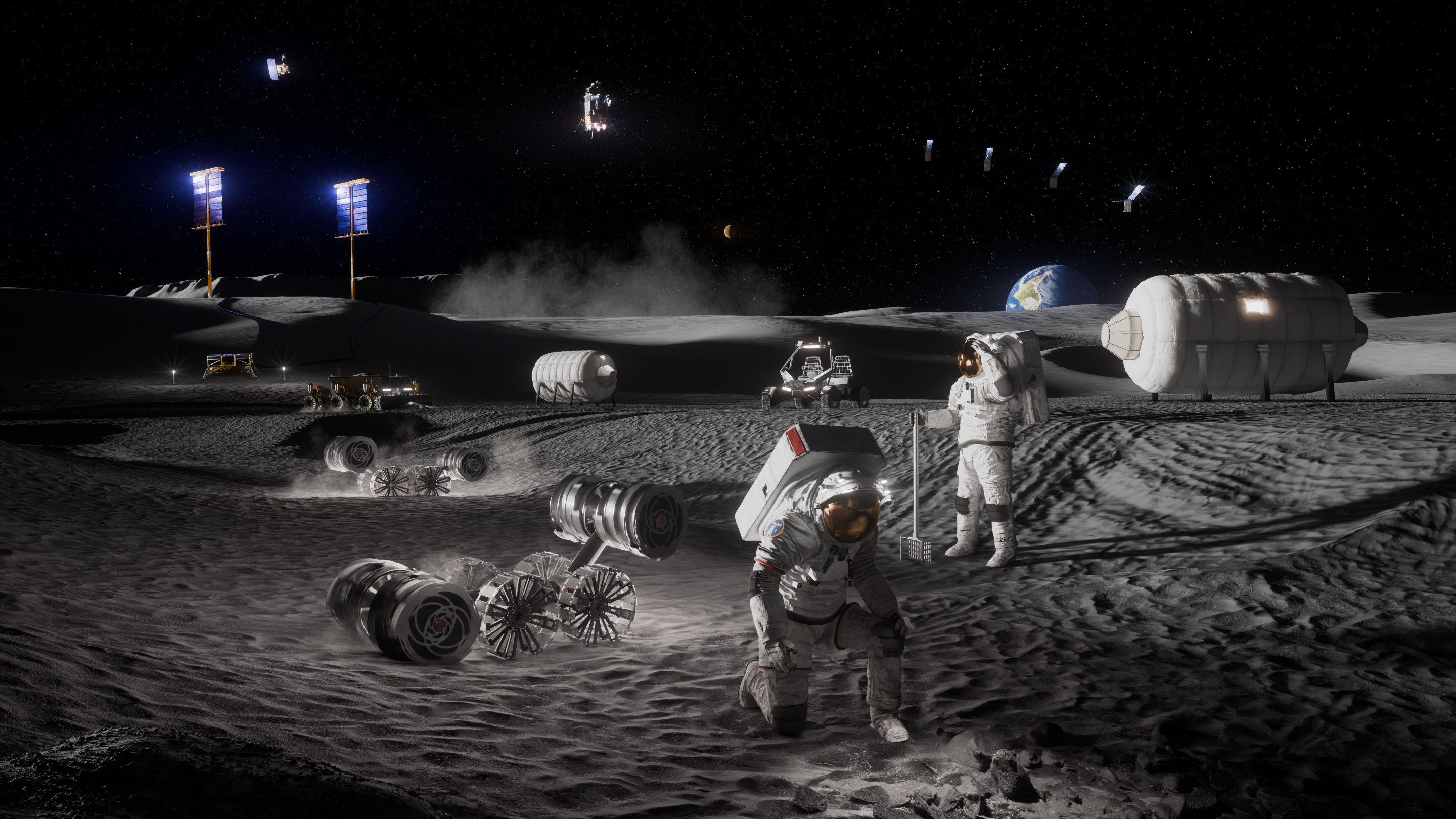
NASA is constructing a lunar base in the South Pole region of the Moon, chosen for its unique lighting conditions and potential for scientific discovery. This area includes regions with extended sunlight, ideal for generating solar power, and shadowed craters that may contain frozen water ice. These conditions are essential for long-term human presence and resource utilization on the Moon (Source ID: 1). [1]
The Moon Base will be constructed in three phases. Phase One involves robotic missions to explore the lunar South Pole, test new technologies, and practice landing procedures. These missions will use multiple landers and lunar terrain vehicles to conduct science experiments and identify optimal locations for the base (Source ID: 1). [1]
Phase Two, planned for 2029-2032, will focus on setting up long-term infrastructure, including power systems, cargo transportation, and communications hardware. These components will be deployed across multiple locations, enabling future expansion of the Moon Base (Source ID: 1). [1]
Phase Three will begin assembling a permanent lunar outpost, where astronauts will live and work for extended periods. This phase will integrate habitats, power and communication systems, and transportation. Crewed and robotic lunar rovers, such as NASA’s VIPER and PROMISE, will play a crucial role in this development (Source ID: 1). [1]
Advertisement
The Moon Base is located in the lunar South Pole region, chosen for its unique lighting conditions and potential for scientific discovery. This area features regions with extended sunlight, ideal for solar power generation and exploration, as well as permanently shadowed craters that may contain deposits of frozen water ice. Shackleton Crater, located in this region, is more than twice as deep as the Grand Canyon, presenting significant challenges for landing and navigation. The lunar South Pole’s extreme temperatures range from over 130°F (54°C) in sunlit areas to as low as -334°F (-203°C) inside shadowed craters, affecting both astronaut safety and infrastructure design. The regolith, a layer of loose, fragmented rock and mineral dust covering the lunar surface, poses additional challenges due to its sharp edges and potential to damage equipment and irritate skin if inhaled. [5]
The Moon Base project is being developed in three distinct phases. Phase One, currently underway, involves sending robotic missions to the lunar South Pole to explore the terrain, test new technologies, and identify suitable locations for the Moon Base. These missions include multiple landers and lunar terrain vehicles, as well as science experiments. Phase Two, planned for 2029-2032, will focus on establishing long-term infrastructure such as power systems, cargo transportation, and communications hardware across multiple locations. Phase Three, beginning after Phase Two, will involve assembling a permanent lunar outpost with habitats, power systems, and transportation, allowing astronauts to live and work on the Moon for extended periods. Crewed and robotic lunar rovers will play a key role in each phase, supporting exploration, resource mapping, and infrastructure development. [5]
Several specialized vehicles are being developed to support the Moon Base. NASA’s VIPER (Volatiles Investigating Polar Exploration Rover) is fully constructed and will launch in 2027 to explore permanently shadowed craters, searching for water and other resources by traveling over 15 miles and analyzing the lunar soil. The PROMISE (Polar Rover for Observation, Mapping, and In-Situ Exploration) is a nuclear-powered rover being built from hardware originally designed for Mars rover missions, with a planned launch by late 2028. Lunar terrain vehicles (LTVs) will be launched by 2028 to transport astronauts and allow them to explore the lunar surface, with the vehicles being remotely operated from Earth when not in use. NASA’s MoonFall mission will also send propulsive drones to the Moon by 2028, mapping difficult-to-reach terrain and aiding in site selection for Artemis landings. [5]
Sources
Prepared with AI assistance from the cited sources.
The Cali Reporter newsletter
The stories worth your time.
California, the country, and what comes next. Join our free newsletter for reporting that keeps you informed.
More in Science
- Volcanic Eruption Reshapes Iwo Jima’s Coastline
A recent volcanic eruption near Iwo Jima has temporarily extended the island's black sand beaches, though the longevity of the new land remains uncertain.
- Galaxies in the NGC 7771 Group Engage in Cosmic Merger
Astronomers have observed a group of galaxies in the NGC 7771 Group, which is located approximately 200 million light-years away in the constellation Pegasus. These galaxies are in the process of merging, a phenomenon…
- NASA Awards Contract for NOAA’s Near Earth Orbit Network Program
NASA has awarded a contract to Northrop Grumman Systems Corporation for the Sounder for Microwave-Based Applications (SMBA) instruments on NOAA’s Near Earth Orbit Network (NEON) satellites. The contract includes a…