Milky Way's Star Formation May Be Happening in an Unusual Location
New research suggests that the Milky Way produces stars in a region previously thought to be inhospitable, challenging long-held assumptions about the galaxy's structure and star formation processes.

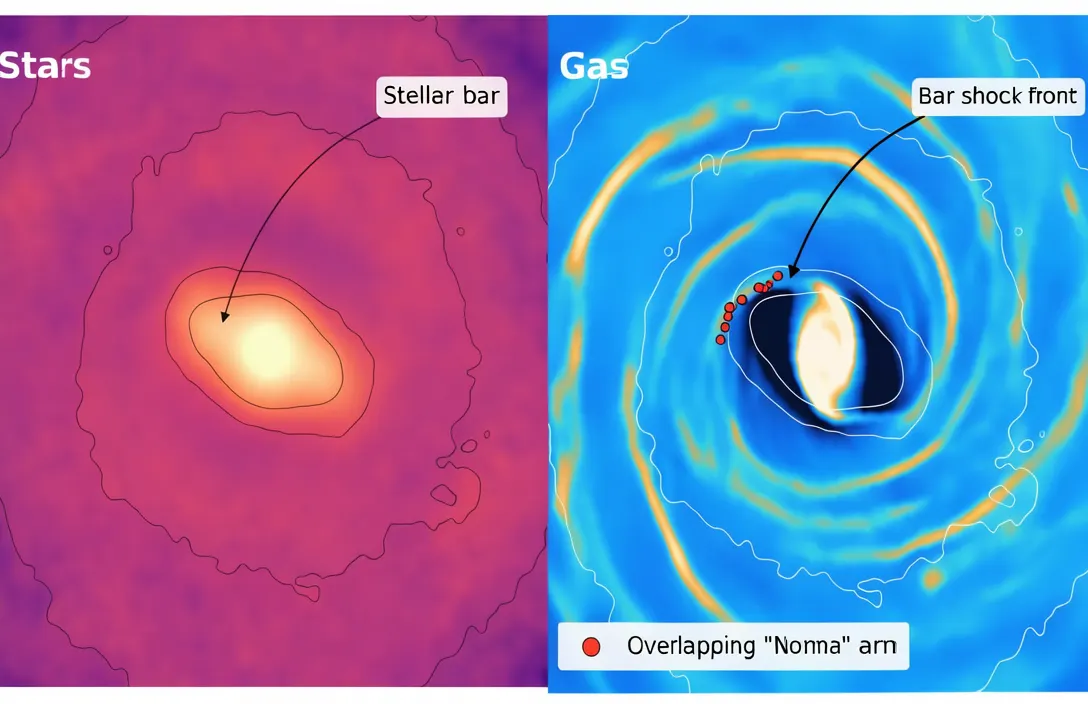
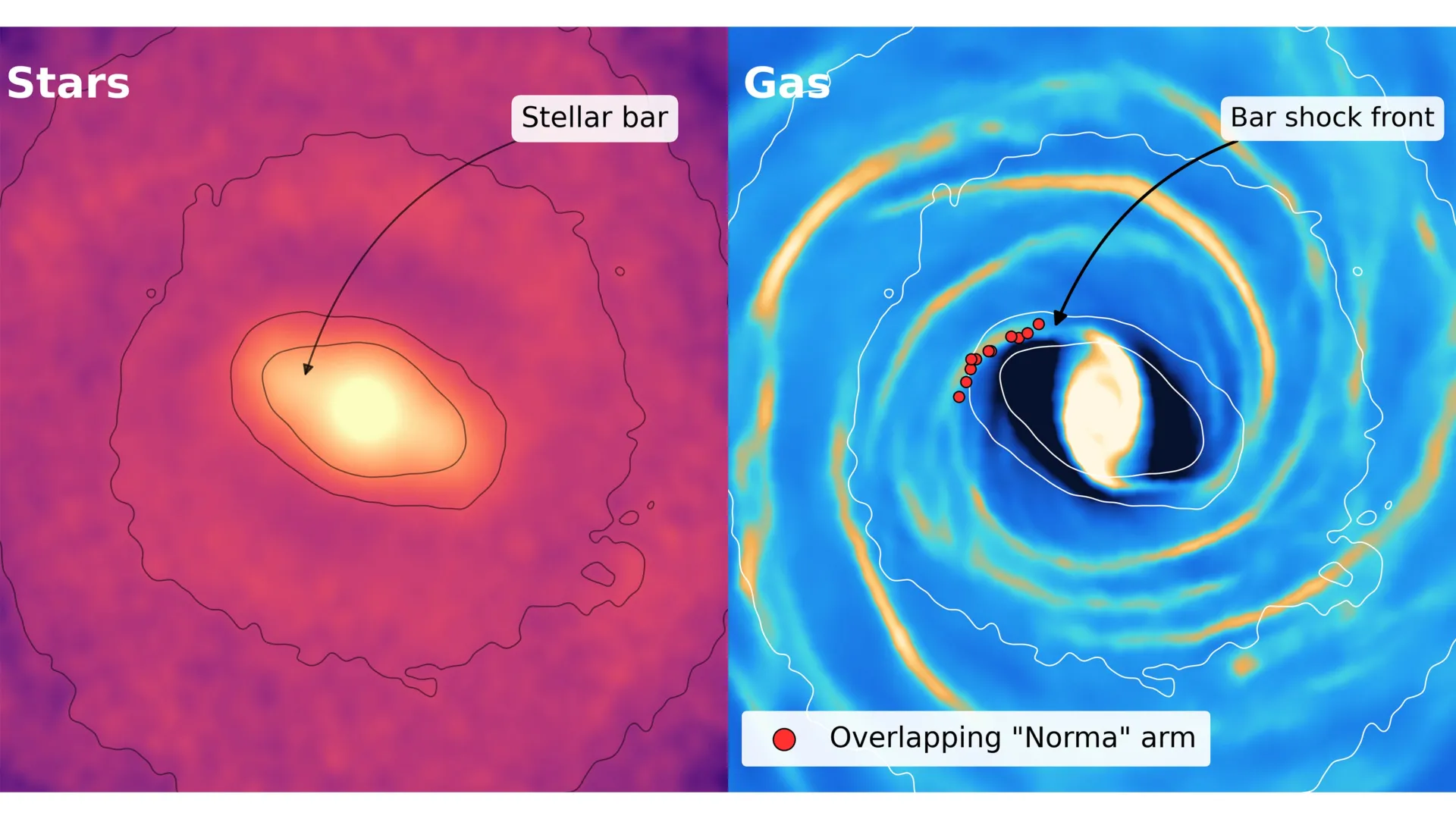
New research indicates that the Milky Way produces stars in an unexpected location, challenging previous assumptions about its structure (1). The study, led by Dr. Hillary Davis of the University of Sydney, found evidence that a massive rotating structure near the galactic center generates powerful shock waves, which compress gas and create conditions for new stars to form in regions where such intense forces usually prevent their birth (1). This discovery, published in Nature Astronomy, raises questions about the familiar feature of the Milky Way known as the Norma spiral arm (1). [1]
The research team compared detailed computer simulations of galaxy evolution with astronomical observations of star-forming regions, uncovering a striking match between the positions of masers and the locations of shock fronts predicted by their simulations (1). This suggests that at least part of the Norma arm may not be a spiral arm at all, but a region of star formation along the leading edge of the Galactic bar (1). This interpretation would change how astronomers understand the arrangement of stars and gas in that part of the Milky Way (1). [1]
The findings also provide new insights into the properties of the Galactic bar, which has long been difficult to observe due to the Milky Way's position and the presence of cosmic dust (1). The study's analysis indicates that the bar extends approximately 4.3 kiloparsecs, or about 14,000 light-years, outward from the galactic center along its long axis (1). This supports a picture of the Milky Way containing a relatively long bar that rotates slowly (1). [1]
The research identified the Galactic bar as a central structure extending approximately 4.3 kiloparsecs, or about 14,000 light-years, from the galactic center along its long axis. This measurement provides a more precise understanding of the bar's length and supports the idea that the Milky Way contains a relatively long bar that rotates slowly. The findings also suggest that the bar is oriented at a specific angle relative to the galactic plane, though the exact orientation remains subject to further investigation due to observational challenges. The study's authors emphasized that the bar's properties, including its rotation speed and alignment, have been debated for decades because of the Milky Way's position within the galaxy and the obscuring effects of interstellar dust. This new evidence narrows the range of possible configurations and contributes to a more accurate map of the Milky Way's central region. [1]
Advertisement
The study highlights the role of masers in identifying regions of star formation near the Galactic bar. Masers are naturally occurring sources that emit highly concentrated microwave radiation, and they are closely associated with the formation of massive stars. By analyzing the positions of these masers, the researchers found a strong correlation between observed maser locations and the predicted positions of shock fronts from their simulations. This alignment suggests that some of the star formation previously attributed to the Norma spiral arm may instead occur along the leading edge of the Galactic bar. This finding challenges the conventional understanding of the Milky Way's spiral structure and raises new questions about the classification of the Norma arm as a spiral arm. [1]
The research team used detailed computer simulations to model the evolution of galaxies over billions of years and compared these simulations with actual astronomical observations. This approach allowed the researchers to test hypotheses about the structure and dynamics of the Milky Way's central bar. The simulations predicted the presence of shock fronts along the leading edge of the bar, and the observed maser positions provided direct evidence supporting these predictions. This method demonstrates how advanced computational models can help scientists investigate regions of the Milky Way that are difficult to observe directly due to the galaxy's position and the obscuring effects of interstellar dust. The study's findings contribute to a growing body of evidence that the Milky Way may behave differently from other barred spiral galaxies in terms of star formation along shock fronts. [1]
New research indicates that the Milky Way produces stars in an unexpected location, challenging previous assumptions about its structure (1). The research team compared detailed computer simulations of galaxy evolution with astronomical observations of star-forming regions, uncovering a striking match between the positions of masers and the locations of shock fronts predicted by their simulations (1). This finding suggests that the Milky Way may behave differently from other barred spiral galaxies, where shock fronts typically inhibit star formation (1). [1]
The study also casts doubt on the nature of the Norma spiral arm, a feature of the Milky Way named for the constellation Norma as seen from Earth (1). Observations of masers previously associated with the Norma arm closely align with the shock front predicted by the simulations, suggesting that at least part of the so-called Norma arm may not be a spiral arm at all, but a region of star formation along the leading edge of the Galactic bar (1). [1]
Advertisement
The possibility is significant because it suggests that some of the star formation previously attributed to the Norma spiral arm could instead be occurring along the central bar (1). If confirmed, this interpretation would change how astronomers understand the arrangement of stars and gas in that part of the Milky Way (1). The findings also provide new insights into the properties of the Galactic bar, which has long been difficult to observe due to the Milky Way's position and the presence of cosmic dust (1). [1]
Sources
Prepared with AI assistance from the cited sources.
The Cali Reporter newsletter
The stories worth your time.
California, the country, and what comes next. Join our free newsletter for reporting that keeps you informed.
More in Science
- Volcanic Eruption Reshapes Iwo Jima’s Coastline
A recent volcanic eruption near Iwo Jima has temporarily extended the island's black sand beaches, though the longevity of the new land remains uncertain.
- Galaxies in the NGC 7771 Group Engage in Cosmic Merger
Astronomers have observed a group of galaxies in the NGC 7771 Group, which is located approximately 200 million light-years away in the constellation Pegasus. These galaxies are in the process of merging, a phenomenon…
- NASA Awards Contract for NOAA’s Near Earth Orbit Network Program
NASA has awarded a contract to Northrop Grumman Systems Corporation for the Sounder for Microwave-Based Applications (SMBA) instruments on NOAA’s Near Earth Orbit Network (NEON) satellites. The contract includes a…