

Los Osos CSD unanimously approves continued Cal Fire Services
Los Osos CSD sticks with Cal Fire's three-firefighter model despite chronic understaffing and safety warnings, betting on future tax hikes instead of overhauling now.
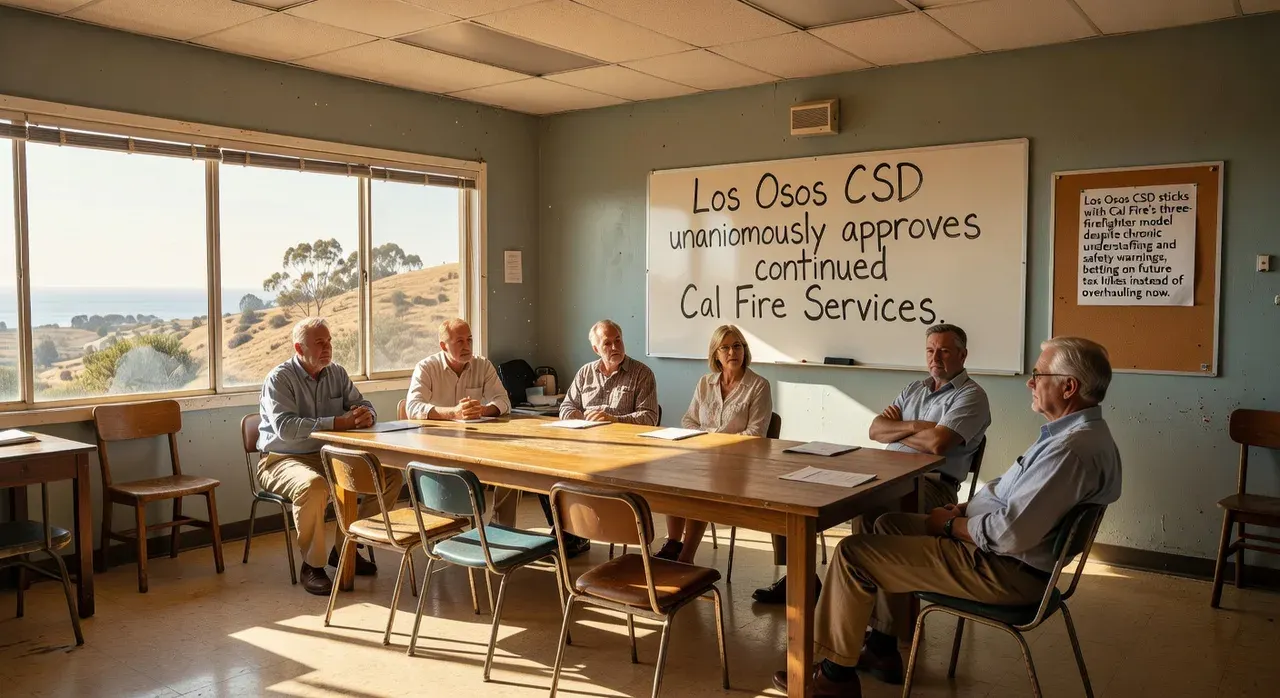
The Los Osos Community Services District board voted 5-0 on April 2 to renew its contract with Cal Fire, locking in the same understrength staffing model that has already triggered safety concerns and unreliable emergency responses.
Board President Matthew Fourcroy insisted the decision preserves Station 15 rather than eliminates it, telling residents the district is drafting strategic plans to improve service. Yet the staff report he relied on paints a different picture: the current setup of three full-time firefighters, one reserve, and two paramedics worked until the COVID-19 pandemic triggered applicant shortages, high turnover, and what General Manager Ron Munds called "reduced staffing reliability."
Since May 2025 the district has been reviewing alternatives after discovering escalating staffing costs, administrative overhead, and accounting errors that forced Los Osos to overpay the county-operated Cal Fire contract. Those overpayments, Fourcroy acknowledged, "have been recouped," but the underlying math has not changed. Revenue from the Zone B property tax and special fire tax "have not kept pace with increasing costs," according to the report, meaning a future tax increase is almost certainly required for any real upgrade.

Evaluators compared Cal Fire’s three-year proposal, priced at $3.1 million for Year 1, against a Morro Bay bid that would have delivered four full-time paramedics under a 15-year deal. Morro Bay’s personnel costs alone were estimated at $3.67 million, plus dispatch and administrative fees, along with a brutal six-month transition requiring roughly 12 new hires. The staff report flagged those startup costs and disruption as decisive drawbacks.
Munds highlighted one practical upside of staying with Cal Fire: when real trouble hits, such as the Cabrillo Basin flooding, a much larger force arrives quickly and without extra billing. "Normally we don’t have really big incidents here," he said, "but when we do, we have a much bigger force behind us." That benefit, however, does not solve the daily reality of three-person crews unable to perform all required duties when the fourth seat sits empty.
The board now buys time to finish its Emergency Services Strategic Plan while the same staffing shortages that surfaced after 2020 continue. Whether voters will accept the tax increase needed to reach the long-promised four-person standard remains the question the district has yet to answer.
Original reporting: newtimesslo.com.
More in California
- UC Berkeley Lab Proposes New Civic Framework for California’s Next Governor
A research-driven agenda calls for institutionalizing 'co-governance' to address low public trust and lack of resident influence in state decision-making.
- Five Tax Measures on California’s Ballot Aim to Reshape State Finances
Propositions 3, 40–43 would alter income, wealth and local taxation rules—marking the highest number of tax measures on a general election ballot since 1994.
- Catalina Helicopter Crash Highlights Risks of Island Medevac Flights
A medical evacuation chopper carrying Catalina Romero, pilot, and nurse Jessica Devries crashed into the ocean shortly after takeoff, killing all three; federal investigators are assessing causes including night flying, spatial disorientation, and the island’s challenging Pebbly Beach heliport.