Lonca: A Version Control System for AI Agents
Lonca is a version control system designed to manage repositories where AI agents and humans collaborate. It addresses issues related to permissions, concurrency, and accountability in AI-driven development workflows.

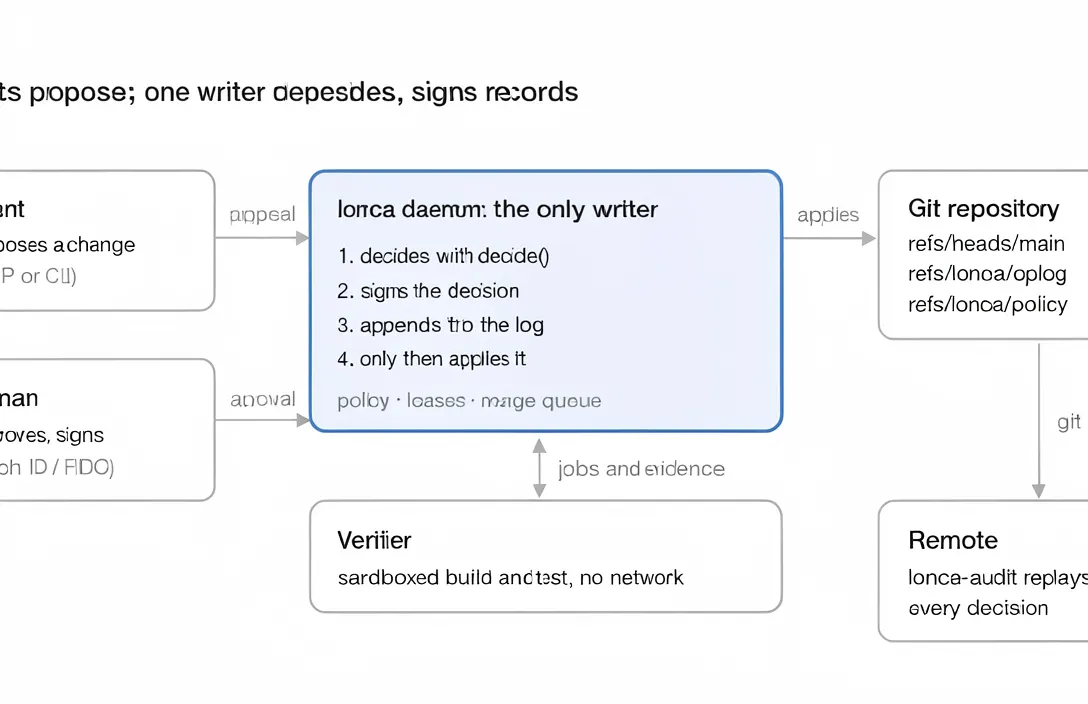

Lonca is a version control system for repositories where AI agents and humans work together. Unlike traditional systems like Git, which assume all writers are human, Lonca introduces a framework where AI agents propose changes, and a single process, the Lonca daemon, acts as the only writer. This daemon evaluates every request, signs decisions, and appends them to an operation log within the repository (refs/lonca/oplog) before applying changes. This approach ensures that AI agents do not have the same permissions as humans, preventing issues such as unauthorized force-pushing or deletion of branches (Dev.to, 2024). [1]
To manage concurrency, Lonca uses a system of 'symbol leases,' allowing multiple agents to work on different parts of the same file simultaneously. When an agent proposes a change, Lonca verifies that the actual change matches the agent's declaration using tools like tree-sitter. If there is a mismatch, the proposal is rejected. Additionally, changes are merged symbol by symbol in a structural merge queue, with builds and tests run in a sandboxed environment before merging into the trunk (Dev.to, 2024). [1]
Lonca also includes a 'taint' system to prevent prompt injection by tracking whether an agent accesses external content such as web pages or other servers. If an agent accesses external data, its changes are marked as 'tainted' and require human approval. This system ensures that AI agents do not alter critical files such as build scripts or CI configurations without oversight. Furthermore, every operation, whether approved or denied, is logged in an append-only format, which can be audited independently using the 'lonca-audit' tool (Dev.to, 2024). [1]
Lonca is a version control system specifically designed for managing AI agents and human collaboration in software development. It is developed in Rust and is open source under the Apache-2.0 license. The system is not intended to replace Git but instead works alongside it, maintaining the standard Git workflow for pushing to platforms like GitHub. The name 'Lonca' is inspired by the Ottoman bazaar's craft guilds, emphasizing structured rules, roles, and oversight in the development process. The project is currently in version 0.2.3, and it is being actively developed and tested. The system is compatible with macOS and Linux, and it can be installed using Homebrew, an install script, or via Cargo. The current implementation includes support for 13 programming languages, including Rust, Python, TypeScript, JavaScript, and others, as well as Markdown, TOML, JSON, and YAML files. [1]
Advertisement
Lonca addresses three primary issues in the current tooling for AI agents: permissions, concurrency, and accountability. Traditional systems like Git assume that all contributors are human users, which creates problems when AI agents are involved. For example, an AI agent may have the same permissions as its human user, allowing it to make changes that could be disruptive, such as force-pushing to a branch or altering CI configuration files. Concurrency issues arise when multiple AI agents work on the same file without proper coordination, leading to merge conflicts and failed builds. Lonca ensures accountability by tracking all operations in an operation log, which is stored as a Git reference (refs/lonca/oplog). This log is append-only and can be audited independently, ensuring that all changes are transparent and verifiable. [1]
The system operates by having a central daemon process that acts as the sole writer to the repository. AI agents do not write directly to the repository; instead, they propose changes, and the daemon evaluates and applies them based on predefined rules. This approach introduces a structured merge queue that processes changes symbol by symbol, ensuring that each change is validated before being applied. Additionally, Lonca implements a concept known as 'symbol leases,' which allows multiple agents to work on different parts of the same file simultaneously without interfering with each other. This is achieved by using tools like tree-sitter to analyze the actual changes made by agents and ensuring that proposals match the expected changes. The system also includes a 'taint' mechanism that prevents agents from accessing external content without human approval, reducing the risk of prompt injection and other security issues. [1]
Currently, Lonca is in its early stages of development and has several limitations. For instance, it is primarily designed for a single developer working with multiple AI agents on a local machine rather than for team collaboration. A team server has been designed but is not yet implemented. The system is also limited in terms of supported AI harnesses, with full support only for Claude Code at the moment. Other harnesses like Codex and Gemini CLI have profiles and can be used in an isolated manner, but their hooks are not yet fully integrated. Additionally, the system has not been tested with FIDO security keys for signing operations, and the AI advisor has only been tested against a fake API. The project's website lists these limitations in more detail under the 'Limitations' section. Despite these limitations, Lonca provides a robust framework for managing AI agents in development workflows and is actively being developed and improved by its creator. [1]
Lonca is a version control system for repositories where AI agents and humans collaborate. It is designed to address the challenges of managing multiple agents working on the same codebase. According to the Dev.to article, Lonca is written in Rust and is open source under the Apache-2.0 license. It does not replace Git but enhances it by changing how permissions, concurrency, and accountability are managed around Git operations (source ID 1). [1]
Advertisement
The system uses a 'symbol lease' mechanism to allow multiple agents to work on different parts of the same file simultaneously. This helps manage concurrency by ensuring that agents lease specific symbols, such as functions or types, and only modify those areas. The Dev.to article explains that when an agent proposes a change, Lonca computes the actual change using tree-sitter and only applies the proposal if it matches the declared change (source ID 1). [1]
Lonca also includes a 'taint' system to prevent prompt injection by tracking whether an agent accesses external content such as web pages or other servers. If an agent reads external content, the session is marked as 'tainted,' and its changes require human approval. The Dev.to article notes that tainted sessions cannot modify build scripts, CI configurations, or lock files at all (source ID 1). [1]
Sources
Prepared with AI assistance from the cited sources.
The Cali Reporter newsletter
The stories worth your time.
California, the country, and what comes next. Join our free newsletter for reporting that keeps you informed.
More in Technology
- Modern Web Guidance 1.0 and Browser Compatibility
Modern Web Guidance 1.0, announced by Chrome for Developers on November 10, introduces browser compatibility data to assist coding agents in building web features. The initiative emphasizes the importance of fallback…
- Apache mod_http2 Vulnerability Detection with Nmap
A new Nmap scripting module has been developed to detect the Apache mod_http2 vulnerability (CVE-2026-119618), addressing the challenges of identifying affected systems accurately.
- Securing Remote Vendor Access in Industrial Networks
Best practices for managing remote vendor access in operational technology (OT) networks emphasize controlled access points, multifactor authentication, and time-bound sessions to reduce cybersecurity risks.