

Lead Exposure 2 Million Years Ago Explains Why Neanderthals Died and We Survived
Scientists found a toxic legacy hiding in our DNA that explains the difference between us and our extinct cousins

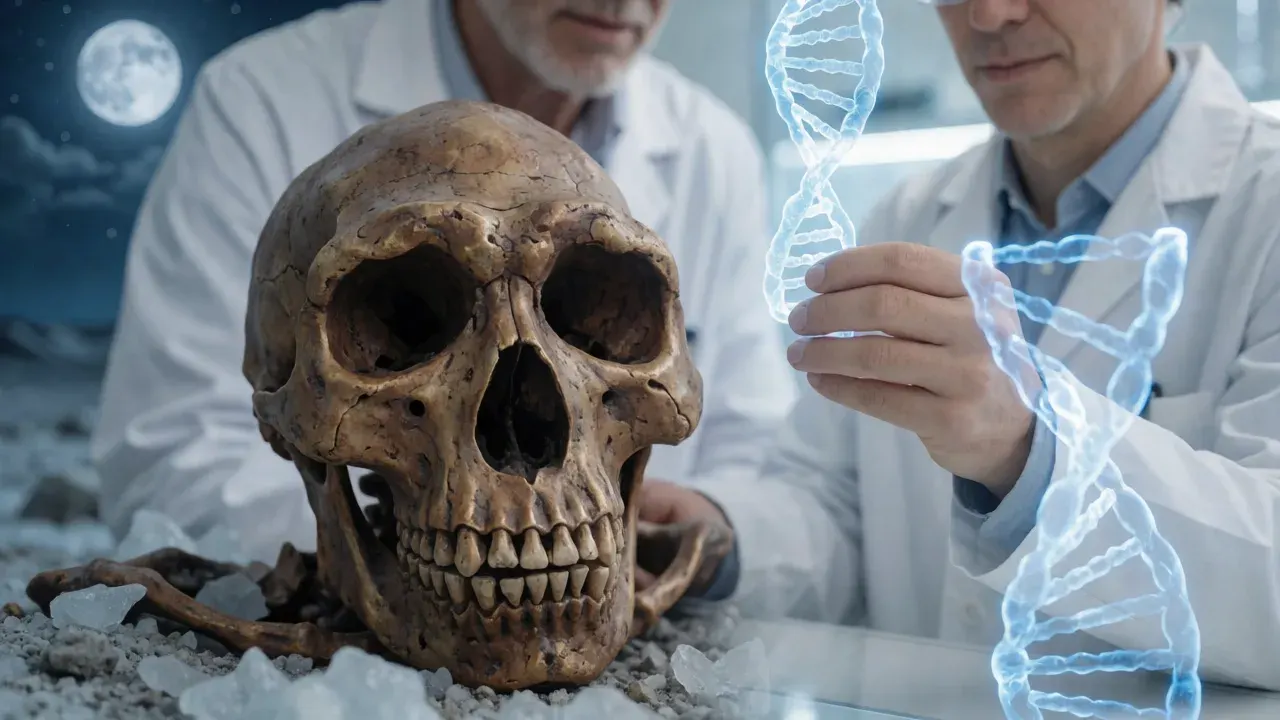
Do you ever feel like you are carrying the weight of history in your very cells? It is a strange feeling to consider that the way you think the way you speak the very capacity you have to love and fight might be the result of a toxic accident from two million years ago. Scientists from the University of California San Diego School of Medicine have been looking into this very thing. They have been examining the deep past to understand why we are here and why they are not. This is not just a story about biology. It is a story about how we survived a poisoned world. You can read more about this fascinating journey into our past at our relationship section here.
The team, which includes researchers from across the globe, has made a discovery that is both horrifying and beautiful. They found that the ancient hominids who walked our Earth before us were swimming in lead. They looked at fifty-one fossilized teeth from across Africa, Asia, and Europe. These were not just any teeth. They belonged to modern humans, early human ancestors, extinct great apes, and even the Neanderthals. The results were startling. Lead traces were present in seventy-three percent of the fossils studied. In fact, seventy-one percent of the modern and archaic human samples showed signs of this heavy metal contamination. This was a pervasive problem that started very early.
When we think of lead, we tend to imagine the Roman Empire or the Industrial Revolution. We think of lead pipes and smog. But this study suggests the story began much earlier. Researchers believe ancient humans and their relatives encountered this heavy metal while searching for water. Just like the Romans would later do, early humans likely looked for caves with running water inside. It turns out that caves contain lead, and they were all contaminated. The evidence suggests this exposure started very early in infancy.

Lead exposure is not kind. It disrupts brain growth and function. It impairs intelligence and emotional regulation. Faced with this evidence, the researchers began to question the resilience of our ancestors. How did we make it? How did we evolve from these vulnerable creatures navigating a toxic landscape into the sophisticated beings we are today? The answer, they found, lies in a tiny genetic change. It is a story of survival. You can learn more about the science behind this evolution by following the link below.
The hero of this evolutionary drama is a gene known as neuro-oncological ventral antigen 1, or NOVA1. This gene plays a major role in brain formation and synaptic development. It acts as a key regulator of neurodevelopment. It helps determine how neural progenitor cells react to lead exposure. Nearly all modern humans carry a version of the NOVA1 gene that differs by a single DNA base pair from the version found in Neanderthals. This single change may have been the shield that protected us from the lead that surrounded us. Earlier work from the Stanford Integrated Space Stem Cell Orbital Research Center showed that swapping the modern NOVA1 with the older variant in miniature brain models caused dramatic changes in brain structure and connectivity. It is a very specific kind of irony that the ancient version of this gene actually accelerated brain maturation but resulted in less complexity over time.
This finding is profound because it suggests that if all humans have this newer mutation in all corners of the world, very strong genetic pressure must have selected for it in our species. To test whether lead exposure might have shaped this genetic shift, the researchers created brain organoids with both the modern and ancestral NOVA1 variants. They exposed them to lead and monitored the growth of cortical and thalamic neurons. It was a controlled experiment with high stakes. They found that lead changed NOVA1 activity in both types of organoids, influencing genes linked to conditions such as autism and epilepsy. However, only the archaic NOVA1 variant altered the activity of FOXP2, a gene crucial for speech and language. People with certain FOXP2 mutations struggle to form complex words and sentences.
This leads us to the most heartbreaking part of the story. The scientists suggest that these type of neurons related to complex language are susceptible to death in the archaic version of NOVA1. The FOXP2 gene is identical between us and the Neanderthals, but it is how the gene is regulated by NOVA1 that likely contributes to language differences. This implies that the lead exposure our relatives faced might have hindered their ability to connect. It might have severed the threads of social cohesion that hold a society together. The study suggests that the acquisition of the modern NOVA1 variant may have protected us from the detrimental effects of lead, promoting complex language development.
This could have given modern humans a significant evolutionary advantage over Neanderthals, even in the presence of lead contamination. This perspective helps us understand how environmental stressors shaped brain development during human evolution. It also sheds light on neurological conditions related to language. We are talking about speech apraxia, a condition that makes it difficult to produce speech sounds correctly, and autism. It is a reminder that our biology is complex and that what we consider normal might be a specific adaptation to a chaotic world. The study was funded, in part, by the National Institutes of Health and the Australian Research Council, among others. It was published in Science Advances on October 15, 2025.
So, consider this when you are arguing with a partner or trying to explain yourself. Language is such an important advantage, it is transformational, it is our superpower. Because we have language, we are able to organize society and exchange ideas, allowing us to coordinate large movements. There is no evidence that Neanderthals could do that. They might have had abstract thinking, but they could not translate that to each other. And maybe the reason is because they never had a system to communicate that was as efficient as our complex language. It is a beautiful and terrible thing to think about. Muotri believes these results have important implications for our understanding of the past. He speculates that lead exposure may have contributed to the extinction of Neanderthals around 40,000 years ago. It is a tragic end for a species that was our cousin in every way that matters.
First reported by ScienceDaily: Relationships.
More in Love & Relationships
- Clear requests and respectful boundaries belong in everyday relationships
NIH guidance highlights honest conversation, listening and limits as parts of supportive connections.
- How Eye-Tracking Revealed Hidden Social Skills in Severely Disabled Youth
A new study finds that personalized training can unlock social abilities in people often considered untestable.
- Sleep matters: Duration, timing, quality and more may affect cardiovascular disease risk
Healthy sleep includes multiple components, such as number of hours of sleep per night, how long it takes to fall asleep, daytime functionin