

In L.A., playing ball in the streets is illegal. A city council member wants to change that
A dusty 1936 ban still makes playing catch in Los Angeles streets a crime. One council member finally wants to repeal it.
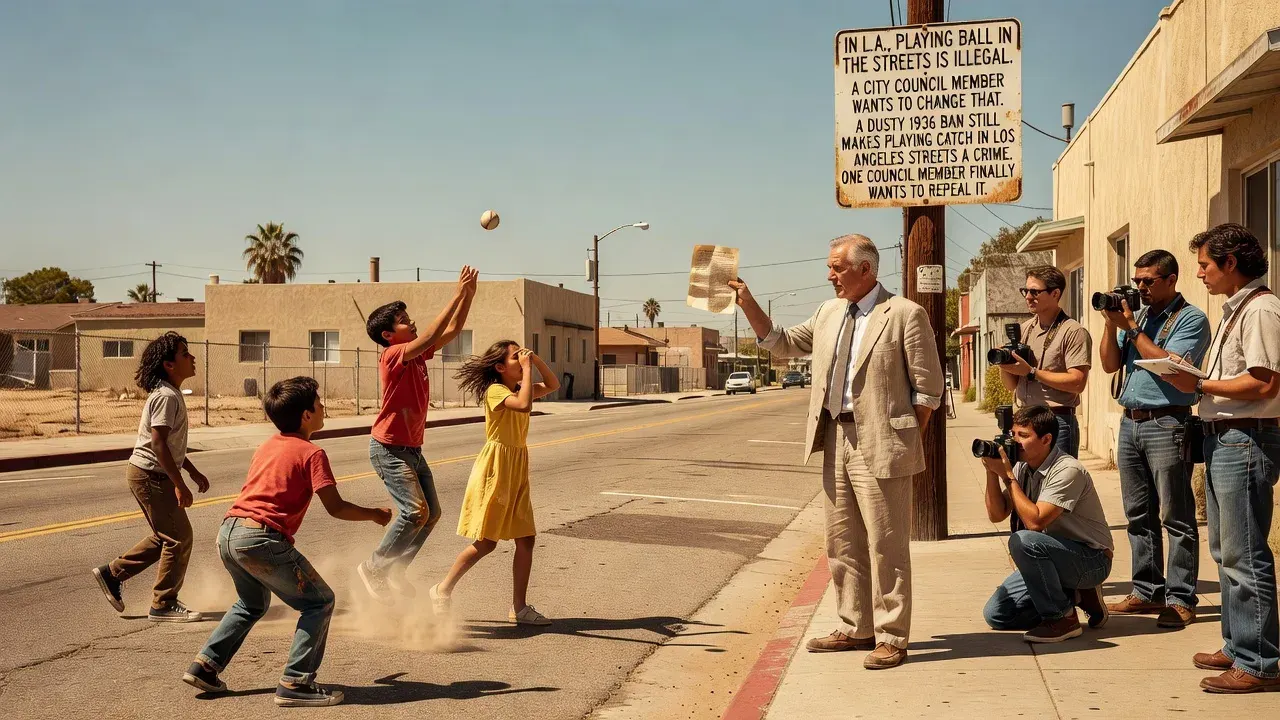
Los Angeles still enforces a 1936 ordinance that turns kids kicking a soccer ball or shooting hoops on a residential street into lawbreakers. The rule, written when the city looked nothing like today’s gridlocked neighborhoods, bans baseball, basketball, soccer or “any other ball game” on streets and sidewalks alike.
The prohibition has survived untouched for nearly nine decades while the city’s population exploded, housing grew denser, and open play space remained scarce. What was once a tidy Progressive-era safety measure now reads like an artifact that criminalizes normal childhood in half the blocks of Los Angeles.
City Councilmember Eunisses Hernandez is pushing to repeal the anachronism. Her move acknowledges a simple reality the original lawmakers never faced: thousands of Angeleno children have no backyard and few nearby parks, so the pavement in front of their homes becomes the only available field.

Enforcing the law has always been selective, but its continued existence gives police discretionary power that feels arbitrary in 2026. A parent watching her son play catch can technically be ticketed; the ordinance makes no distinction between a quiet cul-de-sac at dusk and a busy arterial at noon.
Repealing it won’t magically conjure new parks, but it stops treating ordinary play as outlaw behavior. Hernandez’s proposal forces the city to admit that streets have always been social spaces, not just traffic corridors, and that a Depression-era rule no longer fits a metropolis where pavement is often the only recreation option.
The real test will be whether the rest of the council follows through or prefers to keep an unenforced but symbolically controlling law on the books. In a city that lectures endlessly about equity and access, clinging to a statute that polices play reveals more about bureaucratic inertia than public safety.
Original reporting: LA Times.
Original reporting: LA Times, California.
More in California
- UC Berkeley Lab Proposes New Civic Framework for California’s Next Governor
A research-driven agenda calls for institutionalizing 'co-governance' to address low public trust and lack of resident influence in state decision-making.
- Five Tax Measures on California’s Ballot Aim to Reshape State Finances
Propositions 3, 40–43 would alter income, wealth and local taxation rules—marking the highest number of tax measures on a general election ballot since 1994.
- Catalina Helicopter Crash Highlights Risks of Island Medevac Flights
A medical evacuation chopper carrying Catalina Romero, pilot, and nurse Jessica Devries crashed into the ocean shortly after takeoff, killing all three; federal investigators are assessing causes including night flying, spatial disorientation, and the island’s challenging Pebbly Beach heliport.