Implementation of Pending Approval for Media Assets
This section discusses the technical implementation of a pending approval system for media assets in a marketplace environment, focusing on database transactions and authorization checks.


An image upload process can be structured to hold content pending approval before it is published or used to generate derivative media. According to the provided evidence, an upload should be recorded in a pending state, allowing for immediate screening while delaying the rendering of promotional content until it is explicitly requested. This approach avoids the generation of unnecessary derivatives and ensures that content is reviewed before being made available. The Dev.to article outlines that storing each upload as pending allows for a review process to occur before any content is made public. This method keeps the original and any generated derivatives private or accessible only via signed URLs, which are issued after authorization is granted. [1]
The implementation of an approval gate involves binding approval decisions to immutable input pairs, such as an image revision and a prompt. The evidence from the Dev.to article explains that an application should create a record for each image-and-prompt revision, and any changes to either input should generate a new pending record. This ensures that reviewers can approve one version of an image while a different version is being processed, and it prevents mismatches in the audit log. The example provided in the article uses a Python 3.11 and SQLite implementation to demonstrate how an approval decision can be recorded in the same transaction as the notification intent, ensuring that the decision and the notification are committed together. [1]
Admitting rendering only for approved image-and-prompt revisions is a crucial step in the approval gate process. The Dev.to article explains that a function called request_render should only insert render intent for an asset that has been approved. This function uses a uniqueness constraint to ensure that repeated local requests converge on a single render intent. The example provided demonstrates that a render request is only allowed if the corresponding asset has been approved. This ensures that the render process does not begin until the asset has been reviewed and approved, preventing the publication of content that has not been vetted. This approach ensures that the original content is screened at upload and that video generation is deferred until an approved revision is actually requested. [1]
The source describes a system where image uploads are stored in a 'pending' state until they are approved for publication or on-demand rendering. This approach is implemented using a database with specific tables: 'assets' to track image revisions and prompts, 'notices' to log review outcomes, and 'renders' to manage render requests. The 'assets' table includes a 'state' column with values 'pending', 'approved', or 'rejected', which indicates the current status of each uploaded image. The 'notices' table records the outcome of the review process, while the 'renders' table tracks render requests, ensuring that rendering only occurs for approved images. The system uses a Python 3.11 and SQLite example to demonstrate how to manage these states and transitions, ensuring that only approved images are eligible for rendering. This implementation emphasizes the separation between media handling and publication decisions, ensuring that automated screening and manual review are distinct processes. The 'decide' function in the example updates the asset state and logs the outcome in the 'notices' table within the same database transaction, ensuring atomicity and consistency. This approach helps prevent the premature publication of content that has not been reviewed, maintaining control over what is ultimately made available to users. [1]
Advertisement
The system enforces a strict separation between the approval of an image and the rendering of a promotional video. According to the source, rendering a video is only admitted if the associated image has been approved and the corresponding prompt has been processed. This ensures that the video generation is not automatically triggered by the upload of the image alone, but rather by a deliberate decision to approve the image and the prompt for a specific use case. The 'request_render' function in the example checks the 'assets' table to ensure that the image is in an 'approved' state before allowing a render request to be inserted into the 'renders' table. This design ensures that the rendering process is only initiated when the content has been explicitly approved, and that the rendered output is subject to additional review if necessary. The 'renders' table also includes a 'state' column with values 'pending', 'approved', or 'rejected', mirroring the 'assets' table to maintain consistency and control over the rendering process. This approach ensures that the rendering of content is not conflated with the approval of the original image, maintaining a clear distinction between different stages of the workflow. [1]
The source highlights the importance of keeping the original image files and any generated derivatives private or accessible only through signed URLs. This is crucial for maintaining control over access to content before it has been approved for publication. The system described ensures that presigned URLs are only issued after authorization has been granted, preventing unauthorized access to pending or unapproved content. This is implemented by checking the approval status in the 'assets' table before issuing a signed URL, ensuring that the content is only made available once it has been explicitly approved. The 'notices' table is used to track the outcomes of the review process, and the 'renders' table is used to manage render requests. This ensures that the system does not expose content that has not been reviewed or approved, maintaining the integrity of the content and preventing the premature release of potentially inappropriate or unreviewed material. The example also emphasizes that the 'pending' column in the 'assets' table is not an object-store access policy, but rather a representation of the review state, reinforcing the distinction between media handling and publication decisions. [1]
The source discusses the integration of various storage and media handling services such as Amazon S3, Cloudinary, ImageKit, and Uploadcare, each of which addresses different parts of the storage and media handling workflow. However, it emphasizes that none of these services automatically equate upload completion with approval. Instead, the application code is responsible for making decisions about rendering and notifications, ensuring that the approval process is not conflated with the upload process itself. The example provided in the source uses Python 3.11 and SQLite to demonstrate the implementation of an approval gate, a system that ensures that rendering is only admitted for approved images. This example includes tables for tracking assets, notices, and renders, with the 'assets' table containing information about the image revisions and prompts, and the 'notices' table recording the outcome of the review process. The 'renders' table is used to manage render requests, ensuring that rendering only occurs for approved images. This approach ensures that the system maintains control over the content and prevents the premature publication of unreviewed material. [1]
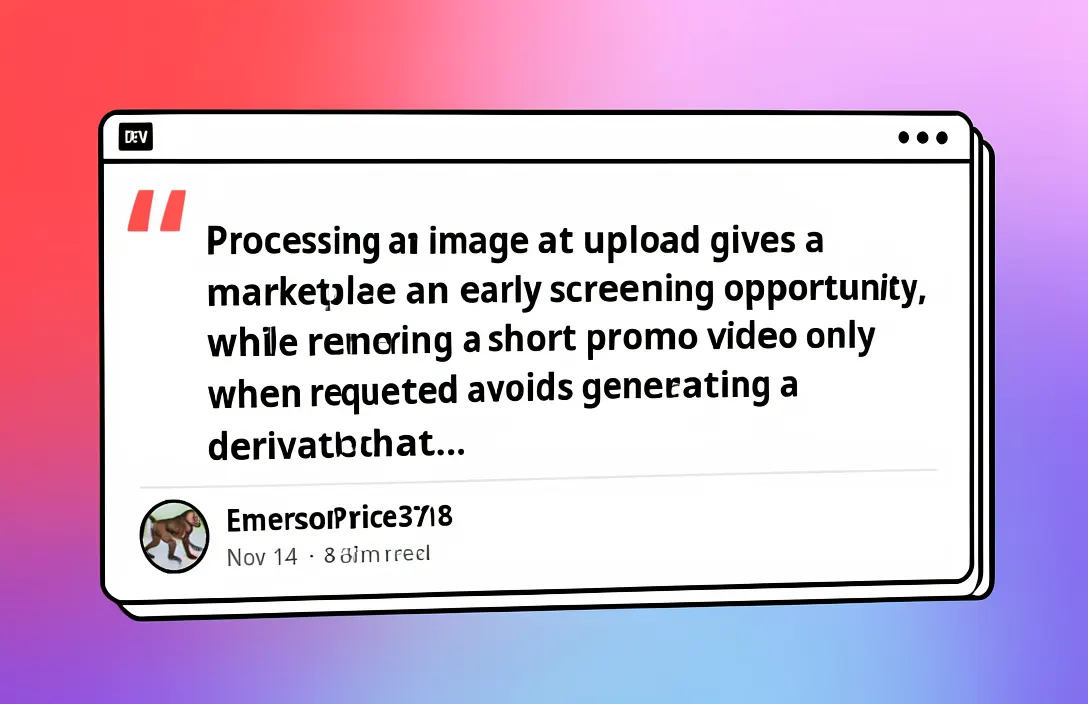
Processing an image at upload gives a marketplace an early screening opportunity, while rendering a short promo video only when requested avoids generating a derivative that nobody needs. According to the Dev.to article, storing each upload as pending and requiring approval before publication or on-demand rendering is a crucial step in the approval gate process. This ensures that content is not made publicly accessible until it has been reviewed and approved by the appropriate parties. [1]
Advertisement
The implementation of an approval gate involves binding approval decisions to immutable input pairs, such as an image revision and a prompt. As detailed in the Dev.to article, admitting rendering only for approved image-and-prompt revisions is a critical step in the approval gate process. This approach ensures that changes to either the image or the prompt create a fresh pending record, preventing mismatches between approved content and the actual media being rendered. [1]
The Dev.to article emphasizes that the approval gate process must be implemented with a database transaction that changes eligibility. This ensures that the approval decision is committed together with the notification intent, preventing any discrepancies between the asset state and the outcome of the review. This step is essential to ensure that only approved content is rendered and that the system maintains a clear audit trail of all approval decisions. [1]
Sources
Prepared with AI assistance from the cited sources.
The Cali Reporter newsletter
The stories worth your time.
California, the country, and what comes next. Join our free newsletter for reporting that keeps you informed.
More in Technology
- Modern Web Guidance 1.0 and Browser Compatibility
Modern Web Guidance 1.0, announced by Chrome for Developers on November 10, introduces browser compatibility data to assist coding agents in building web features. The initiative emphasizes the importance of fallback…
- Apache mod_http2 Vulnerability Detection with Nmap
A new Nmap scripting module has been developed to detect the Apache mod_http2 vulnerability (CVE-2026-119618), addressing the challenges of identifying affected systems accurately.
- Securing Remote Vendor Access in Industrial Networks
Best practices for managing remote vendor access in operational technology (OT) networks emphasize controlled access points, multifactor authentication, and time-bound sessions to reduce cybersecurity risks.