Immune Effector Cell-Associated Enterocolitis (IEC-EC) Following Cilta-Cel Therapy
A study published in Nature Medicine highlights the rare but serious delayed toxicity known as immune effector cell-associated enterocolitis (IEC-EC), which can occur after B cell maturation antigen (BCMA)-directed…

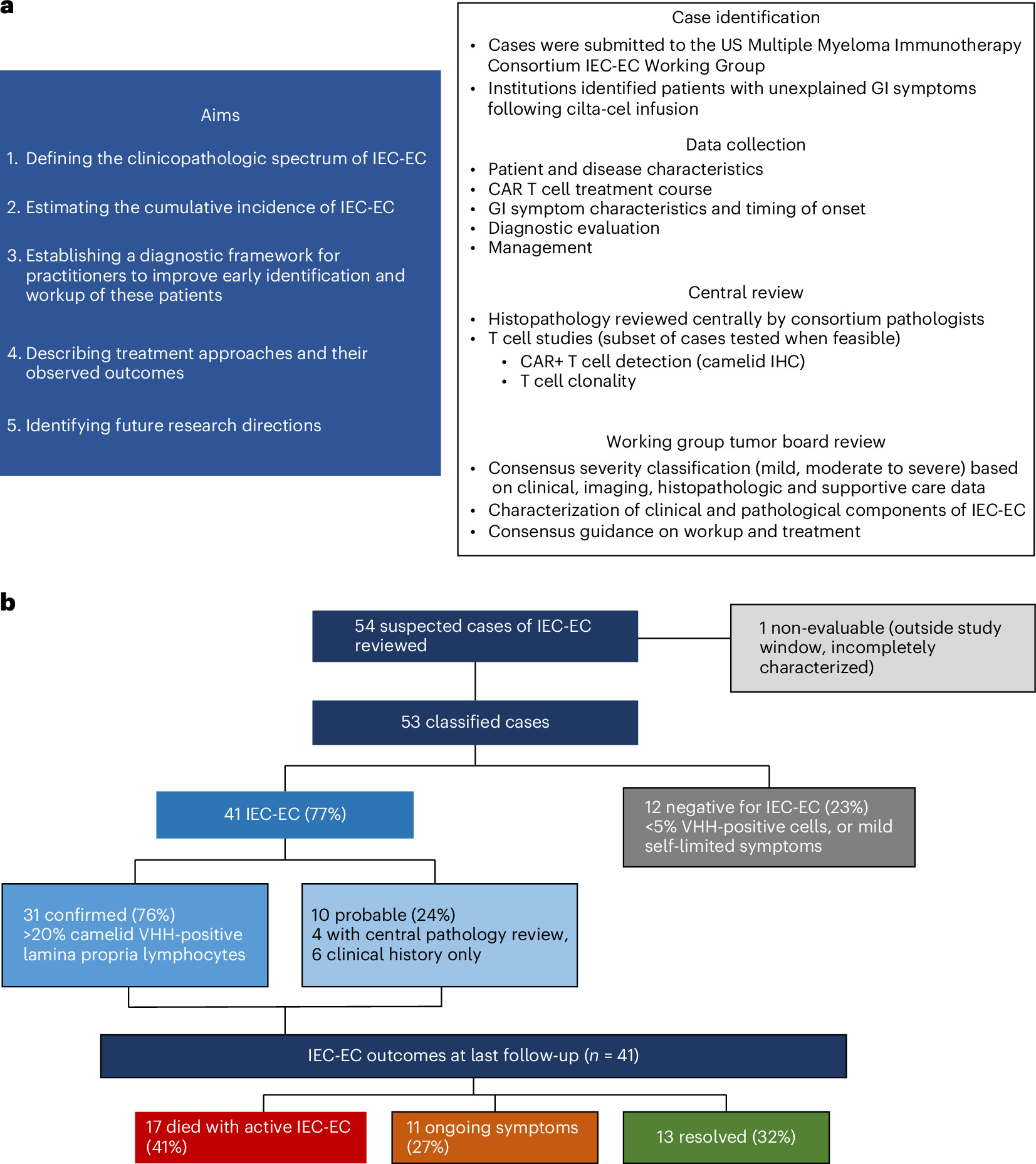
Immune effector cell-associated enterocolitis (IEC-EC) has been identified as a rare but serious delayed toxicity following B cell maturation antigen (BCMA)-directed chimeric antigen receptor (CAR) T cell therapy for multiple myeloma, particularly with cilta-cel. According to a study published in Nature Medicine, the overall incidence of IEC-EC following BCMA-targeting CAR T cell therapy was 1.2%, and 2.2% following cilta-cel therapy. These reports, however, relied on locally reviewed pathology and lacked standardized diagnostic criteria, potentially leading to under- or over-identification of the condition. In response, the US Multiple Myeloma Immunotherapy Consortium convened the IEC-EC Working Group to address these gaps and improve early identification and workup of affected patients (source ID 1). [1]
The study evaluated 54 suspected cases of post-cilta-cel gastrointestinal (GI) toxicity across eight academic institutions in the United States. Of these, 41 (77%) were adjudicated as IEC-EC, with 31 confirmed by anti-camelid variable heavy-chain (VHH) immunohistochemistry (IHC) and 10 classified as probable. The remaining 12 cases were negative. Notably, 17 (41%) of the IEC-EC cases resulted in death, with 10 attributed to infectious complications and five directly to IEC-EC or its complications. The median time from cilta-cel infusion to GI symptom onset in the IEC-EC cohort was 75 days (source ID 1). [1]
The study also found that delayed neurological toxicity (DNT) co-occurred in 17 of 41 IEC-EC patients (41%), a higher rate than the approximately 10% reported among all cilta-cel recipients in real-world data. Neurological symptoms often preceded GI symptoms in many cases, with a median interval of 48 days. Patients with DNT had a higher median peak post-infusion absolute lymphocyte count (ALC) compared to those without DNT. However, DNT was not significantly associated with overall or progression-free survival in exploratory analysis (source ID 1). [1]
Histopathologic evaluation of duodenal biopsies in confirmed and probable IEC-EC cases showed features such as villous blunting, increased apoptotic bodies, and dense infiltration of lymphocytes in the lamina propria. Immunohistochemical (IHC) assays confirmed the presence of cilta-cel CAR+ T cells in the infiltrate, with a majority being CD3+ and TCRβ+ T cells. Clonality assessments using T cell receptor β-chain constant region 1 (TRBC1) IHC and molecular testing revealed restricted expression in many cases, indicating clonal expansion of T cells. These findings contribute to a better understanding of the pathophysiology and diagnostic framework for IEC-EC (source ID 1). [1]
Advertisement
A study published in Nature Medicine evaluated 54 suspected cases of post-cilta-cel gastrointestinal (GI) toxicity across eight academic institutions in the United States, identifying immune effector cell-associated enterocolitis (IEC-EC) as a rare but serious delayed toxicity following B cell maturation antigen (BCMA)-directed chimeric antigen receptor (CAR) T cell therapy for multiple myeloma, particularly with cilta-cel (source ID: 1). The study found that IEC-EC occurred in 77% of the 53 evaluable cases, with 41 confirmed cases and 10 probable cases. Of these, 17 patients (41%) died with active IEC-EC, 11 had ongoing symptoms, and 13 achieved resolution at last follow-up (source ID: 1). [1]
Among the 41 IEC-EC cases, 10 deaths were due to infectious complications during active disease, 5 were directly attributable to IEC-EC or its complications, and 2 were from other causes, such as an embolic cerebrovascular accident and Parkinsonism (source ID: 1). Delayed neurological toxicity (DNT) co-occurred in 17 of 41 IEC-EC patients (41%), a higher rate than the approximately 10% reported among all cilta-cel recipients in real-world data (source ID: 1). DNT presentations included parkinsonism, cranial nerve palsies, and tremors, with some cases showing prolonged overlap between neurologic and GI symptoms (source ID: 1). [1]
Histopathologic evaluation of IEC-EC cases showed features consistent with previously published reports, including villous blunting, increased apoptotic bodies, and a dense infiltrate of small to slightly enlarged lymphocytes in the lamina propria (source ID: 1). Immunohistochemistry (IHC) assays confirmed the presence of cilta-cel CAR+ T cells in the abnormal infiltrate, which were primarily CD3+ and TCRβ+ T cells with a predominance of CD4+ immunophenotype (source ID: 1). Clonality testing via molecular methods or TRBC1 IHC revealed restricted expression of T cell receptor β-chain constant region 1 (TRBC1) in the majority of confirmed IEC-EC cases, indicating a clonal T cell population (source ID: 1). [1]
A study published in Nature Medicine evaluated 54 suspected cases of post-cilta-cel gastrointestinal (GI) toxicity across eight academic institutions in the United States, identifying immune effector cell-associated enterocolitis (IEC-EC) as a rare but serious delayed toxicity following B cell maturation antigen (BCMA)-directed chimeric antigen receptor (CAR) T cell therapy for multiple myeloma, particularly with cilta-cel (source ID: 1). The study found that IEC-EC is characterized by severe presentations with substantial morbidity and mortality, with an overall incidence of 1.2% following BCMA-targeting CAR T cell therapy and 2.2% following cilta-cel therapy. These findings underscore the importance of this toxicity, which led to the United States Food and Drug Administration revising the cilta-cel prescribing information in 2025 with a boxed warning citing severe diarrhea, weight loss, and fatal outcomes. [1]
Advertisement
Among the 41 IEC-EC cases, 17 (41%) died with active IEC-EC, 11 (27%) had ongoing symptoms, and 13 (32%) achieved resolution at last follow-up. Of the 17 deaths, 10 were due to infectious complications during active disease, 5 were directly attributable to IEC-EC or its complications, and 2 were from other causes, such as an embolic cerebrovascular accident and Parkinsonism (source ID: 1). These outcomes highlight the severity of IEC-EC and the need for early identification and intervention. [1]
The study also found that delayed neurological toxicity (DNT) co-occurred in 17 of 41 IEC-EC patients (41%), a higher rate than the approximately 10% reported among all cilta-cel recipients in real-world data. DNT presentations included parkinsonism, cranial nerve palsies, and tremors, with two patients experiencing both parkinsonism and facial palsy (source ID: 1). These findings indicate that DNT is a significant complication associated with IEC-EC and may further complicate patient outcomes. [1]
Sources
Prepared with AI assistance from the cited sources.
The Cali Reporter newsletter
The stories worth your time.
California, the country, and what comes next. Join our free newsletter for reporting that keeps you informed.
More in Health & Medicine
- Understanding Fascia and the Evidence Behind Fascia Release
Fascia is a connective tissue that plays a structural role in the human body, but evidence supporting specific exercises or tools for 'fascia release' remains limited.
- Antidepressant Effectiveness and Long-Term Use
A new review suggests that some antidepressants may be more effective than others in helping people manage depression symptoms over the long term, according to a study published in The Lancet Psychiatry.
- Experimental Weight-Loss Drug Shows Promise for Knee Osteoarthritis Pain
A new study suggests that an experimental weight-loss drug, retatrutide, may significantly reduce knee pain in people with osteoarthritis and obesity.