Hunger Influences Risk-Taking in Fruit Flies Through Neural Circuits
A study led by Professor Carolina Rezaval reveals that fruit flies use a specific brain circuit to balance hunger, food cues, and danger in decision-making.

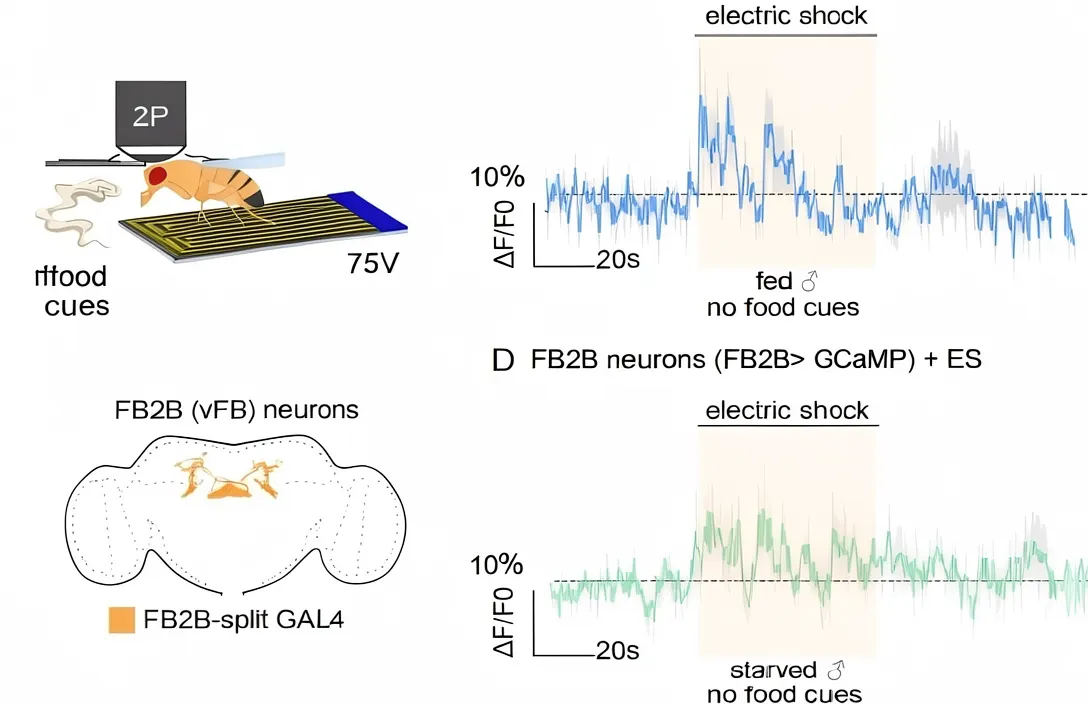

Researchers identified a neural circuit in fruit flies that integrates signals about hunger, food cues, and danger to guide risk-taking behavior. Using genetic approaches, brain imaging, and neural circuit mapping, the study found that food-deprived fruit flies were more willing to cross an electrified barrier to reach a meal. In experiments, 70% of flies deprived of food for 24 hours braved the electrified barrier to reach a yeast-rich food source, whereas flies that had already been fed avoided crossing the barrier regardless of food presence (Source ID: 1). [1]
The study revealed that a chemical messenger associated with hunger, leucokinin, increases the responsiveness of specific brain cells, called PV5K1 neurons, to food smells. These neurons suppress the activity of another group of neurons, FB2B, which normally promote avoidance of danger, such as electric shocks. This suppression allows food-seeking behavior to take priority over avoidance when food cues are present (Source ID: 1). [1]
The researchers tested the role of this circuit by selectively activating or silencing specific neurons. Activating PV5K1 neurons encouraged well-fed flies to approach food despite electric shocks, but only when food smells were present. Conversely, silencing these neurons reduced food approach in hungry flies. Brain imaging also showed that neurons involved in shock avoidance became less responsive to electric shocks when hungry flies were exposed to food smells (Source ID: 1). [1]
Researchers discovered that a chemical messenger associated with hunger, leucokinin, increases the responsiveness of specific brain cells, called PV5K1 neurons, to food smells. The study, published in Science Advances, used genetic approaches, brain imaging, and neural circuit mapping to show that food-deprived fruit flies were willing to cross an electrified barrier to reach a meal. In experiments, 70% of flies deprived of food for 24 hours braved the electrified barrier to reach a yeast-rich food source, while flies that had already been fed avoided crossing the barrier regardless of food presence (Source ID: 1). [1]
Advertisement
The study found that PV5K1 neurons suppress the activity of FB2B neurons, which normally promote avoidance of danger, when food is nearby. This suppression allows food-seeking behavior to take priority over avoidance when food cues are present. Brain imaging revealed that neurons involved in shock avoidance became less responsive to electric shocks when hungry flies were exposed to food smells (Source ID: 1). [1]
The researchers tested the role of this circuit by selectively activating or silencing specific neurons. Activating PV5K1 neurons encouraged well-fed flies to approach food despite electric shocks, but only when food smells were present. Silencing these neurons reduced food approach in hungry flies, demonstrating the critical role of this circuit in balancing competing behaviors (Source ID: 1). [1]
Researchers identified a neural circuit in fruit flies that integrates signals about hunger, food cues, and danger to guide risk-taking behavior. The study, published in Science Advances, revealed that a chemical messenger associated with hunger, leucokinin, increases the responsiveness of specific brain cells, called PV5K1 neurons, to food smells (source ID: 1). The researchers tested the role of this circuit by selectively activating or silencing specific neurons, demonstrating that food-deprived fruit flies were willing to cross an electrified barrier to reach a meal. In experiments, 70% of flies deprived of food for 24 hours braved the electrified barrier to reach a yeast-rich food source, while flies that had already been fed avoided crossing the barrier regardless of food presence (source ID: 1). [1]
The study found that PV5K1 neurons suppress the activity of FB2B neurons, which normally promote avoidance of danger, when food is nearby. FB2B neurons were activated by electric shock, showing an increase in GCaMP signal during the shock window relative to baseline (source ID: 1). This suppression of the animal's built-in 'danger alarm' does not cause hungry animals to disregard risk in all circumstances, but allows food-seeking behavior to take priority over avoidance when food cues are present. The researchers used brain imaging to observe that neurons involved in shock avoidance became less responsive to electric shocks when hungry flies were exposed to food smells (source ID: 1). [1]
Advertisement
The researchers tested the role of this circuit by selectively activating or silencing specific neurons. Activating PV5K1 neurons encouraged well-fed flies to approach food despite electric shocks, but only when food smells were present. Conversely, silencing these neurons reduced food approach in hungry flies. These findings reveal how hunger can selectively reduce the brain's avoidance response when food is available, allowing an animal to pursue a reward despite danger (source ID: 1). [1]
Researchers identified a neural circuit in fruit flies that integrates signals about hunger, food cues, and danger to guide risk-taking behavior. The study, published in Science Advances, found that a chemical messenger associated with hunger, leucokinin, increases the responsiveness of specific brain cells, called PV5K1 neurons, to food smells (source ID: 1). These findings suggest that the brain's response to danger is not static but is modulated by internal states such as hunger. [1]
The study revealed that PV5K1 neurons suppress the activity of FB2B neurons, which normally promote avoidance of danger, when food is nearby. This suppression allows food-seeking behavior to take priority over avoidance when food cues are present. The researchers tested the role of this circuit by selectively activating or silencing specific neurons, demonstrating that food-deprived fruit flies were willing to cross an electrified barrier to reach a meal (source ID: 1). [1]
Brain imaging showed that neurons involved in shock avoidance became less responsive to electric shocks when hungry flies were exposed to food smells. Further experiments showed that activating the PV5K1 pathway could suppress these avoidance neurons, indicating that the brain can selectively reduce the avoidance response when food is available, allowing an animal to pursue a reward despite danger (source ID: 1). [1]
Advertisement
The Cali Reporter newsletter
The stories worth your time.
California, the country, and what comes next. Join our free newsletter for reporting that keeps you informed.
More in Health & Medicine
- Understanding Fascia and the Evidence Behind Fascia Release
Fascia is a connective tissue that plays a structural role in the human body, but evidence supporting specific exercises or tools for 'fascia release' remains limited.
- Antidepressant Effectiveness and Long-Term Use
A new review suggests that some antidepressants may be more effective than others in helping people manage depression symptoms over the long term, according to a study published in The Lancet Psychiatry.
- Experimental Weight-Loss Drug Shows Promise for Knee Osteoarthritis Pain
A new study suggests that an experimental weight-loss drug, retatrutide, may significantly reduce knee pain in people with osteoarthritis and obesity.