How a Digital Being Learns to Seek Light
This article explores how a digital creature called a spark can learn to seek light through a process of trial and error, similar to how humans learn new skills.

A digital creature called a spark is designed to learn how to steer toward light through a process of trial and error. This learning process is modeled after how humans and animals learn from their environment, using feedback to adjust behavior. The spark's brain is composed of four neurons—two serving as eyes and two controlling its flippers. The connections between these neurons are defined by three parameters: the strength of straight and crossed connections, and a drive that controls speed in the absence of light. These parameters determine how the spark moves and respond to its environment. The spark's learning is guided by a simple algorithm that adjusts its brain wiring based on the outcome of each trial. [1]
Initially, the spark is a novice, with a brain that is randomly wired and unable to move effectively. Through repeated trials, the spark adjusts its brain wiring based on whether it encounters more or less light. If a trial results in encountering more light, the spark's brain shifts in the direction of the random change that led to the better outcome. If the trial results in encountering less light, the brain shifts in the opposite direction. This process is similar to how humans learn through reinforcement, where success is rewarded and failure is punished. Over time, the spark becomes more efficient at navigating toward the light, demonstrating how even a simple system can learn complex behaviors through repeated practice. [1]
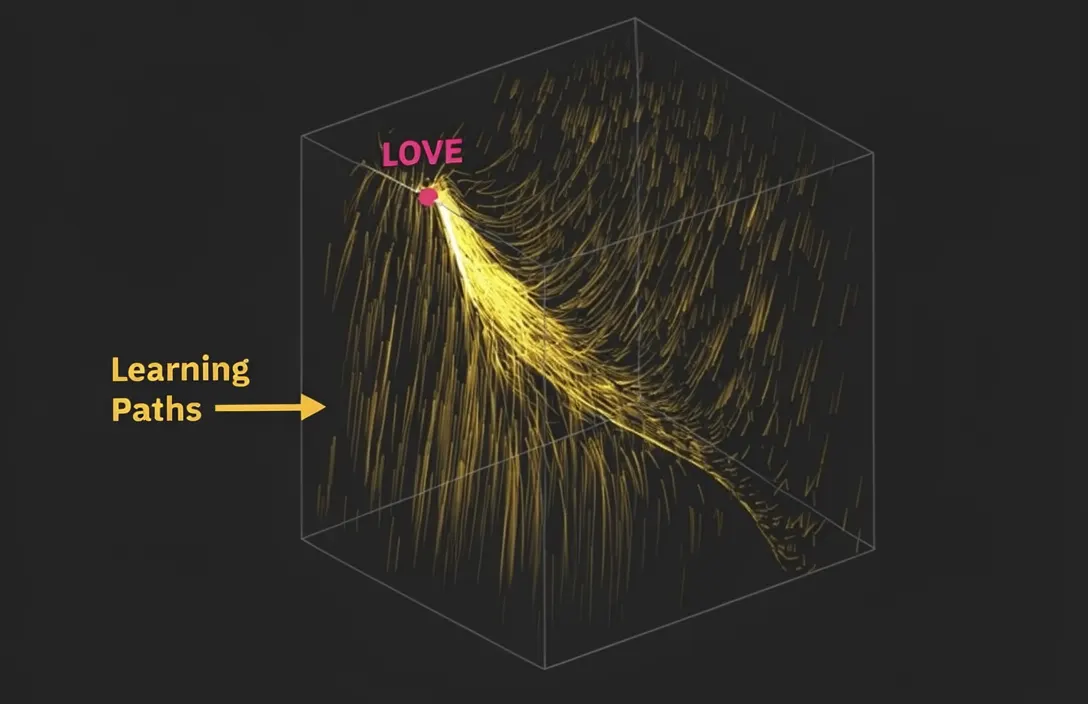
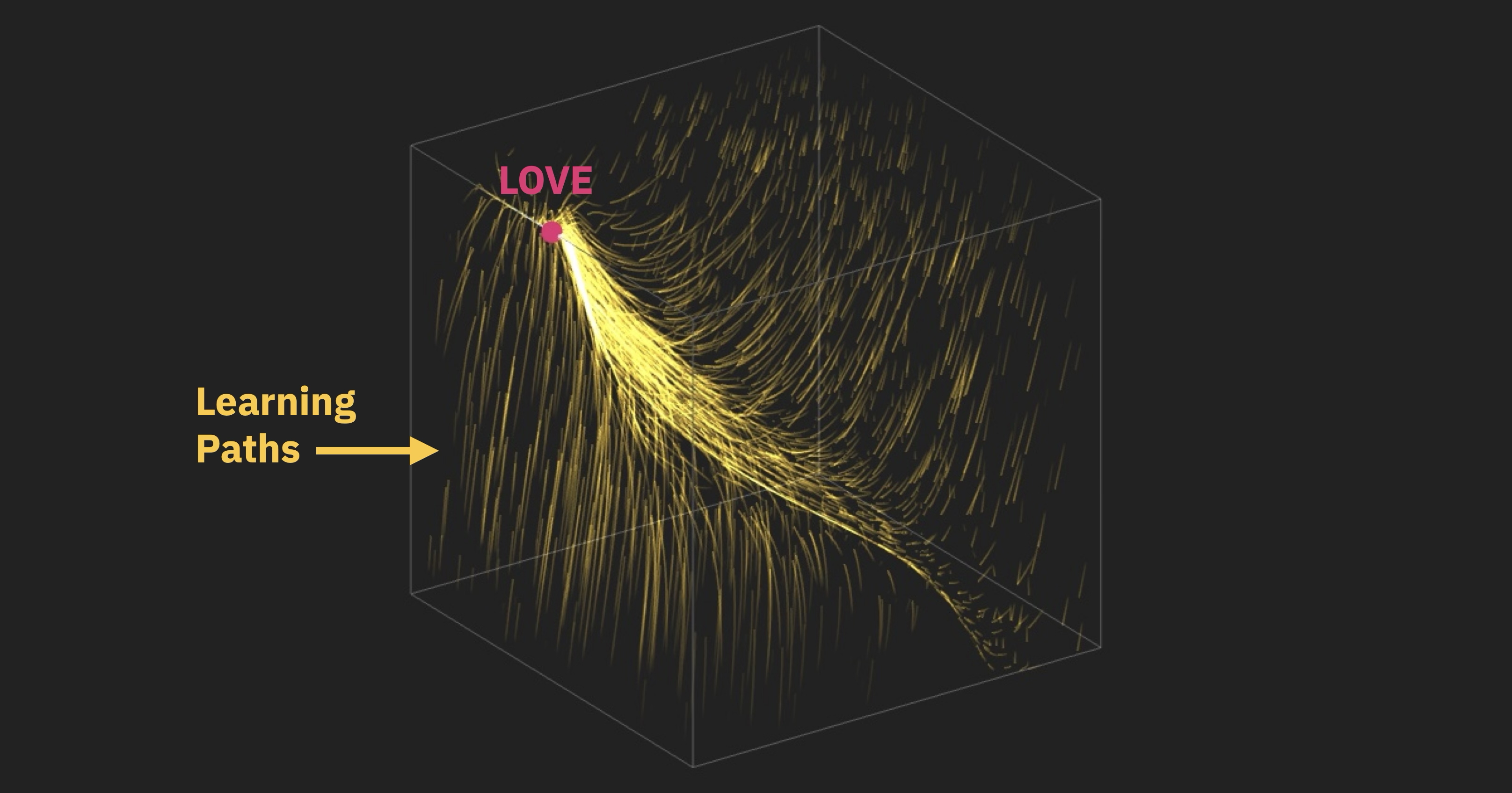
The learning process of the spark can be visualized as a path through a three-dimensional space defined by the three parameters that control its brain wiring. This space represents all possible configurations of the spark's brain. The spark's learning trajectory is not linear but rather a path filled with setbacks and adjustments. Over thousands of trials, the spark's brain wiring converges toward a configuration that allows it to efficiently seek the light. This demonstrates how feedback—whether in the form of reward or punishment—guides the learning process. The spark's learning is not limited to seeking light; it can also be trained to avoid light or to move toward it with high speed, depending on the reward structure. This adaptability mirrors how biological brains learn from their environments. [1]
The spark is a digital being with a brain composed of four neurons — two serving as eyes and two controlling its flippers. The brain wiring is determined by three parameters: the strength of straight and crossed connections between neurons and the drive that controls the spark’s speed when there is no light (source ID: 1). These parameters define the spark’s behavior and are adjusted through a process of trial and error, similar to how humans learn new skills. [1]
Advertisement
The spark's learning process involves a trial-and-error algorithm where its brain wiring is changed randomly before each trial. If a trial results in better performance, the spark is rewarded and its wiring shifts in the direction of the random change. If the trial results in worse performance, the spark is punished and its wiring shifts in the opposite direction (source ID: 1). This process allows the spark to gradually improve its ability to steer toward light. [1]
Over time, the spark’s learning trajectory can be visualized as a path through a three-dimensional space defined by the three parameters that control its brain wiring. This path shows how the spark’s brain changes as it learns. Initially, the spark is a novice with a brain that is randomly wired and unable to move effectively. However, through repeated trials, the spark becomes an expert at seeking and following the light (source ID: 1). [1]
The spark is a digital being with a brain composed of four neurons — two serving as eyes and two controlling its flippers (source ID 1). The spark's learning process involves a trial-and-error algorithm where its brain wiring is changed randomly before each trial. Over time, the spark’s learning trajectory can be visualized as a path through a three-dimensional space defined by the three parameters that control its brain wiring (source ID 1). [1]
Initially, the spark is a novice, with a brain that is randomly wired and unable to move effectively. The learning process of the spark can be visualized as a path through a three-dimensional space defined by the three parameters that control its brain wiring (source ID 1). The spark's brain wiring boils down to just three numbers — the strength of each kind of connection, and the drive (source ID 1). [1]
Advertisement
The spark learns by adjusting its brain wiring based on the outcomes of its trials. If a trial goes better than previous ones, the spark gets a reward and its wiring shifts in the direction of this random change. If the trial goes worse, the spark gets a punishment, and its wiring shifts the other way (source ID 1). This process mirrors how humans learn through rewards and punishments in their environments (source ID 1). [1]
Sources
Prepared with AI assistance from the cited sources.
The Cali Reporter newsletter
The stories worth your time.
California, the country, and what comes next. Join our free newsletter for reporting that keeps you informed.
More in Technology
- Modern Web Guidance 1.0 and Browser Compatibility
Modern Web Guidance 1.0, announced by Chrome for Developers on November 10, introduces browser compatibility data to assist coding agents in building web features. The initiative emphasizes the importance of fallback…
- Apache mod_http2 Vulnerability Detection with Nmap
A new Nmap scripting module has been developed to detect the Apache mod_http2 vulnerability (CVE-2026-119618), addressing the challenges of identifying affected systems accurately.
- Securing Remote Vendor Access in Industrial Networks
Best practices for managing remote vendor access in operational technology (OT) networks emphasize controlled access points, multifactor authentication, and time-bound sessions to reduce cybersecurity risks.