Hera Spacecraft Begins Detailed Observations of Asteroid Impact Site
The European Space Agency's Hera spacecraft has commenced its mission to study the effects of NASA's DART impact on the Dimorphos asteroid, providing critical insights for planetary defense strategies.

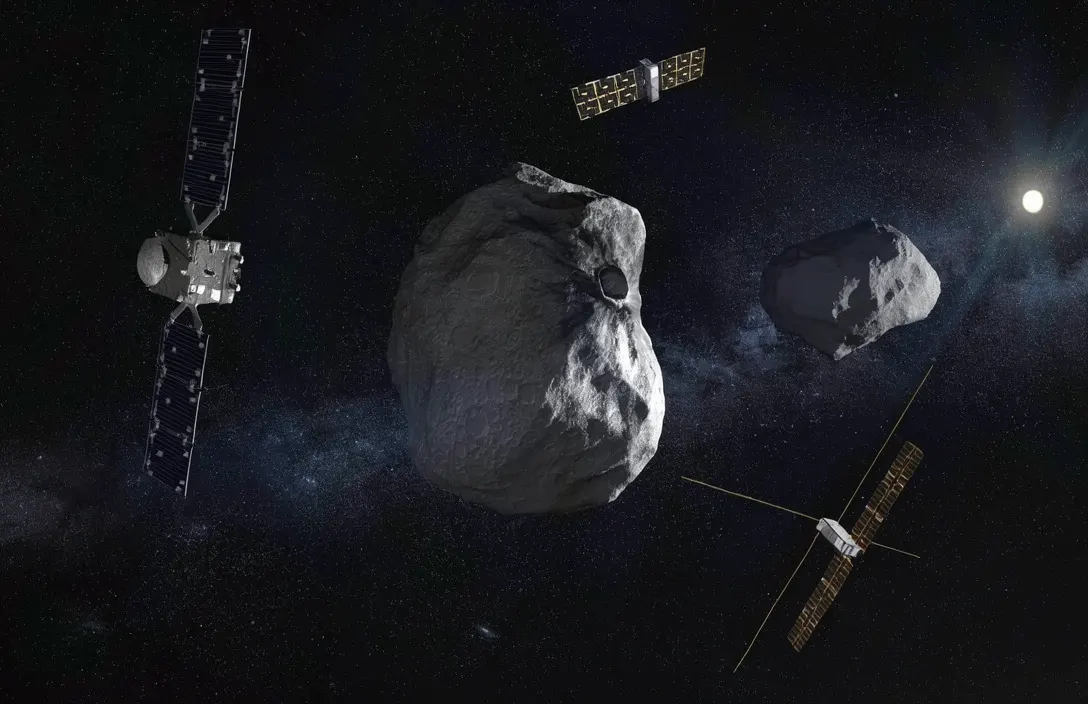
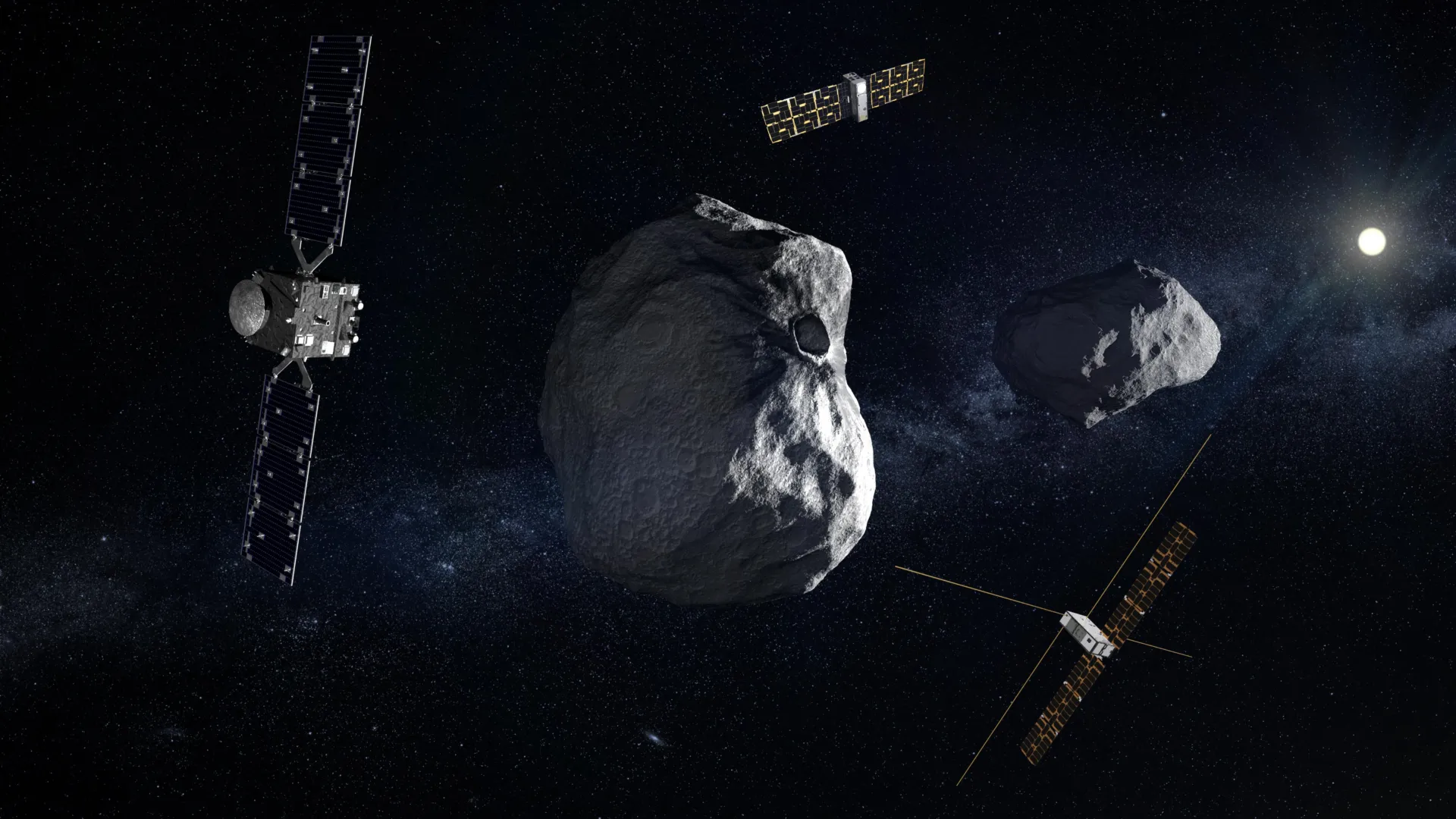
The European Space Agency's Hera spacecraft has arrived near the Didymos asteroid system, beginning its initial scientific observations in what is known as the 'early characterization phase.' During this stage, the spacecraft is traveling approximately 25 to 30 kilometers from the Didymos system, gathering data to support planetary defense goals. This phase aims to provide researchers with a broad understanding of the two asteroids and their surroundings, with particular interest in Dimorphos, the smaller asteroid that was struck by NASA's DART spacecraft in 2022 (source ID: 1). [1]
Hera's navigation strategy involves traveling along 'rectangular orbits' around the Didymos and Dimorphos asteroids due to the weak gravitational pull of these celestial bodies. The spacecraft moves at a speed of about 12 centimeters per second, significantly slower than typical spacecraft, which allows for precise trajectory control and minimal propellant use. This approach is based on experience from ESA's Rosetta comet mission and provides a safety advantage if planned maneuvers fail (source ID: 1). [1]
In the coming months, Hera will transition to the 'detailed characterization phase,' bringing it closer to Didymos and Dimorphos. During this phase, the spacecraft will use complex hyperbolic trajectories shaped like bowties, beginning at distances of approximately 20 kilometers. Communication with Hera is maintained through four large Deep Space Antennas located in Argentina, Spain, and Australia, allowing mission control in Germany to guide the spacecraft effectively (source ID: 1). [1]
The European Space Agency's Hera spacecraft has arrived near the Didymos asteroid system, beginning its initial scientific observations in what is known as the 'early characterization phase.' During this stage, the spacecraft is traveling approximately 25 to 30 kilometers from the Didymos system, gathering data to support planetary defense goals (source ID: 1). This phase is designed to provide researchers with a broad understanding of the two asteroids and their surroundings, with particular interest in Dimorphos, the smaller asteroid that NASA struck with its DART spacecraft in 2022 to test asteroid deflection techniques. [1]
Advertisement
Hera's navigation strategy involves traveling along 'rectangular orbits' around the Didymos and Dimorphos asteroids due to the weak gravitational pull of these celestial bodies (source ID: 1). The main asteroid, Didymos, measures approximately 780 meters across and has gravitational pull about 40,000 times weaker than Earth's, while Dimorphos is just 151 meters wide and has gravity roughly 200,000 times weaker than Earth's. Maintaining a conventional circular orbit is not practical with such weak gravity, so Hera instead travels around the shared center of gravity of the two asteroids, moving at a remarkably slow speed of approximately 12 centimeters per second. [1]
In the coming months, Hera will transition to the 'detailed characterization phase,' bringing it closer to Didymos and Dimorphos (source ID: 1). During this stage, the spacecraft will switch from rectangular flight paths to more complex hyperbolic trajectories shaped like bowties, beginning at distances of approximately 20 kilometers. The mission is directed from ESA's ESOC mission control center in Darmstadt, Germany, with communication maintained through four enormous Deep Space Antennas located in Argentina, Spain, and Australia. [1]
The European Space Agency's Hera spacecraft has arrived near the Didymos asteroid system, beginning its initial scientific observations in what is known as the 'early characterization phase.' During this stage, the spacecraft is traveling approximately 25 to 30 kilometers from the Didymos system, gathering data to support planetary defense goals (source ID: 1). Hera's navigation strategy involves traveling along 'rectangular orbits' around the Didymos and Dimorphos asteroids due to the weak gravitational pull of these celestial bodies (source ID: 1). This strategy allows the spacecraft to maintain a safe distance while collecting data, as conventional circular orbits are impractical given the minimal gravitational forces exerted by the asteroids. [1]
The spacecraft's rectangular orbits are achieved by firing its thrusters at alternating intervals of three and four days, changing direction by 90 degrees. These maneuvers create a series of unusual rectangular paths that keep Hera approximately 25 to 30 kilometers from the asteroid pair (source ID: 1). The unusual navigation strategy builds on experience gained during ESA's Rosetta comet mission and provides an important safety advantage. If a planned thruster firing fails, Hera will naturally drift farther from the asteroids instead of moving toward a potentially dangerous collision (source ID: 1). [1]
Advertisement
Hera's current mission phase is designed to give researchers a broad understanding of the two asteroids and their surroundings. Of particular interest is Dimorphos, the smaller asteroid that NASA deliberately struck with its DART spacecraft in 2022 to test whether a collision could change an asteroid's path (source ID: 1). Scientists still do not know exactly how the impact changed Dimorphos itself, and Hera's observations will help answer some of the biggest questions left unanswered by NASA's first asteroid deflection experiment (source ID: 1). [1]
The European Space Agency's Hera spacecraft has arrived near the Didymos asteroid system, beginning its initial scientific observations in what is known as the 'early characterization phase.' During this stage, the spacecraft is traveling approximately 25 to 30 kilometers from the Didymos system, gathering data to support planetary defense goals (source ID: 1). Hera's navigation strategy involves traveling along 'rectangular orbits' around the Didymos and Dimorphos asteroids due to the weak gravitational pull of these celestial bodies (source ID: 1). [1]
The spacecraft's rectangular orbits are achieved by firing its thrusters at alternating intervals of three and four days, changing direction by 90 degrees. Hera's current mission phase is designed to give researchers a broad understanding of the two asteroids and their surroundings (source ID: 1). The unusual navigation strategy builds on experience gained during ESA's Rosetta comet mission. It also provides an important safety advantage. If a planned thruster firing fails, Hera will naturally drift farther from the asteroids instead of moving toward a potentially dangerous collision (source ID: 1). [1]
Because the spacecraft travels so slowly, each course correction requires very little propellant. Hera's current mission phase is designed to give researchers a broad understanding of the two asteroids and their surroundings (source ID: 1). The mission is directed from ESA's ESOC mission control center in Darmstadt, Germany. Despite Hera being approximately 196.5 million kilometers from Earth, controllers maintain contact with the spacecraft for about eight hours each day (source ID: 1). [1]
Advertisement
The Cali Reporter newsletter
The stories worth your time.
California, the country, and what comes next. Join our free newsletter for reporting that keeps you informed.
More in Science
- Volcanic Eruption Reshapes Iwo Jima’s Coastline
A recent volcanic eruption near Iwo Jima has temporarily extended the island's black sand beaches, though the longevity of the new land remains uncertain.
- Galaxies in the NGC 7771 Group Engage in Cosmic Merger
Astronomers have observed a group of galaxies in the NGC 7771 Group, which is located approximately 200 million light-years away in the constellation Pegasus. These galaxies are in the process of merging, a phenomenon…
- NASA Awards Contract for NOAA’s Near Earth Orbit Network Program
NASA has awarded a contract to Northrop Grumman Systems Corporation for the Sounder for Microwave-Based Applications (SMBA) instruments on NOAA’s Near Earth Orbit Network (NEON) satellites. The contract includes a…