Genetic 'Dimmer Switch' May Improve Sepsis Survival
Researchers have identified a genetic mechanism that could help improve survival rates for patients with sepsis, a life-threatening condition caused by an overactive immune response to infection.

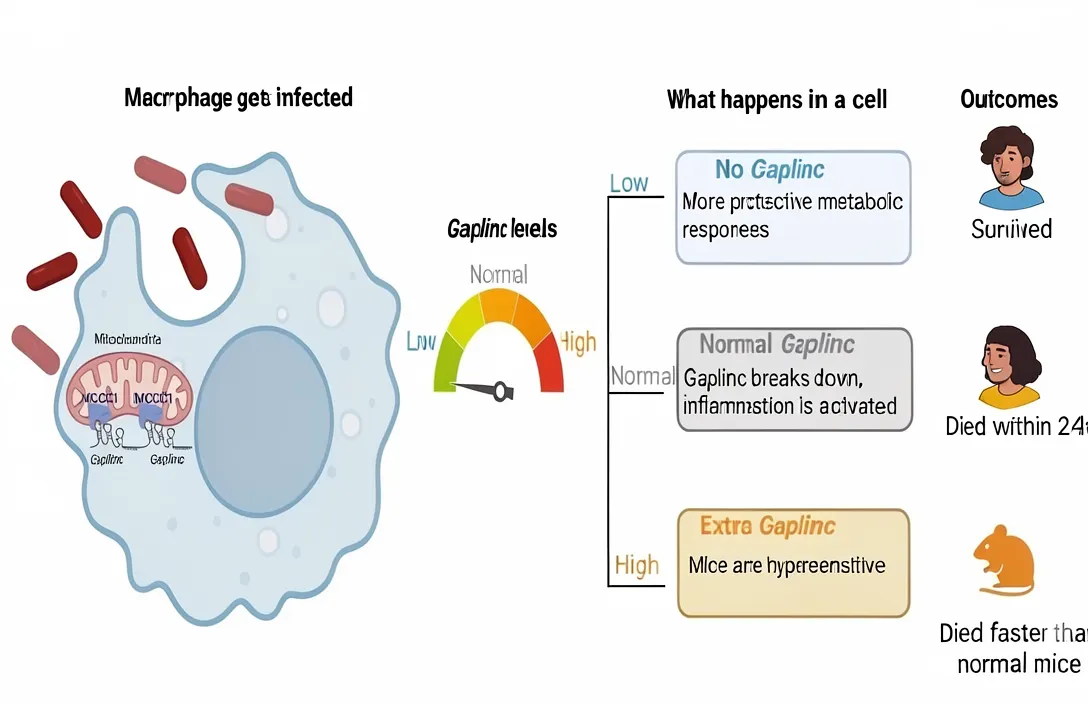

A new study from the University of California, Santa Cruz, has uncovered a molecular mechanism involving a long noncoding RNA called Gaplinc that may influence survival during sepsis (1). The research, published in the Proceedings of the National Academy of Sciences, shows that Gaplinc functions as a genetic 'dimmer switch' that regulates both inflammatory activity and cellular metabolism within immune cells. This discovery could lead to new treatment strategies for sepsis, which kills at least 20% of adults and 10% of children who develop the illness, according to the Centers for Disease Control and Prevention (CDC) (1). [1]
The study reveals that Gaplinc, found in immune cells known as macrophages, directly regulates host survival during endotoxic shock by binding to an enzyme called MCCC1 inside the mitochondria (1). In mouse models where Gaplinc was absent, the animals showed increased survival rates when exposed to lethal bacterial toxins, compared to normal mice. This suggests that Gaplinc plays a crucial role in balancing immune readiness and metabolic resilience during sepsis (1). [1]
Sepsis remains a significant public health challenge in the United States, contributing to at least 350,000 adult and 1,800 child deaths annually. The discovery of Gaplinc's role in regulating metabolic pathways presents a potential new avenue for developing lifesaving drugs that could help manage the condition more effectively (1). [1]
A new study from the University of California, Santa Cruz, has uncovered a molecular mechanism involving a long noncoding RNA called Gaplinc that may influence survival during sepsis (1). The study reveals that Gaplinc, found in immune cells known as macrophages, directly regulates host survival during endotoxic shock by binding to an enzyme called MCCC1 inside the mitochondria (1). Sepsis remains a significant public health challenge in the United States, contributing to at least 350,000 adult and 1,800 child deaths annually (1). [1]
Advertisement
The research team found that Gaplinc acts as a genetic 'dimmer switch'—or rheostat—that controls both inflammatory activity and cellular metabolism inside immune cells (1). This discovery presents a promising new strategy for treating sepsis, which kills at least 20% of adults and 10% of children who develop the illness, according to the Centers for Disease Control and Prevention (CDC) (1). Sepsis occurs when the immune system overreacts to an infection, triggering runaway inflammation that damages healthy organs (1). [1]
The new study reveals that Gaplinc, a long noncoding RNA (lncRNA) found in key immune cells known as macrophages, directly regulates host survival during endotoxic shock (1). It does this by binding to an enzyme called MCCC1 inside the cell's energy factories, the mitochondria (1). By attaching to MCCC1, Gaplinc bridges gene expression with metabolic processing (1). [1]
The persistence of sepsis is a major public health challenge in the United States, where sepsis persists as a leading cause of hospital deaths (1). At least 350,000 adults and more than 1,800 children die from sepsis annually during hospitalization or after transfer to hospice care (1). And according to the CDC, sepsis is present in one out of every three hospital deaths across the country (1). [1]
A new study from the University of California, Santa Cruz, has uncovered a molecular mechanism involving a long noncoding RNA called Gaplinc that may influence survival during sepsis (1). The research team found that Gaplinc acts as a genetic 'dimmer switch'—or rheostat—that controls both inflammatory activity and cellular metabolism inside immune cells (1). This discovery presents a promising new strategy for treating sepsis, which kills at least 20% of adults and 10% of children who develop the illness, according to the Centers for Disease Control and Prevention (CDC) (1). [1]
Advertisement
The new study reveals that Gaplinc, a long noncoding RNA (lncRNA) found in key immune cells known as macrophages, directly regulates host survival during endotoxic shock (1). It does this by binding to an enzyme called MCCC1 inside the cell's energy factories, the mitochondria (1). By attaching to MCCC1, Gaplinc bridges gene expression with metabolic processing (1). In mouse models where Gaplinc was completely absent, baseline immune genes remained slightly 'pre-armed,' and circulating blood fats shifted into a protective, 'sepsis-resistant' balance (1). [1]
As a result, 100% of Gaplinc-deficient mice survived lethal bacterial toxin levels that proved fatal to normal mice (1). Conversely, when Gaplinc was overproduced, baseline immune readiness dropped too low and left the lab mice much more prone to rapid, fatal shock (1). The research team says its discovery that Gaplinc functions as a fine-tuned regulator presents a new path for treating or preventing sepsis (1). For instance, transient RNA therapeutics such as lipid nanoparticles could temporarily rebalance Gaplinc levels and reprogram cellular metabolism during acute infection (1). [1]
A new study from the University of California, Santa Cruz, has uncovered a molecular mechanism involving a long noncoding RNA called Gaplinc that may influence survival during sepsis (1). The research team found that Gaplinc acts as a genetic 'dimmer switch'—or rheostat—that controls both inflammatory activity and cellular metabolism inside immune cells (1). This discovery presents a promising new strategy for treating sepsis, which kills at least 20% of adults and 10% of children who develop the illness, according to the Centers for Disease Control and Prevention (CDC) (1). [1]
The new study reveals that Gaplinc, a long noncoding RNA (lncRNA) found in key immune cells known as macrophages, directly regulates host survival during endotoxic shock (1). It does this by binding to an enzyme called MCCC1 inside the cell's energy factories, the mitochondria. By attaching to MCCC1, Gaplinc bridges gene expression with metabolic processing (1). In mouse models where Gaplinc was completely absent, baseline immune genes remained slightly 'pre-armed,' and circulating blood fats shifted into a protective, 'sepsis-resistant' balance (1). [1]
Advertisement
As a result, 100% of Gaplinc-deficient mice survived lethal bacterial toxin levels that proved fatal to normal mice (1). Conversely, when Gaplinc was overproduced, baseline immune readiness dropped too low and left the lab mice much more prone to rapid, fatal shock (1). The research team says its discovery that Gaplinc functions as a fine-tuned regulator presents a new path for treating or preventing sepsis (1). [1]
Sources
Prepared with AI assistance from the cited sources.
The Cali Reporter newsletter
The stories worth your time.
California, the country, and what comes next. Join our free newsletter for reporting that keeps you informed.
More in Health & Medicine
- Understanding Fascia and the Evidence Behind Fascia Release
Fascia is a connective tissue that plays a structural role in the human body, but evidence supporting specific exercises or tools for 'fascia release' remains limited.
- Antidepressant Effectiveness and Long-Term Use
A new review suggests that some antidepressants may be more effective than others in helping people manage depression symptoms over the long term, according to a study published in The Lancet Psychiatry.
- Experimental Weight-Loss Drug Shows Promise for Knee Osteoarthritis Pain
A new study suggests that an experimental weight-loss drug, retatrutide, may significantly reduce knee pain in people with osteoarthritis and obesity.