Fortran's Enduring Role in Scientific Computing
Despite being over six decades old, Fortran remains a critical tool in scientific and engineering fields due to its efficiency in numerical computations.

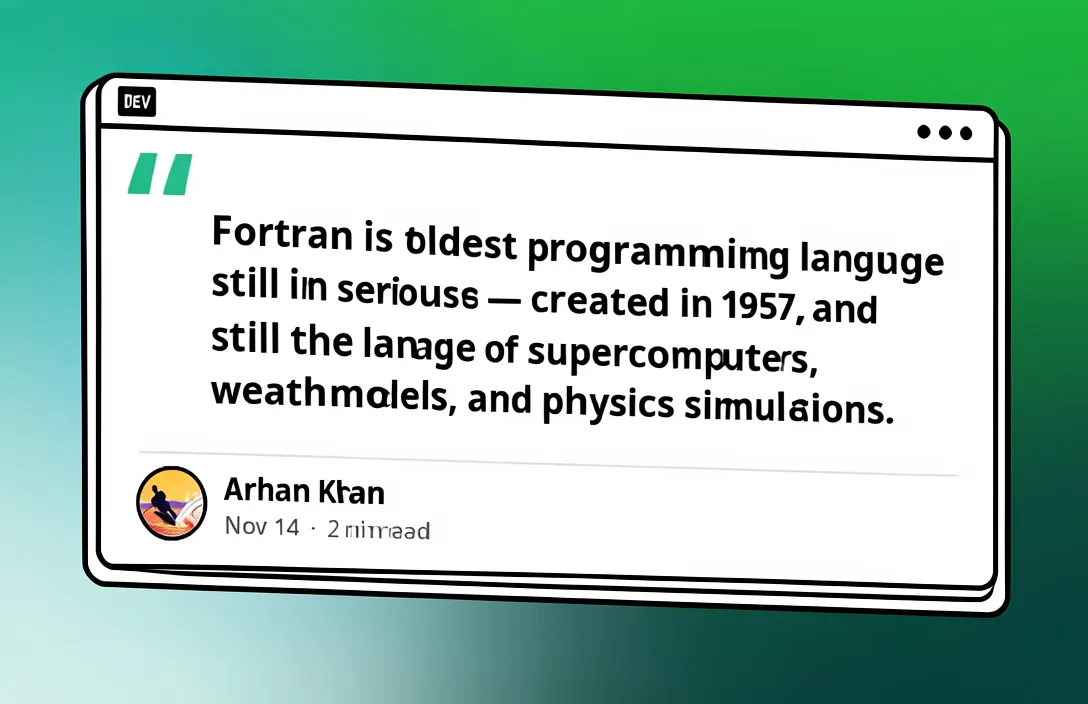

Fortran, created in 1957, is still widely used in scientific computing, particularly in areas such as supercomputing, weather modeling, and physics simulations (Dev.to). Its continued relevance stems from its ability to perform fast and reliable number-crunching on large arrays, a feature that remains unmatched by many modern languages. This efficiency is due in part to Fortran's design, which allows compilers to optimize array operations without requiring explicit loops or indices (Dev.to). [1]
Modern Fortran has evolved significantly from its early punch-card era, with contemporary versions supporting more advanced programming constructs while retaining the language's core strengths. For example, a simple Fortran program can add two arrays with a single line of code, demonstrating the language's ability to handle array operations in a concise and efficient manner (Dev.to). This array-first approach helps compilers generate highly optimized machine code, making Fortran well-suited for high-performance computing tasks (Dev.to). [1]
Despite its strengths, Fortran has limitations, particularly in areas such as string manipulation, web development, and general-purpose application programming. However, for tasks involving large-scale numerical computations, Fortran remains the standard in fields like physics, climate science, and aerospace engineering (Dev.to). It is recommended for scientists and engineers who need to work with high-performance computing systems, though it is not suitable for building websites or mobile applications (Dev.to). [1]
Fortran is the oldest programming language still in serious use — created in 1957, and still the language of supercomputers, weather models, and physics simulations. When a climate model runs on ten thousand cores, or a satellite's orbit is calculated, there is a good chance Fortran is doing the maths. It survives because it does one thing better than almost anything else: fast, reliable number-crunching on huge arrays (Dev.to). [1]
Advertisement
Modern Fortran looks nothing like the punch-card code people imagine. Here is a small program that adds two arrays: program add_arrays implicit none real :: a(5) = [1.0, 2.0, 3.0, 4.0, 5.0] real :: b(5) = [5.0, 4.0, 3.0, 2.0, 1.0] real :: c(5) c = a + b print *, "Result: ", c end program add_arrays Enter fullscreen mode Exit fullscreen mode No loop, no index, no boilerplate: c = a + b adds the whole arrays at once. That array-first style is why Fortran is still fast — the compiler knows exactly what you mean, and it can vectorise the work across CPU cores without you asking (Dev.to). [1]
Fortran is worth learning because it teaches you how high-performance computing actually works. You learn about memory layout, about why the order you loop over an array matters, and about how compilers turn simple maths into machine code that runs at full speed. Those lessons transfer to every language you use afterwards, from NumPy to CUDA (Dev.to). [1]
Fortran is the oldest programming language still in serious use — created in 1957, and still the language of supercomputers, weather models, and physics simulations (Dev.to). It survives because it does one thing better than almost anything else: fast, reliable number-crunching on huge arrays. When a climate model runs on ten thousand cores, or a satellite's orbit is calculated, there is a good chance Fortran is doing the maths (Dev.to). [1]
Modern Fortran looks nothing like the punch-card code people imagine. Here is a small program that adds two arrays: program add_arrays implicit none real :: a(5) = [1.0, 2.0, 3.0, 4.0, 5.0] real :: b(5) = [5.0, 4.0, 3.0, 2.0, 1.0] real :: c(5) c = a + b print *, "Result: ", c end program add_arrays Enter fullscreen mode Exit fullscreen mode No loop, no index, no boilerplate: c = a + b adds the whole arrays at once (Dev.to). [1]
Advertisement
That array-first style is why Fortran is still fast — the compiler knows exactly what you mean, and it can vectorise the work across CPU cores without you asking. Fortran is worth learning because it teaches you how high-performance computing actually works. You learn about memory layout, about why the order you loop over an array matters, and about how compilers turn simple maths into machine code that runs at full speed (Dev.to). [1]
Fortran, the oldest programming language still in serious use, was created in 1957 and is still the language of supercomputers, weather models, and physics simulations (Dev.to). It survives because it excels at fast, reliable number-crunching on huge arrays, making it indispensable in fields that require high-performance computing (Dev.to). Modern Fortran has evolved significantly from its early punch-card era, with contemporary versions supporting more advanced programming constructs while retaining the language's core strengths (Dev.to). [1]
Modern Fortran looks nothing like the punch-card code people imagine. A small program that adds two arrays demonstrates how Fortran simplifies complex operations, such as c = a + b, which adds the whole arrays at once without the need for loops or indices (Dev.to). This array-first style is why Fortran is still fast — the compiler knows exactly what you mean, and it can vectorise the work across CPU cores without you asking (Dev.to). [1]
Fortran is worth learning because it teaches how high-performance computing actually works, including memory layout, the importance of array ordering, and how compilers translate simple mathematics into efficient machine code (Dev.to). These lessons are transferable to other languages like NumPy and CUDA, making Fortran a valuable tool for science and engineering students, researchers, and anyone working with supercomputers (Dev.to). [1]
Advertisement
The Cali Reporter newsletter
The stories worth your time.
California, the country, and what comes next. Join our free newsletter for reporting that keeps you informed.
More in Technology
- Modern Web Guidance 1.0 and Browser Compatibility
Modern Web Guidance 1.0, announced by Chrome for Developers on November 10, introduces browser compatibility data to assist coding agents in building web features. The initiative emphasizes the importance of fallback…
- Apache mod_http2 Vulnerability Detection with Nmap
A new Nmap scripting module has been developed to detect the Apache mod_http2 vulnerability (CVE-2026-119618), addressing the challenges of identifying affected systems accurately.
- Securing Remote Vendor Access in Industrial Networks
Best practices for managing remote vendor access in operational technology (OT) networks emphasize controlled access points, multifactor authentication, and time-bound sessions to reduce cybersecurity risks.