Forgetful Neural Networks Could Shed Light on Human Learning
A study published in Trends in Cognitive Sciences explores how forgetting in artificial neural networks may provide insight into human learning processes.

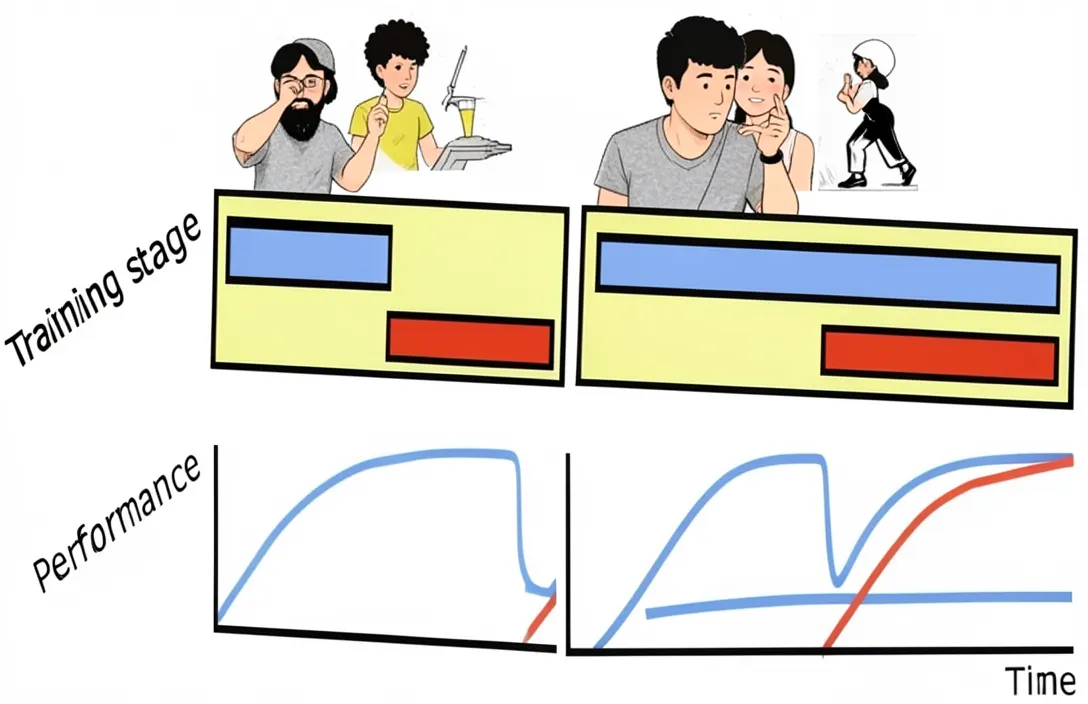

Artificial neural networks, modeled after the human brain, can learn new tasks through a process called gradient descent learning. However, when learning a new task, these networks often experience catastrophic forgetting, where they rapidly and lastingly lose the ability to perform previously learned tasks. This phenomenon is well-documented in computer science, and researchers have attempted to mitigate it using a technique called replay, which involves revisiting examples from earlier tasks during the learning of new ones (source ID: 1). [1]
Despite the use of replay, studies have shown that even with continued training on the original task, performance on that task initially declines before recovering. This temporary decline is referred to as the "stability gap." Researchers from the University of Groningen and KU Leuven have investigated whether a similar phenomenon occurs in human learning. Their survey of cognitive science literature identified various forms of transient forgetting in humans, but none directly matched the stability gap (source ID: 1). [1]
The researchers suggest that the stability gap could be a key insight into how the human brain learns. They propose that if a stability gap is found in human learning, it would indicate that the brain's learning process resembles gradient descent learning, similar to that of artificial neural networks. Conversely, if no stability gap is found, it would suggest that the human brain employs a fundamentally different learning mechanism (source ID: 1). [1]
Artificial neural networks, modeled after the human brain, can learn new tasks through a process called gradient descent learning. However, when learning a new task, these networks often experience a phenomenon known as catastrophic forgetting, where they rapidly and lastingly forget how to perform a previously learned task. To mitigate this, a technique called replay is used, where the network continues to practice on examples from the old task while learning the new one. This approach helps the network retain performance on both tasks, but researchers have observed a different pattern in the learning process. [1]
Advertisement
Even with continued training on the original task, performance on that task initially declines before recovering. This temporary decline, referred to as the stability gap, occurs as the network begins learning the new task. The researchers noted that this phenomenon is not just a feature of artificial systems, but could also be relevant to human learning. While the study did not find direct evidence of the stability gap in human learning, it also found no evidence against its presence. This opens the door for future experiments to explore whether similar patterns occur in the human brain. [1]
The presence of a stability gap in both artificial and human learning could provide important insight into how the brain learns. The researchers suggest that the stability gap may be a fingerprint left behind by gradient descent learning, a process that is commonly used in artificial neural networks. If future studies confirm the existence of a stability gap in human learning, it would indicate that the brain learns in a way that is similar to machines. Conversely, if the stability gap is not found in human learning, it would suggest that the brain uses a fundamentally different learning mechanism. [1]
Artificial neural networks, modeled after the human brain, can learn new tasks through a process called gradient descent learning. However, studies have shown that even with continued training on the original task, performance on that task initially declines before recovering. This transient decline in performance is referred to as the stability gap (Medical Xpress, 2026). [1]
The usual fix to reduce forgetting when learning a new task is an approach called replay, where the network continues to practice on examples from the old task. This method can help the network retain performance on both the original and new tasks. However, researchers observed that even with replay, the network's performance on the original task still worsens initially before improving again (Medical Xpress, 2026). [1]
Advertisement
Scientists from the University of Groningen and KU Leuven investigated whether a stability gap also occurs in human learning. They reviewed the cognitive science literature and identified different types of transient forgetting in humans, but none directly matched the stability gap. However, they found no evidence against the possibility of a stability gap in human learning (Medical Xpress, 2026). [1]
The researchers suggest that the stability gap could be a key insight into how the human brain learns. If future studies find evidence of a stability gap in human learning, it could indicate that the brain learns in a manner similar to artificial neural networks, through a process that approximates gradient descent (Medical Xpress, 2026). [1]
Artificial neural networks, modeled after the human brain, can learn new tasks through a process called gradient descent learning. Without continued training on the first task, learning a new task leads to lasting forgetting, known as catastrophic forgetting. However, with continued training on the original task, learning a new task induces transient forgetting, referred to as the stability gap (source ID: 1). [1]
The usual fix to reduce forgetting when learning a new task is an approach called replay, where the network continues to practice on examples from the old task. Even with replay, performance on the original task initially declines before recovering, indicating the presence of a stability gap (source ID: 1). [1]
Advertisement
Scientists from the University of Groningen and KU Leuven investigated whether a stability gap also occurs in human learning. They performed a survey of the cognitive science literature and identified different types of transient forgetting in humans, but none directly matched the stability gap. They found no evidence against a stability gap in human learning either (source ID: 1). [1]
Sources
Prepared with AI assistance from the cited sources.
The Cali Reporter newsletter
The stories worth your time.
California, the country, and what comes next. Join our free newsletter for reporting that keeps you informed.
More in Health & Medicine
- Understanding Fascia and the Evidence Behind Fascia Release
Fascia is a connective tissue that plays a structural role in the human body, but evidence supporting specific exercises or tools for 'fascia release' remains limited.
- Antidepressant Effectiveness and Long-Term Use
A new review suggests that some antidepressants may be more effective than others in helping people manage depression symptoms over the long term, according to a study published in The Lancet Psychiatry.
- Experimental Weight-Loss Drug Shows Promise for Knee Osteoarthritis Pain
A new study suggests that an experimental weight-loss drug, retatrutide, may significantly reduce knee pain in people with osteoarthritis and obesity.