FAA Reopens U.S. Skies After National Ground Stop as Cause Remains Unsettled
The agency allowed departures again Friday night after a day of diversions and stranded travelers. Officials pointed to communications trouble at regional centers, described an aging system under strain and said no cyber link had surfaced; the root cause remained unresolved.

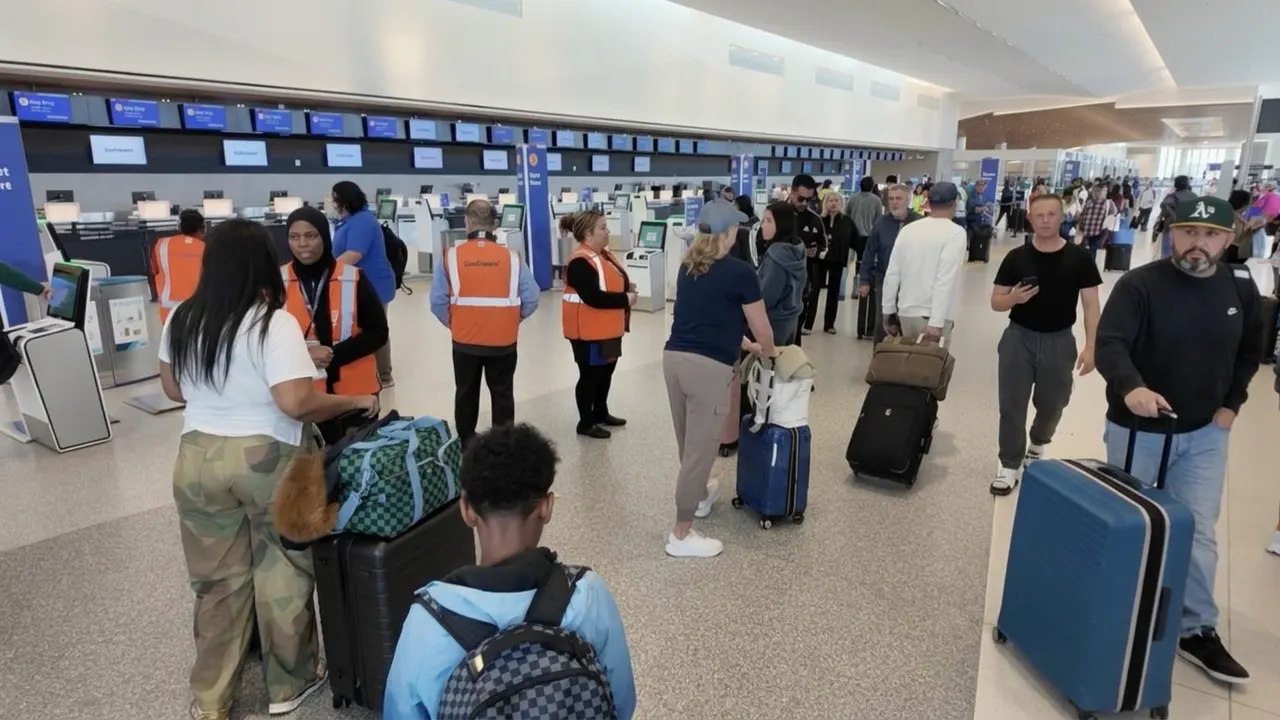

The Federal Aviation Administration halted departures across the United States on Friday afternoon and lifted the nationwide order Friday night, permitting takeoffs again. The agency attributed the stop to what it described as exceptional circumstances stemming from communications failures at regional air traffic control centers. At the White House, Homeland Security Secretary Markwayne Mullin told reporters that blending a new piece of technology with an older air traffic control system had placed too much strain on it. Trump administration officials characterized the affected systems as overloaded and obsolete. The order's removal did not restore normal operations, because many aircraft and crews were out of position. [1]
The FAA grounded all flights nationwide Friday afternoon, and the ground stop caused hundreds of flights to be diverted. Even after the freeze ended, airlines could not immediately resume full schedules. Mullin said international flights were reviewed individually, and some were seen departing Friday evening. Travelers sought alternatives; Amtrak's ticketing system appeared to be down that evening, and several hundred users reported the outage on Down Detector. The report did not establish whether the rail ticketing problem was connected to the aviation disruption. [1]
The disruption was the first national ground stop since January 2023, when a critical FAA computer system failed, and the second since the period after the Sept. 11, 2001, attacks, according to the report. Officials saw no sign that the communications failure stemmed from a cyberattack. The effects were wide, disrupting possibly thousands of scheduled flights through at least late Friday and forcing passengers to change plans. These historical comparisons describe rarity and scale; they do not identify the cause of Friday's failure. [1]
Cirium, an aviation analytics firm, counted at least 827 diverted flights as of 7:05 p.m. Eastern. Of those, 670 returned to the airport from which they had taken off, and 157 went to a different airport. Many diverted aircraft landed at Washington Dulles International, Los Angeles International, Cincinnati/Northern Kentucky International and Nashville International. About 11,000 flights with more than 1.5 million passengers were scheduled to depart from U.S. airports after 4 p.m. Eastern, the report said, increasing the chance of further cancellations and diversions. The report did not provide a final tally of canceled flights. [1]
Advertisement
Sports travel and cargo also felt the freeze. NBA, NHL and college teams were stranded while trying to reach destinations, and NFL teams did not know whether they could travel to weekend games. Cargo flights were delayed. FedEx, described as the world's largest cargo airline, said it could activate contingency plans to limit disruptions. Airlines for America, an industry trade group, says U.S. carriers move about 61,000 tons of goods daily to and from more than 220 countries. SpaceX launched its Starship rocket from Texas on Friday afternoon despite the halt. [1]
At San Diego International Airport, nearly all departing flights were delayed. An airport official said arriving flights would keep landing as space allowed. Southwest Airlines ticketing agents moved through the Terminal 1 departures hall to field passenger questions, but the report said they had little information to offer. Christin Barber, a traveler at SAN, said her travel plans were unclear: she was headed first to Denver for a funeral and then home to Albany, New York. [1]
At Chicago O'Hare, passengers discovered the halt from screens showing widespread delays. Some called relatives or friends while weighing an overnight stay against another route. Amber McQuilkin, a 27-year-old software engineer from Seattle, had taken a week of vacation for a New York trip centered on a League of Legends championship event; her friends had already arrived. She said she was receiving little information and had considered abandoning the flight to drive, then decided that would be too unpleasant. [1]
Austin Curtis and his wife were rethinking a journey from South Bend, Indiana, to a friend's baby shower in Denver after a delay during a Chicago layover. They had boarded a Denver-bound flight at O'Hare when they were instructed to leave the aircraft. They saw luggage being removed from their plane and others and assumed a long delay. They debated a hotel room versus waiting at the airport; with child care arranged at home for two young children, they considered spending the weekend in Chicago. [1]
Advertisement
Steve Arroyo, an aviation safety expert and former United Airlines pilot, explained the safety rationale. If controllers cannot communicate, whether because old wiring is worn or for another reason, aircraft must remain on the ground rather than fly into airspace where contact could fail. That logic helps explain how a communications problem can become a nationwide aviation event before investigators pinpoint a technical trigger. [1]
The report frames the stop as a precaution rather than proof of a specific technical fault. It says officials were still looking for the cause and that no cyber link had surfaced. The distinction matters because a national ground stop can be justified by uncertainty about communications even before investigators name the failed component. [1]
Arroyo said Friday's stop differed from the one after Sept. 11 because planes were not ordered to land immediately, and pilots likely could communicate with ground controllers at airports. He compared Friday's trouble to a September regional air traffic control communications outage that disrupted hundreds of flights in the Northeast, except that Friday's event was national in scope. The report also says the problem may be linked to outdated technology used by air traffic controllers. Those were Arroyo's assessments, not official findings, and the report did not settle the cause. [1]
Officials had not identified the cause Friday night. Mullin said nothing indicated a cyberattack. Asked whether he could exclude a cyberattack or a rogue artificial intelligence incident, he said nothing was completely certain then, though it did not appear that way. He said there were no footprints indicating an attack and that the problem looked mechanically driven, while officials continued searching. Those remarks were an early official assessment, not a final conclusion. [1]
Advertisement
Mullin said investigators would examine whether the FAA's national deployment of a new artificial intelligence system was connected. The tool is based at one location near Washington, D.C., and sends recommendations to air traffic control centers; the report describes it as intended to help identify problems and reroute planes. That detail describes the system; it does not establish that the tool caused the outage. The report did not determine whether the AI tool, old equipment or another factor was involved. It did report that the problem might be tied to outdated technology, and Arroyo said the trouble resembled the September regional outage except on a national scale. [1]
Administration officials described the affected system as overloaded and outdated, and Mullin's account tied the trouble to modern tools being placed in an aging system. Those statements do not establish which specific component failed. The report also did not say whether the new AI deployment would be paused or reviewed during the investigation, how its recommendations interact with older communications equipment, or whether the September outage and Friday's stop involved the same equipment, procedures or failure mode. [1]
Congress approved $12.5 billion last year to modernize the equipment controllers use. Old copper lines have been replaced with fiber optic cables in places, and aging radio systems are being replaced gradually at airports around the country. The report says substantial work is still needed. Transportation Secretary Sean Duffy has estimated that another $30 billion is required, and the White House has started urging Congress to approve it. [1]
Officials had not definitively established how the trouble began, although Mullin's account held that adding modern tools to an aging system had overwhelmed it. It was unclear how many regional centers were affected, whether aging wires, radios or other equipment contributed, and how quickly airlines could rebuild schedules. The report also did not say how many flights would be canceled rather than delayed, whether the Amtrak outage was connected, or whether the AI deployment would be paused or reviewed while the investigation continued. [1]
Advertisement
The relationship between September's regional outage and Friday's national stop was not settled. Arroyo said they looked similar, but that was his assessment, not an official finding. Officials said they were still searching for the cause. The report did not specify how long displaced crews and aircraft would take to return to rotation, how international operations would be prioritized, or when official cause information would come. [1]
Several scenarios remain unconfirmed and should be treated as questions, not predictions. Could the inquiry link the failure to the new AI system, to old copper wiring or radios, or to another factor? Could the AI deployment be paused or reviewed while investigators work? Could Congress approve the additional $30 billion Duffy describes as necessary, and on what timetable? Could another communications failure trigger a similar national stop? The report does not answer these questions. It lists the FAA status website and FlightAware as tracking resources but does not state when official cause information will come. [1]
The report supports a limited set of conclusions. The ground stop was lifted, recovery was not immediate, and the cause remained under investigation. It confirms effects on international flights, cargo, sports travel and passenger plans across the country, while leaving the precise technical trigger and the length of aftereffects unresolved. It also records official caution: Mullin said nothing was completely certain, and he described the problem as appearing mechanically driven while officials continued to look for the cause. Any claim that Friday's event was definitively caused by the AI rollout, by old wiring or by another specific factor would go beyond the evidence. [1]
Sources
Prepared with AI assistance from the cited sources.
The Cali Reporter newsletter
The stories worth your time.
California, the country, and what comes next. Join our free newsletter for reporting that keeps you informed.
More in San Diego
- New Mexico's Universal Childcare Program Faces Capacity Challenges
New Mexico's universal childcare initiative, the first of its kind in the U.S., has been transformative for many families but is grappling with significant capacity constraints that leave thousands on waitlists.
- GOP Officials Push to Revive Trump's Mail Voting Restrictions for 2028 Election
Republican state attorneys general are appealing a court order that blocked the U.S. Postal Service from implementing Trump-era mail voting restrictions for the 2028 election.
- SpaceX Successfully Catches Starship in Historic Achievement
SpaceX's Starship made history on Saturday with the first-ever midair capture of a spacecraft returning from space, marking a significant step toward full reusability for future lunar and Martian missions.