Employee Verification Practices Remain Weak Despite Rising Cyber Threats
A 2026 report by WatchGuard Technologies highlights a critical gap in employee verification practices, despite an increase in AI-generated fraud and deepfake attacks.

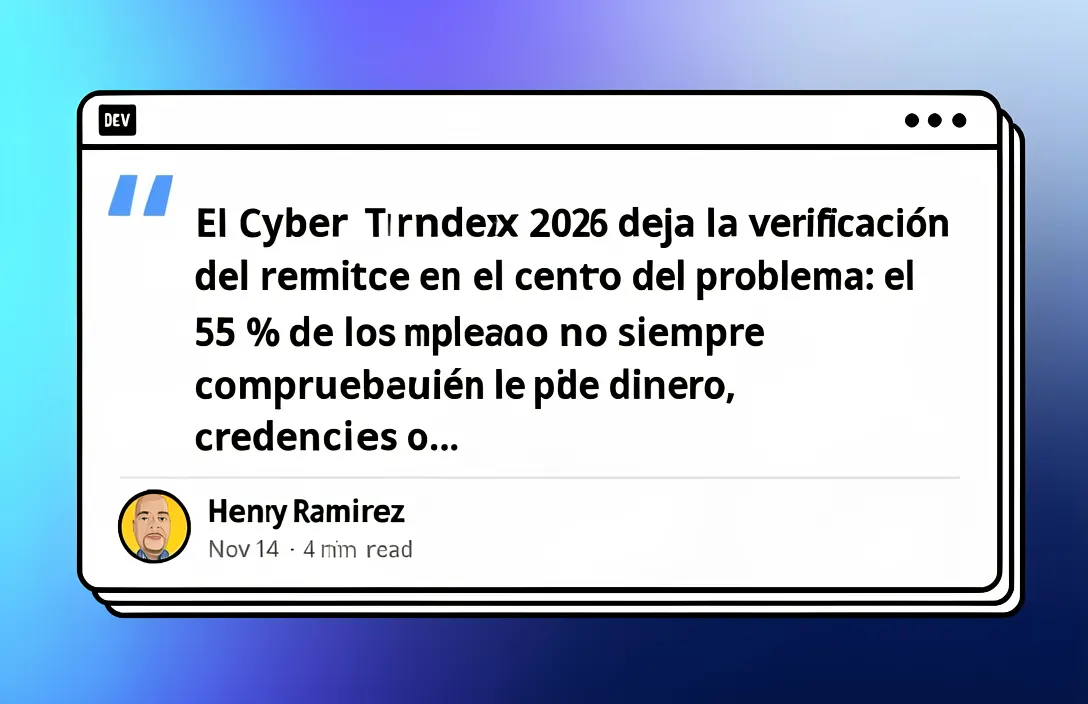

The Cyber Trust Index 2026, presented by WatchGuard Technologies on November 10, reveals that 55% of employees do not always verify the sender before responding to requests for money, credentials, or confidential information. The report, based on a survey of over 500 full-time employees across eight countries, highlights a significant contradiction: while 46% of respondents express greater trust in digital communications compared to five years ago, only 27% prioritize independent verification as a reliable method to confirm the authenticity of a request. This discrepancy underscores a growing vulnerability in workplace cybersecurity, as employees increasingly rely on familiar names, voices, or company branding rather than verifying the source independently (source ID: 1). [1]
The report further notes that 72% of employees have clicked on a link or opened an attachment because it appeared to come from someone they know. This tendency is exacerbated by the ease with which AI can now replicate voices, faces, and writing styles, making it increasingly difficult to distinguish genuine communications from fraudulent ones. A significant 42% of employees would likely trust an urgent text message from their CEO or manager requesting sensitive information without verification, with the percentage rising to 59% in the United States. This reliance on urgency and familiarity over verification is a major concern for cybersecurity professionals (source ID: 1). [1]
The report also highlights significant regional and sectoral differences in verification practices. Australia leads with 69% of employees consistently verifying sensitive requests, while Germany lags behind with only 22%. The healthcare sector demonstrates the highest verification rate at 63%, whereas the insurance sector ranks lowest at 22%. Despite these variations, the report emphasizes that only 21% of employees believe their organizations are fully prepared to prevent or resist serious cyberattacks. Insufficient training and lack of employee awareness are cited as the primary obstacles to effective verification and response (source ID: 1). [1]
The Cyber Trust Index 2026, presented by WatchGuard Technologies on November 10, reveals that Australia has the highest rate of verification among the countries surveyed, with 69% of employees always checking sensitive requests before responding. This is in contrast to Germany, where only 22% of employees verify such requests, followed by Portugal with 28% and Spain with 31% (source ID: 1). These differences suggest that cultural and organizational factors may play a role in how employees approach verification of digital communications. [1]
Advertisement
Sectoral variations are also evident, with the healthcare sector leading in verification at 63%, while the insurance sector lags behind with only 22% of employees verifying sensitive requests. The financial services sector shows the highest level of trust in digital content, with 72% of employees trusting digital communications, but also has a high rate of 65% of employees willing to believe urgent messages from their director without verification (source ID: 1). These figures indicate that trust and verification practices are not uniformly distributed across different industries. [1]
The report also notes that only 21% of employees believe their organizations are fully prepared to prevent or resist a serious cyberattack, with 38% citing insufficient training or lack of employee awareness as the main obstacle. The findings suggest that improving verification practices and increasing employee training are critical steps in enhancing cybersecurity preparedness (source ID: 1). [1]
According to the Cyber Trust Index 2026, presented by WatchGuard Technologies on November 10, 55% of employees do not always verify the sender before responding to requests for money, credentials, or confidential information. The report indicates that 72% of employees have clicked on a link or opened an attachment because it appeared to come from someone they know. These behaviors are exacerbated by the ease with which AI can mimic voices, faces, and writing styles, making it difficult for employees to distinguish between legitimate and fraudulent communications. The report also notes that 38% of employees rely on the familiarity of the sender, 36% on personal or work-related details, and 32% on the correct company image to validate digital requests, with only 27% prioritizing independent verification. [1]
Regional and sectoral differences are also evident. Australia has the highest rate of verification, with 69% of employees always checking sensitive requests before responding. In contrast, Germany has the lowest rate at 22%, followed by Portugal (28%) and Spain (31%). Sectoral variations are also significant, with the healthcare sector leading in verification at 63%, while the insurance sector lags behind with only 22% of employees verifying sensitive requests. The report also highlights that only 21% of employees believe their organizations are fully prepared to prevent or resist a serious cyberattack. [1]
Advertisement
The Cyber Trust Index 2026 emphasizes that the reliance on familiar names, voices, and company images has become a major vulnerability in cybersecurity. The report notes that 42% of employees would likely trust an urgent text message from their CEO or manager without verification, and 40% would do the same with a voice message. In the United States, this percentage rises to 59%. Additionally, the report states that 54% of employees have encountered AI-generated fraud, such as deepfakes or impersonation attempts, in their inboxes. These findings underscore the urgent need for improved verification practices and employee training to mitigate cybersecurity risks. [1]
Sources
Prepared with AI assistance from the cited sources.
The Cali Reporter newsletter
The stories worth your time.
California, the country, and what comes next. Join our free newsletter for reporting that keeps you informed.
More in Technology
- Modern Web Guidance 1.0 and Browser Compatibility
Modern Web Guidance 1.0, announced by Chrome for Developers on November 10, introduces browser compatibility data to assist coding agents in building web features. The initiative emphasizes the importance of fallback…
- Apache mod_http2 Vulnerability Detection with Nmap
A new Nmap scripting module has been developed to detect the Apache mod_http2 vulnerability (CVE-2026-119618), addressing the challenges of identifying affected systems accurately.
- Securing Remote Vendor Access in Industrial Networks
Best practices for managing remote vendor access in operational technology (OT) networks emphasize controlled access points, multifactor authentication, and time-bound sessions to reduce cybersecurity risks.