Email Test Fixtures and Their Security Risks
Email test fixtures, commonly used in software development, can pose significant security risks if not properly managed. While often treated as harmless, these fixtures can inadvertently expose sensitive data and…

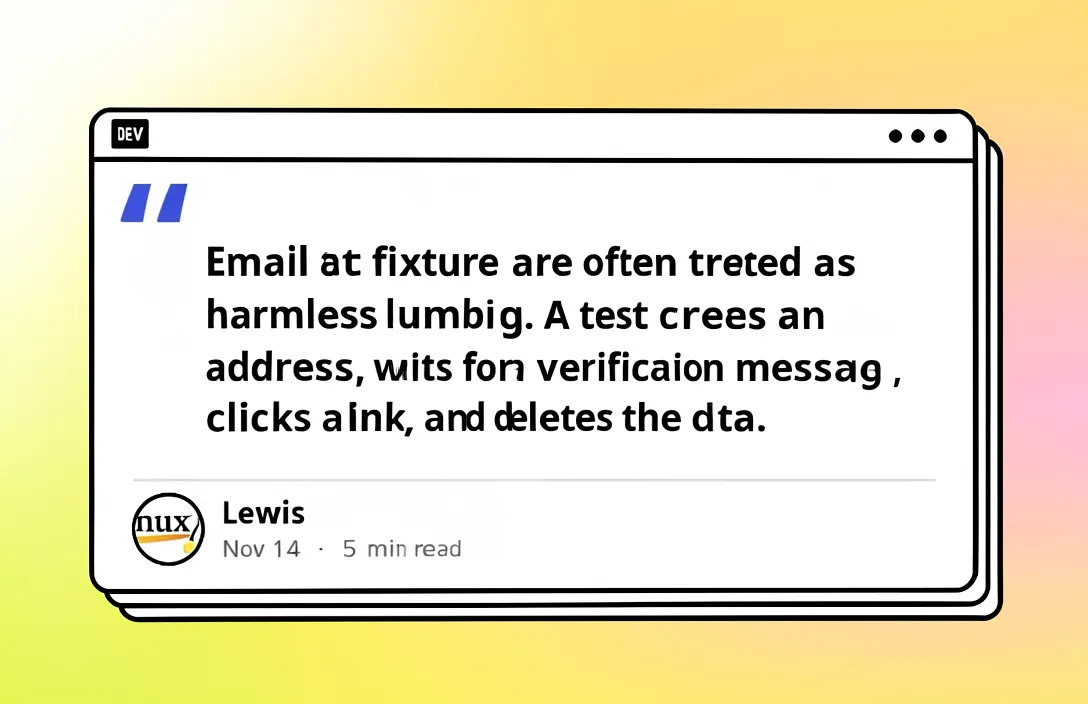

Email test fixtures are frequently used in software testing but are often treated as simple plumbing. A test may create an email address, wait for a verification message, click a link, and delete the data. However, in practice, these fixtures can contain sensitive information such as tokens, password-reset URLs, or product behavior that was never intended to leave a staging system (Dev.to, 2023). The key issue is not whether the test inbox is temporary, but whether the team understands what can happen to the data before, during, and after the test. A short-lived inbox can still be copied into logs or reused by parallel test runs, potentially exposing data beyond the intended scope. [1]
An email fixture crosses several trust boundaries, each with different owners. The test runner creates an identity, the application may store or send a message, and the mailbox provider receives and retains content. The test may read a token and print it in a failure report, while cleanup attempts to remove the data after the run (Dev.to, 2023). If the fixture is managed as a single variable, nobody may be responsible for its retention, access, or cleanup. A threat model, even a simple one-page map, can help identify sensitive content, allowed readers, expected lifetime, and what happens when cleanup fails. This model should be integrated into the test design review, not only in a provider configuration file. [1]
The threat model should address four key questions: who can read the fixture, what is the maximum lifetime of the data, what can be replayed, and what happens when isolation fails (Dev.to, 2023). For example, a token may move from the message to a browser URL and then into a trace archive. An address may appear in a test name and remain in a dashboard for weeks. The original inbox may expire correctly while secondary copies may not. The threat model should also ensure that parallel tests have unique identities and a way to prove that a message belongs to the current run. This helps avoid situations where a test mistakenly uses data from another run, leading to incorrect results or data exposure. [1]
Email test fixtures are frequently used in software testing but are often treated as simple plumbing. An email fixture crosses several trust boundaries, each with different owners. The threat model should address four key questions: who can read the fixture, what is the maximum lifetime of the data, what can be replayed, and what happens when isolation fails (Dev.to, 2023). [1]
Advertisement
A test creates an address, waits for a verification message, clicks a link, and deletes the data. In practice, that fixture can contain a name, a token, a password-reset URL, or a copy of product behavior that was never meant to leave a staging system. The useful question is not whether a test inbox is temporary. It is whether the team understands what can happen to the data before, during, and after the test (Dev.to, 2023). [1]
A short-lived inbox can still be copied into logs or reused by a parallel run. This is the same kind of boundary I look for when reviewing a web workflow: make the ownership and failure states visible, then choose tools that fit the risk. Teams sometimes search for “temp mail so” or “use and throw email” when they need a quick fixture, but the search phrase should not become the security design (Dev.to, 2023). [1]
Email test fixtures are frequently used in software testing but are often treated as simple plumbing. An email fixture crosses several trust boundaries, each with different owners. The threat model should address four key questions: who can read the fixture, what is the maximum lifetime of the data, what can be replayed, and what happens when isolation fails (Dev.to, 2023). [1]
A test creates an address, waits for a verification message, clicks a link, and deletes the data. A short-lived inbox can still be copied into logs or reused by a parallel run. This is the same kind of boundary I look for when reviewing a web workflow: make the ownership and failure states visible, then choose tools that fit the risk (Dev.to, 2023). [1]
Advertisement
Teams sometimes search for “temp mail so” or “use and throw email” when they need a quick fixture, but the search phrase should not become the security design. The useful question is not whether a test inbox is temporary. It is whether the team understands what can happen to the data before, during, and after the test (Dev.to, 2023). [1]
Email test fixtures are frequently used in software testing but are often treated as simple plumbing. A test creates an address, waits for a verification message, clicks a link, and deletes the data. In practice, that fixture can contain a name, a token, a password-reset URL, or a copy of product behavior that was never meant to leave a staging system (Dev.to, 2023). [1]
A short-lived inbox can still be copied into logs or reused by a parallel run. This is the same kind of boundary I look for when reviewing a web workflow: make the ownership and failure states visible, then choose tools that fit the risk. Teams sometimes search for “temp mail so” or “use and throw email” when they need a quick fixture, but the search phrase should not become the security design (Dev.to, 2023). [1]
An email fixture crosses several trust boundaries: the test runner creates an identity; the application stores or sends a message; a mailbox provider receives and retains content; the test reads a token and may print it in a failure report; cleanup attempts to remove the data after the run. Each boundary has a different owner. If the fixture are managed as one simple variable, nobody may be responsible for retention, access, or cleanup (Dev.to, 2023). [1]
Advertisement
The Cali Reporter newsletter
The stories worth your time.
California, the country, and what comes next. Join our free newsletter for reporting that keeps you informed.
More in Technology
- Modern Web Guidance 1.0 and Browser Compatibility
Modern Web Guidance 1.0, announced by Chrome for Developers on November 10, introduces browser compatibility data to assist coding agents in building web features. The initiative emphasizes the importance of fallback…
- Apache mod_http2 Vulnerability Detection with Nmap
A new Nmap scripting module has been developed to detect the Apache mod_http2 vulnerability (CVE-2026-119618), addressing the challenges of identifying affected systems accurately.
- Securing Remote Vendor Access in Industrial Networks
Best practices for managing remote vendor access in operational technology (OT) networks emphasize controlled access points, multifactor authentication, and time-bound sessions to reduce cybersecurity risks.