eBay's Discontinued API and Alternatives for Sold Data in 2026
eBay's findCompletedItems API was retired in February 2025, leaving developers without a direct way to access sold data. In response, third-party APIs and other methods have emerged as alternatives for retrieving eBay…

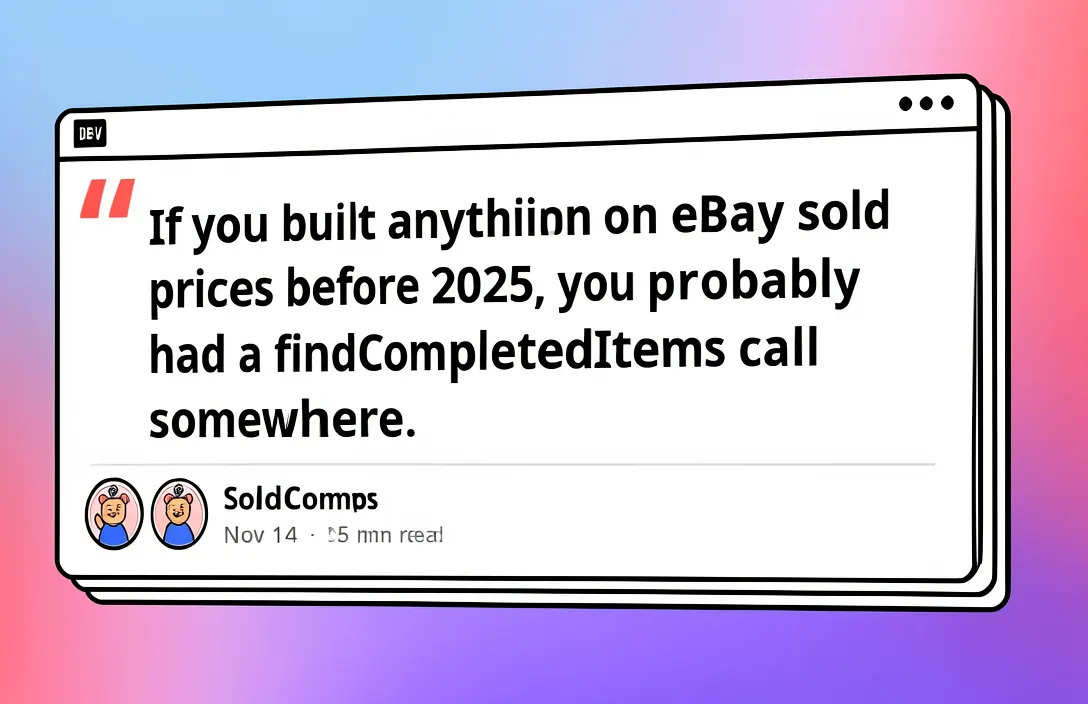

eBay's findCompletedItems API, which was used to retrieve sold data, was retired in February 2025. As a result, developers who relied on this function for accessing eBay's sold listings have had to seek alternatives. According to a November 2026 analysis, eBay's remaining public APIs, such as the Browse API and Marketplace Insights API, do not return sold data. The Marketplace Insights API, while capable of returning sold data, is only available to a limited number of applicants and does not provide full access to historical sold listings (Dev.to, 2026). [1]
In the absence of a direct eBay API for sold data, developers have turned to third-party APIs as replacements. SoldComps.io, for example, offers a free tier with 2,000 credits per month and is described as one of the available options for retrieving eBay sold listings. Other alternatives include CompSniper, Trawl, and Apify actors, which provide varying levels of historical data and pricing models. These APIs differ in their ability to return statistics such as median, p25, p75, and in their support for AI agents or integration with tools like Claude and ChatGPT (Dev.to, 2026). [1]
Each third-party API has its own limitations and features. For instance, SoldComps.io provides statistics and filters such as condition, price range, and days, but does not support historical data beyond about 90 days or marketplaces other than eBay. In contrast, CompSniper offers data up to three years and includes an MCP server for AI integration. Developers are advised to evaluate their specific needs, such as the depth of historical data required and the ability to process large volumes of results, when selecting an API to replace the discontinued findCompletedItems function (Dev.to, 2026). [1]
eBay's findCompletedItems API, which was used to retrieve sold data, was retired in February 2025. In the absence of a direct eBay API for sold data, developers have turned to third-party APIs as replacements. Each third-party API has its own limitations and features. According to a comparison published on Dev.to, developers are now using various third-party services to access eBay sold data, as eBay's remaining public APIs do not return sold data (source ID: 1). [1]
Advertisement
The comparison on Dev.to evaluated several third-party APIs, including SoldComps.io, CompSniper, and Trawl, noting differences in pricing, historical data availability, and statistical features. SoldComps.io offers free access with a limit of 2,000 credits per month and provides statistics such as median, p25, and p75, while other APIs like Trawl and CompSniper offer historical data beyond 90 days (source ID: 1). [1]
Developers must consider factors such as historical data depth, statistical features, and pricing models when choosing a third-party API. Some APIs, like the Apify actors, use a pay-per-result model, while others, like SoldComps.io, use a per-search model with credits. The choice of API depends on the specific needs of the developer, including whether they require AI integration or historical data beyond 90 days (source ID: 1). [1]
eBay's findCompletedItems API, which was used to retrieve sold data, was retired in February 2025. In the absence of a direct eBay API for sold data, developers have turned to third-party APIs as replacements. Each third-party API has its own limitations and features. According to a comparison on Dev.to, developers now rely on various third-party services to access eBay sold listings data (ID: 1). [1]
The comparison on Dev.to evaluated several third-party APIs, including SoldComps.io, CompSniper, and Trawl, noting differences in pricing, historical data availability, and statistical features. Developers must consider factors such as historical data depth, statistical features, and pricing models when choosing a third-party API. The comparison includes details about each API's capabilities and limitations as described on their respective vendor pages (ID: 1). [1]
Advertisement
The comparison also highlights that some APIs, such as CompSniper, offer historical data going back up to three years, while others, like SoldComps.io, are limited to approximately 90 days. Additionally, pricing models vary significantly, with some APIs using a pay-per-result model and others using a per-search model. Developers are advised to test any API on 20 searches from their own use case before committing to one (ID: 1). [1]
Sources
Prepared with AI assistance from the cited sources.
The Cali Reporter newsletter
The stories worth your time.
California, the country, and what comes next. Join our free newsletter for reporting that keeps you informed.
More in Technology
- Modern Web Guidance 1.0 and Browser Compatibility
Modern Web Guidance 1.0, announced by Chrome for Developers on November 10, introduces browser compatibility data to assist coding agents in building web features. The initiative emphasizes the importance of fallback…
- Apache mod_http2 Vulnerability Detection with Nmap
A new Nmap scripting module has been developed to detect the Apache mod_http2 vulnerability (CVE-2026-119618), addressing the challenges of identifying affected systems accurately.
- Securing Remote Vendor Access in Industrial Networks
Best practices for managing remote vendor access in operational technology (OT) networks emphasize controlled access points, multifactor authentication, and time-bound sessions to reduce cybersecurity risks.