Dopamine Neurons Link Threat Detection to Cardiac and Locomotor Responses in Fruit Flies
A recent study has identified two pairs of dopamine-producing neurons in fruit flies that play a crucial role in coordinating heart rate changes and defensive movements when faced with a threat.

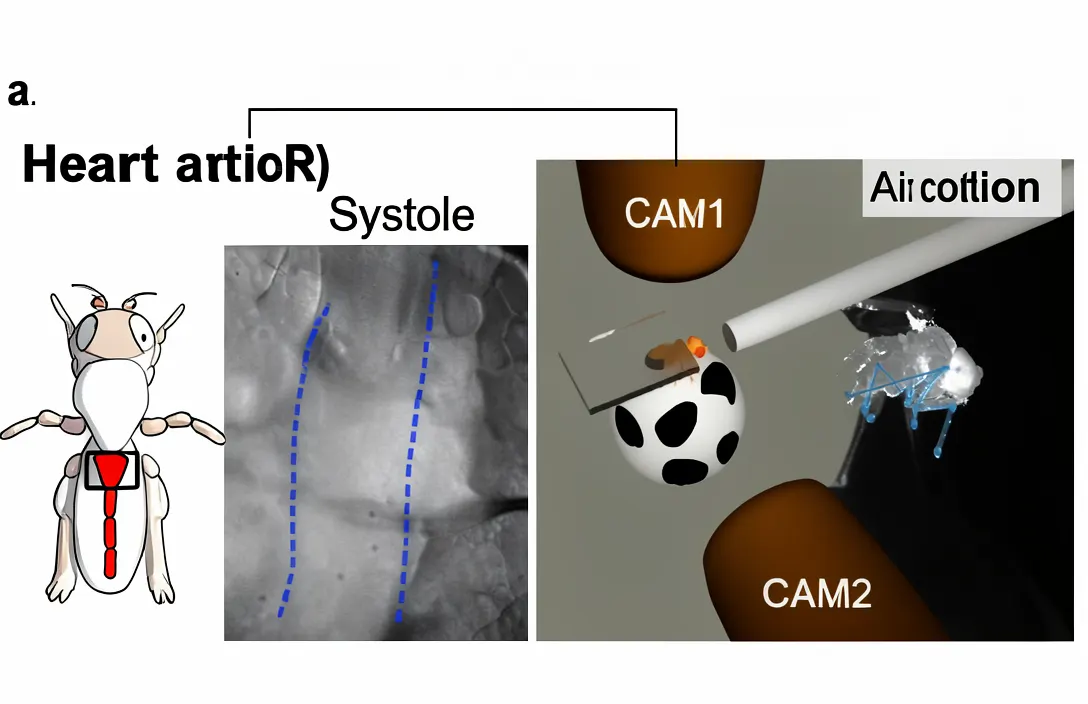

Researchers investigated how the brain coordinates heart activity and what body movement looks like in Drosophila melanogaster, commonly known as the fruit fly, when it encounters a threat (Medical Xpress, 2026). They designed a setup that tethered the fruit flies but allowed them to walk freely. They then simulated a physical threat by blowing short puffs of air at the fly's head. When fruit flies face a mechanical threat, such as a sudden puff of air, their hearts quickly slow down even as their walking activity picks up. The researchers also identified two pairs of dopaminergic neurons, called DA-WED, in Drosophila that coordinate these cardiac and locomotor responses. [1]
To measure and control both brain activity and physiological responses in fruit flies, the researchers gently glued the flies by their upper bodies to a coverslip and placed them over an air-supported foam ball so they could walk freely. This setup was recorded using two high-speed infrared cameras placed at the top and side. Using custom software, the researchers tracked pixel movements in each video frame to detect when the heart expanded and contracted. The software then automatically calculated the heart rate from these movements. They also used tetanus toxin (TNT) to temporarily block synaptic transmission across broad groups of neurons and identify candidate brain circuits. [1]
Two-photon calcium imaging revealed that the DA-WED neurons become more active when an air puff hits the fly. Silencing them prevented the heart rate from slowing down and suppressed defensive walking. Conversely, activating the neurons with red light slowed the heart by roughly 10% and increased walking even without a threat. These neurons slow the heart by releasing dopamine, which binds to dopamine receptors—Dop1R2 and Dop2R. To test whether a slower heartbeat itself influences movement, the researchers used light to briefly slow heart muscle cells, bypassing the brain. The flies responded by walking more, with bigger drops in heart rate closely linked to increases in walking. [1]
Scientists investigated which fly brain cells connect threat detection to a slower heartbeat (Medical Xpress, 2026). The study, published in eLife, examined how the brain coordinates heart activity and body movement in Drosophila melanogaster when it encounters a threat. Researchers used a setup that tethered the fruit flies but allowed them to walk freely, enabling them to simulate a physical threat by blowing short puffs of air at the fly's head. When fruit flies face a mechanical threat, such as a sudden puff of air, their hearts quickly slow down even as their walking activity picks up. This experimental design allowed researchers to measure and control both brain activity and physiological responses in fruit flies. [1]
Advertisement
The researchers identified two pairs of dopaminergic neurons, called DA-WED, in Drosophila that coordinate these cardiac and locomotor responses (Medical Xpress, 2026). Two-photon calcium imaging revealed that these neurons become more active when an air puff hits the fly. Silencing the DA-WED neurons prevented the heart rate from slowing down and suppressed defensive walking. Conversely, activating the neurons with red light slowed the heart by roughly 10% and increased walking even without a threat. These findings suggest that the DA-WED neurons play a crucial role in modulating heart rate and locomotor responses in fruit flies during threat detection. [1]
To test whether a slower heartbeat itself influences movement, the researchers used light to briefly slow heart muscle cells, bypassing the brain (Medical Xpress, 2026). The flies responded by walking more, with bigger drops in heart rate closely linked to increases in walking. This suggests that the heart sends signals back to the brain about its activity, helping trigger defensive movement. The study unlocked a new clue that could help researchers trying to piece together the puzzle called brain-body communication. However, the experiments used restrained flies, mostly males, and future studies could examine whether similar coordination occurs when free-moving animals face threats. [1]
Researchers investigated how the brain coordinates heart activity and what body movement looks like in Drosophila melanogaster when it encounters a threat (Medical Xpress, 2026). To measure and control both brain activity and physiological responses in fruit flies, the researchers gently glued the flies by their upper bodies to a coverslip and placed them over an air-supported foam ball so they could walk freely. Two-photon calcium imaging revealed that the DA-WED neurons become more active when an air puff hits the fly. [1]
Scientists investigated which fly brain cells connect threat detection to a slower heartbeat (Medical Xpress, 2026). The researchers identified two pairs of dopaminergic neurons, called DA-WED, in Drosophila that coordinate these cardiac and locomotor responses (Medical Xpress, 2026). To test whether a slower heartbeat itself influences movement, the researchers used light to briefly slow heart muscle cells, bypassing the brain (Medical Xpress, 2026). [1]
Advertisement
The experiments pinpointed two pairs of dopamine-producing brain cells, called DA-WED neurons, that coordinate the flies' cardiac and defensive responses. Two-photon calcium imaging revealed that these neurons become more active when an air puff hits the fly. Silencing them prevented the heart rate from slowing down and suppressed defensive walking. Conversely, activating the neurons with red light slowed the heart by roughly 10% and increased walking even without a threat. [1]
Scientists investigated which fly brain cells connect threat detection to a slower heartbeat (Medical Xpress, 2026). The researchers identified two pairs of dopaminergic neurons, called DA-WED, in Drosophila that coordinate these cardiac and locomotor responses (Medical Xpress, 2026). These neurons play a crucial role in slowing the heart rate and initiating defensive movements when the fruit fly encounters a threat. [1]
To measure and control both brain activity and physiological responses in fruit flies, the researchers gently glued the flies by their upper bodies to a coverslip and placed them over an air-supported foam ball so they could walk freely (Medical Xpress, 2026). Two-photon calcium imaging revealed that the DA-WED neurons become more active when an air puff hits the fly (Medical Xpress, 2026). This method allowed the researchers to observe the neural activity in real-time during the threat response. [1]
To test whether a slower heartbeat itself influences movement, the researchers used light to briefly slow heart muscle cells, bypassing the brain (Medical Xpress, 2026). The flies responded by walking more, with bigger drops in heart rate closely linked to increases in walking (Medical Xpress, 2026). This indicates that the heart sends signals back to the brain about its activity, helping trigger defensive movement. [1]
Advertisement
The Cali Reporter newsletter
The stories worth your time.
California, the country, and what comes next. Join our free newsletter for reporting that keeps you informed.
More in Health & Medicine
- Understanding Fascia and the Evidence Behind Fascia Release
Fascia is a connective tissue that plays a structural role in the human body, but evidence supporting specific exercises or tools for 'fascia release' remains limited.
- Antidepressant Effectiveness and Long-Term Use
A new review suggests that some antidepressants may be more effective than others in helping people manage depression symptoms over the long term, according to a study published in The Lancet Psychiatry.
- Experimental Weight-Loss Drug Shows Promise for Knee Osteoarthritis Pain
A new study suggests that an experimental weight-loss drug, retatrutide, may significantly reduce knee pain in people with osteoarthritis and obesity.