Distinguishing Between Null and Undefined in API Design
In software development, the distinction between 'null' and 'undefined' can have significant implications, particularly in API design. A recent discussion on Dev.to highlights how treating these two values…

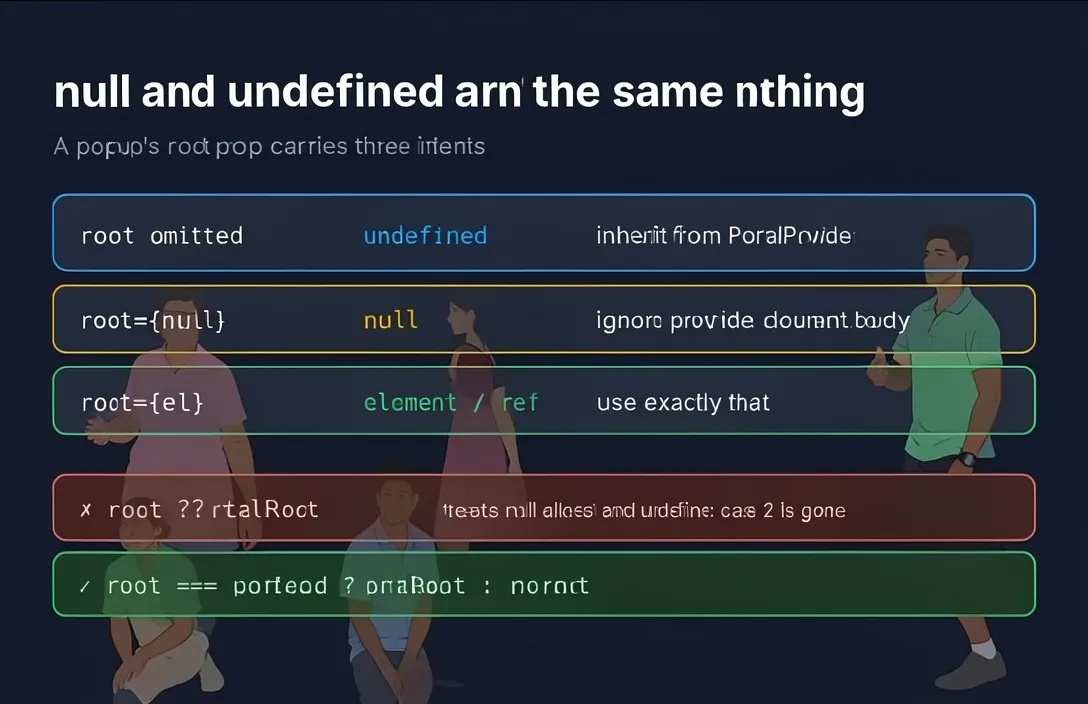

In component APIs, treating null and undefined as the same can lead to unintended consequences. For example, in a design system, the 'root' prop determines where a popup should render. The prop can carry three intents: nothing passed, null passed, or an element or ref passed. The code 'root ?? portalRoot' appears correct but fails because the ?? operator treats null and undefined identically. This oversight can cause the escape hatch to be removed silently, without errors or warnings. [1]
To address this, the correct approach is to explicitly check for undefined. The code 'if (root === undefined) return portalRoot; return root;' ensures that the three intents are properly handled. This method allows for a distinction between 'I didn't say' (undefined) and 'I said: nothing' (null), which is essential for accurate API behavior. [1]
The distinction between null and undefined matters significantly in API design. In React, undefined is what is handed to a prop when it is omitted, and it is the only value that triggers a default parameter. Null, on the other hand, is a deliberate decision by the caller. When the difference between these two values is important, it is necessary to have one test per case, including tests for omitted props, explicit null, and elements. [1]
The source discusses a specific implementation within a component API where the `root` prop determines where a popup should render. This prop has three distinct cases: when nothing is passed, when `null` is passed, and when an element or ref is passed. The first case, where nothing is passed, causes the popup to inherit from the nearest `PortalProvider`. The second case, where `null` is passed, instructs the popup to use `document.body` as the rendering location. The third case uses the provided element or ref directly. These distinctions are crucial for the correct behavior of the popup component. [1]
Advertisement
A key issue arises from the use of the nullish coalescing operator (`??`), which treats both `null` and `undefined` the same. This leads to unexpected behavior in the fallback logic when `null` is explicitly passed, as the fallback value is applied incorrectly. To resolve this, the code explicitly checks for `undefined` using `if (root === undefined)` before returning the fallback value. This ensures that `null` and `undefined` are treated as distinct values, preserving the intended behavior of the API. [1]
The distinction between `null` and `undefined` is emphasized as critical in API design. `undefined` is used when a prop is omitted, and it is the only value that triggers a default parameter in React. On the other hand, `null` is a deliberate choice by the caller to indicate that no value should be used. The example highlights that if the difference between these two values matters, the API should include separate tests for each case: one for an omitted prop, one for an explicit `null`, and one for a provided element or ref. [1]
The source discusses a design system where a popup component's rendering location is determined by the `root` prop. This prop has three distinct intents: if nothing is passed, the popup inherits from the nearest `PortalProvider`; if `null` is passed, it ignores the provider and uses `document.body`; if an element or a ref is passed, it uses that specific element. The code initially attempted to use the nullish coalescing operator (`??`), which treats both `null` and `undefined` the same, leading to unintended behavior in the case where `null` was explicitly passed. This resulted in a fallback that removed an escape hatch, highlighting the importance of distinguishing between `null` and `undefined` in API design. [1]
The article emphasizes that in React, `undefined` typically indicates that a prop was omitted, while `null` represents an explicit decision by the caller to provide no value. This distinction is crucial for APIs that need to handle default values or fallback behavior correctly. The example provided required three separate test cases: one for an omitted prop (which results in `undefined`), one for an explicit `null`, and one for a provided element or ref. This ensures that all possible values of the `root` prop are handled appropriately, avoiding silent failures in the application. [1]
Advertisement
The final solution explicitly checked for `undefined` using `if (root === undefined)` and returned the fallback value `portalRoot`, while returning the provided `root` value otherwise. This approach ensures that `null` and `undefined` are treated as distinct cases, preventing unintended behavior. The article serves as a cautionary example of how subtle differences in JavaScript values can have significant consequences in software design, especially when handling component APIs and fallback logic. [1]
Sources
Prepared with AI assistance from the cited sources.
The Cali Reporter newsletter
The stories worth your time.
California, the country, and what comes next. Join our free newsletter for reporting that keeps you informed.
More in Technology
- Modern Web Guidance 1.0 and Browser Compatibility
Modern Web Guidance 1.0, announced by Chrome for Developers on November 10, introduces browser compatibility data to assist coding agents in building web features. The initiative emphasizes the importance of fallback…
- Apache mod_http2 Vulnerability Detection with Nmap
A new Nmap scripting module has been developed to detect the Apache mod_http2 vulnerability (CVE-2026-119618), addressing the challenges of identifying affected systems accurately.
- Securing Remote Vendor Access in Industrial Networks
Best practices for managing remote vendor access in operational technology (OT) networks emphasize controlled access points, multifactor authentication, and time-bound sessions to reduce cybersecurity risks.