Discrepancy Between Projected and Realized Funding Rates in Perpetual Markets
A recent analysis of perpetual funding rates on Hyperliquid and other decentralized exchanges reveals a significant gap between the rates advertised on funding screens and the actual rates realized by traders over a…

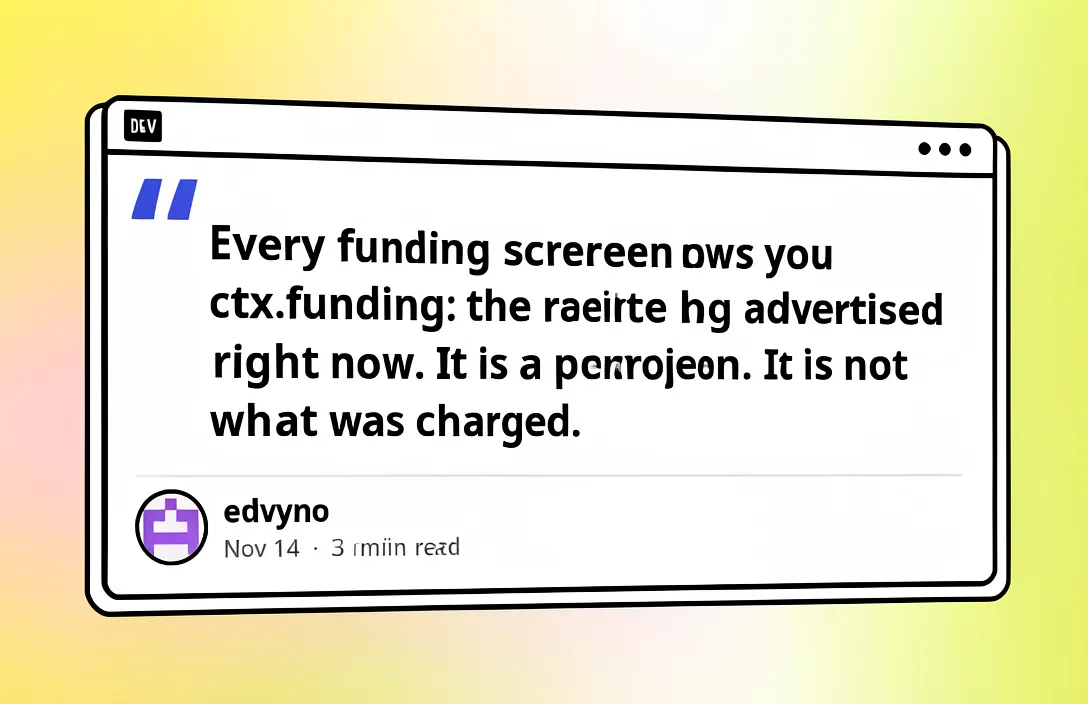

A study conducted on 30 markets across Hyperliquid and other decentralized exchanges (xyz, para, io, mkts) found that the projected funding rates displayed on screens do not accurately reflect the actual rates collected by traders. The analysis compared the forward rate (the rate advertised on the screen) with the realized rate (the actual rate collected over the trailing 24 hours) for each market. According to the data, the forward rate is a projection and not a guarantee of what traders will actually receive. This discrepancy is highlighted in the measurement of 'divergence_x,' which calculates the ratio of forward rate to realized rate (source ID: 1). [1]
The results show that the forward rate can significantly overstate the realized rate. For instance, in the case of 'mkts:BVIV,' the forward rate was 11.56% per day, but the realized rate was only 2.63% per day, with a net of cost after fees and spreads of −0.30%. This indicates that the advertised rate does not account for transaction costs and market spreads, which can drastically reduce the actual return for traders. Additionally, the study found that in some cases, the forward rate had the wrong sign, meaning that the side of the trade that was advertised as the collector actually ended up paying (source ID: 1). [1]
The analysis also identified that some markets, such as 'BERA,' had a forward rate that was lower than the realized rate, suggesting that the actual returns for traders were higher than what was advertised. This variation in the relationship between forward and realized rates indicates that the forward rate is not consistently biased in one direction but rather serves as an incomplete representation of the true cost and return for traders. The study emphasizes that the forward rate is not the rate that traders can expect to collect, and that the actual realized rate must be considered when making trading decisions (source ID: 1). [1]
A study conducted on 30 markets across Hyperliquid and other decentralized exchanges (xyz, para, io, mkts) found that the projected funding rates displayed on screens do not accurately reflect the actual rates collected by traders. The results show that the forward rate can significantly overstate the realized rate. This analysis was based on data from 563 markets scanned on November 14, 2026, and compared the forward rate with the realized rate over a 24-hour period. The forward rate is calculated as the current hourly ctx.funding multiplied by 24 for the side that gets paid, while the realized rate is based on what that same side actually collected over the trailing 24 hours (Source ID: 1). [1]
Advertisement
The study identified that the forward rate can significantly overstate the realized rate. Among the 30 markets analyzed, twelve had a forward rate worth at least 0.5%/24h for the collecting side. However, four of these markets realized a negative number, indicating that the forward rate had the sign backwards, meaning the side advertised as the collector actually paid instead. For the remaining eight markets that stayed positive, the median forward rate overstated the realized rate by 1.89x (Source ID: 1). [1]
The analysis also found that some markets, such as 'BERA,' had a forward rate that was lower than the realized rate, suggesting that the actual returns for traders were higher than what was advertised. In the case of 'BERA,' the forward rate was 1.10% while the realized rate was 2.98%, indicating that the forward rate understated the actual returns. This highlights the importance of considering both forward and realized rates when assessing potential returns on decentralized exchanges (Source ID: 1). [1]
A study conducted on 30 markets across Hyperliquid and other decentralized exchanges (xyz, para, io, mkts) found that the projected funding rates displayed on screens do not accurately reflect the actual rates collected by traders (Source ID: 1). The results show that the forward rate can significantly overstate the realized rate. The analysis also identified that some markets, such as 'BERA,' had a forward rate that was lower than the realized rate, suggesting that the actual returns for traders were higher than what was advertised. [1]
The study compared the forward rate, which is calculated as the current hourly ctx.funding multiplied by 24, with the realized rate, which is based on the actual funding collected over the trailing 24-hour period (Source ID: 1). For example, in the market 'mkts:BVIV,' the forward rate was 11.56% per day, but the realized rate was only 2.63% per day, with a 2.74% quoted book spread plus fees that turned the trade into a net loss of 0.30%. [1]
Advertisement
In contrast, the market 'BERA' showed a forward rate of 1.10% per day, but the realized rate was 2.98% per day, indicating that the actual returns for traders were higher than what was advertised (Source ID: 1). The study also found that the forward rate was not consistently biased in one direction and that it is not the same as the rate that traders actually collect. [1]
A study conducted on 30 markets across Hyperliquid and other decentralized exchanges (xyz, para, io, mkts) found that the projected funding rates displayed on screens do not accurately reflect the actual rates collected by traders (Source ID: 1). The forward rate, calculated as the current hourly ctx.funding multiplied by 24, was compared with the realized rate, which is based on the actual funding collected over the trailing 24-hour period. This analysis revealed that the forward rate can significantly overstate the realized rate, with some markets showing discrepancies as high as 15.1x (Source ID: 1). [1]
The study identified specific examples where the forward rate was significantly different from the realized rate. For instance, in the 'mkts:BVIV' market, the forward rate was 11.56% per day, but the realized rate was only 2.63% per day, resulting in a net loss of −0.30% after accounting for fees and book spreads (Source ID: 1). In contrast, the 'BERA' market showed a forward rate of 1.10% per day, but the realized rate was 2.98% per day, indicating that traders received higher returns than advertised (Source ID: 1). [1]
The analysis also revealed that the forward rate is not consistently biased in one direction. Some markets showed the forward rate understating the realized rate, while others overstated it. This inconsistency highlights the limitations of relying solely on the forward rate as an indicator of actual trading outcomes (Source ID: 1). The study emphasizes that the forward rate is a projection and not a guarantee of the actual returns that traders will receive (Source ID: 1). [1]
Advertisement
The Cali Reporter newsletter
The stories worth your time.
California, the country, and what comes next. Join our free newsletter for reporting that keeps you informed.
More in Technology
- Modern Web Guidance 1.0 and Browser Compatibility
Modern Web Guidance 1.0, announced by Chrome for Developers on November 10, introduces browser compatibility data to assist coding agents in building web features. The initiative emphasizes the importance of fallback…
- Apache mod_http2 Vulnerability Detection with Nmap
A new Nmap scripting module has been developed to detect the Apache mod_http2 vulnerability (CVE-2026-119618), addressing the challenges of identifying affected systems accurately.
- Securing Remote Vendor Access in Industrial Networks
Best practices for managing remote vendor access in operational technology (OT) networks emphasize controlled access points, multifactor authentication, and time-bound sessions to reduce cybersecurity risks.