

Did Newsom’s $3.8 Billion Hotels-to-Housing Program Pay Off?
Newsom poured $3.8 billion into buying motels and churches for the homeless. One in five units never opened, oversight was nonexistent, and now he wants more money anyway.
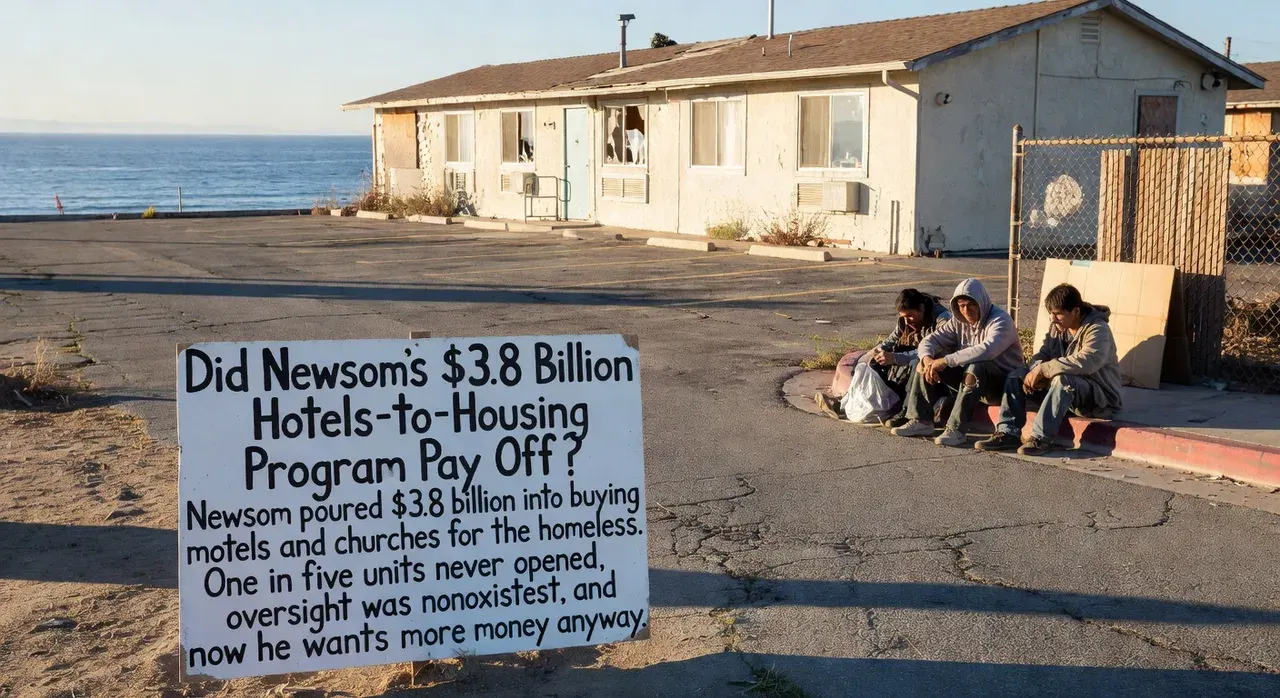
Gavin Newsom’s signature Homekey program spent $3.8 billion turning Motel 6s, a Tri-Delt sorority house, an earthquake-damaged church and even a former Japanese American internment refuge into homeless housing. Nearly 13,500 people now live in completed sites. Yet roughly 3,000 promised units, one in five, remain unfinished as of the end of 2024, another 2,000 house people only temporarily, and 500 more were announced then quietly canceled.
That track record should alarm California voters handing the state another $2 billion through Proposition 1’s mental health bond for the program’s next phase, Homekey+. The original version arrived with almost no built-in oversight; lawmakers killed an audit bill earlier this year. No state agency has produced a public analysis of what worked and what collapsed. Instead, CalMatters had to file more than 100 public records requests to map the outcomes of 250 projects.
When Homekey succeeded, local officials credit factors the state grant itself never covered. Ventura Housing turned a crime-ridden “Booyah Mansion” into the 29-unit El Portal by layering on extra funding, on-site services and close coordination with first responders. “Homekey works because of all the stuff added on top of it,” said CEO Jeffrey Lambert. Mendocino County and Glenn County similarly stabilized residents with counseling and public resources that state dollars did not pay for.

Where those extras were missing, projects stalled, budgets exploded or developers folded. Bay Area developer Taryn Sandulyak watched Homekey destroy her business. “You can only have two of those,” she said of the state’s demand for high quality, high speed and low budgets. “You really can’t ever have three.” At least one developer was forced out; another faces fraud charges. The program made housing faster by front-loading cash and dodging usual lenders, but that also meant less scrutiny and more disasters.
Newsom still calls it a “phenomenal success,” noting the unprecedented scale: “hundreds and hundreds of projects all across the state.” UC Berkeley’s Ryan Finnigan at the Terner Center sees value in the experiment itself, challenging California’s normal slow-motion housing process while people keep landing on the street. Yet the absence of transparent accounting for stalled projects and the refusal to detail improved vetting for Homekey+ repeat the same governance failures that produced the first round’s mixed results.
The deeper problem is structural: converting buildings is one step; sustaining them with ongoing services is another the state has never guaranteed. Without that commitment, even the successes risk sliding backward. California is repeating the urgency-without-accountability model on an even larger bet.
Original reporting: KQED.
More in California
- UC Berkeley Lab Proposes New Civic Framework for California’s Next Governor
A research-driven agenda calls for institutionalizing 'co-governance' to address low public trust and lack of resident influence in state decision-making.
- Five Tax Measures on California’s Ballot Aim to Reshape State Finances
Propositions 3, 40–43 would alter income, wealth and local taxation rules—marking the highest number of tax measures on a general election ballot since 1994.
- Catalina Helicopter Crash Highlights Risks of Island Medevac Flights
A medical evacuation chopper carrying Catalina Romero, pilot, and nurse Jessica Devries crashed into the ocean shortly after takeoff, killing all three; federal investigators are assessing causes including night flying, spatial disorientation, and the island’s challenging Pebbly Beach heliport.