CVE-2026-114125 Risk Assessment and Context
A high CVSS score for CVE-2026-114125 does not necessarily indicate immediate exploitation, according to a risk model analysis. The advisory highlights the complexity of the vulnerability and the conditions under which…

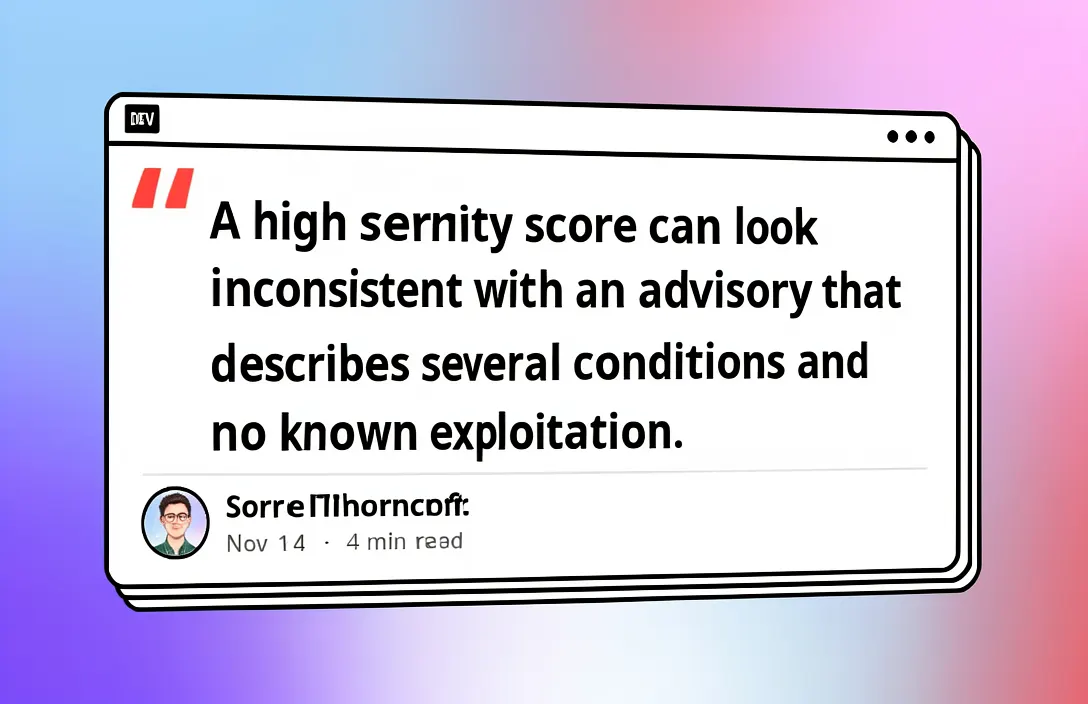

CVE-2026-114125 has been assigned a CVSS v4 score of 9.4, which is classified as critical. The score is based on the attack vector (Network), attack complexity (Low), and the potential high impact on confidentiality, integrity, and availability (CVSS:4.0/AV:N/AC:L/AT:N/PR:N/UI:P/VC:H/VI:H/VA:H/SC:H/SI:H/SA:H) (Dev.to, 1). This indicates that if exploited, the vulnerability could have a significant effect on systems. However, the advisory notes that exploitation requires a sequence of several vulnerabilities, some of which were not disclosed to the Storybook team (Dev.to, 1). [1]
The GitHub advisory lists an EPSS score of 0.385 percent, placing it in the 33rd percentile, suggesting a lower observed or predicted urgency compared to the critical rating alone (Dev.to, 1). Storybook reports no awareness of exploitation in the wild, indicating that the vulnerability may not currently be actively exploited (Dev.to, 1). These signals do not eliminate the possibility of future exploitation but suggest a lower immediate risk, requiring a contextual risk assessment (Dev.to, 1). [1]
The affected package ranges include Storybook 8, 9, 10, and 11 alpha releases, but built output and dev servers not opened in a browser are not affected (Dev.to, 1). A ZoomEye search for title="Storybook" produced 5,438 matches, but the CVE-specific filter produced zero, indicating that the title count is a product fingerprint rather than a census of vulnerable versions (Dev.to, 1). Organizations are advised to assess exposure at the asset level, considering factors such as installed version, interactive browser use, and local test process privileges (Dev.to, 1). [1]
Patching to specific versions (8.6.19, 9.1.21, 10.6.2, or 11.0.0-alpha.6) is recommended, along with stopping affected interactive servers until the update is applied (Dev.to, 1). Removing insecure iframe and messaging flags and keeping development servers on loopback are additional mitigation steps (Dev.to, 1). The patched defaults help reduce risk by blocking cross-host development iframe embedding and rejecting unknown message origins (Dev.to, 1). [1]
Advertisement
CVE-2026-114125 has been assigned a CVSS v4 score of 9.4, which is classified as critical. The attack vector is network-based, with low attack complexity and no required privileges, but passive user interaction is necessary (Dev.to, 1). This score indicates a potentially serious outcome if the vulnerability is successfully exploited, as the vulnerable system and subsequent system impacts are high for confidentiality, integrity, and availability. However, the GitHub advisory notes that the attack relies on correctly exploiting a sequence of many vulnerabilities, some of which were not disclosed to the Storybook team (Dev.to, 1). [1]
The GitHub advisory lists an EPSS score of 0.385 percent, placing it in the 33rd percentile, suggesting a lower observed or predicted urgency compared to the critical rating alone (Dev.to, 1). Storybook states it is not aware of exploitation in the wild, and the EPSS score is a time-bounded estimate rather than a definitive verdict on one organization's exposure (Dev.to, 1). This highlights the importance of combining the CVSS score with local conditions and specific organizational risk factors to form a comprehensive risk assessment. [1]
The affected package ranges include Storybook 8, 9, 10, and 11 alpha releases, but built output and dev servers not opened in a browser are not affected (Dev.to, 1). Organizations should assess exposure at the asset level, considering factors such as installed version, interactive browser use, bind address, and the privileges of local test and build processes (Dev.to, 1). This approach produces a more accurate likelihood estimate than applying the CVSS score uniformly to every Storybook title. [1]
Patching to specific versions (8.6.19, 9.1.21, 10.6.2, or 11.0.0-alpha.6) is recommended, along with stopping affected interactive servers until the update is applied (Dev.to, 1). Additional mitigation steps include removing insecure iframe and messaging flags, keeping development servers on loopback where possible, and updating Chromatic's Visual Tests addon to 5.5.1 or later (Dev.to, 1). These actions are part of a broader risk reduction strategy to prevent potential exploitation of the vulnerability. [1]
Advertisement
The vulnerability's conditional nature raises questions about its real-world exploitability. While the CVSS v4 score of 9.4 indicates a critical severity, the GitHub advisory notes that the attack requires a sequence of multiple vulnerabilities, some of which were not disclosed to the Storybook team (Dev.to, 1). This suggests that the exploit may not be straightforward, and the actual risk depends on the presence of all necessary conditions. The EPSS score of 0.385 percent, placing it in the 33rd percentile, further indicates that while the vulnerability is severe, its likelihood of being exploited may be relatively low (Dev.to, 1). [1]
Another open question concerns the effectiveness of the recommended patches. The advisory suggests upgrading to specific versions (8.6.19, 9.1.21, 10.6.2, or 11.0.0-alpha.6) and stopping affected interactive servers until the update is applied (Dev.to, 1). However, it is unclear whether these patches fully address all potential attack vectors or if additional measures are required. The advisory also recommends removing insecure iframe and messaging flags unless a reviewed compatibility requirement remains, indicating that configuration settings may play a role in mitigating the vulnerability (Dev.to, 1). [1]
The vulnerability's impact on different environments is another area of concern. The advisory notes that built output and dev servers not opened in a browser are not affected, but the risk assessment depends on local conditions such as installed versions, interactive browser use, and network access (Dev.to, 1). This highlights the need for organizations to conduct asset-level exposure assessments rather than applying a uniform risk score to all instances of Storybook. The variability in risk across different environments suggests that a one-size-fits-all approach may not be sufficient (Dev.to, 1). [1]
Sources
Prepared with AI assistance from the cited sources.
The Cali Reporter newsletter
The stories worth your time.
California, the country, and what comes next. Join our free newsletter for reporting that keeps you informed.
More in Technology
- Modern Web Guidance 1.0 and Browser Compatibility
Modern Web Guidance 1.0, announced by Chrome for Developers on November 10, introduces browser compatibility data to assist coding agents in building web features. The initiative emphasizes the importance of fallback…
- Apache mod_http2 Vulnerability Detection with Nmap
A new Nmap scripting module has been developed to detect the Apache mod_http2 vulnerability (CVE-2026-119618), addressing the challenges of identifying affected systems accurately.
- Securing Remote Vendor Access in Industrial Networks
Best practices for managing remote vendor access in operational technology (OT) networks emphasize controlled access points, multifactor authentication, and time-bound sessions to reduce cybersecurity risks.