Custom ERP System Developed for a School in Rawalpindi
A school in Rawalpindi, Pakistan, developed its own ERP system due to budget constraints, highlighting the importance of tailored solutions in educational institutions.

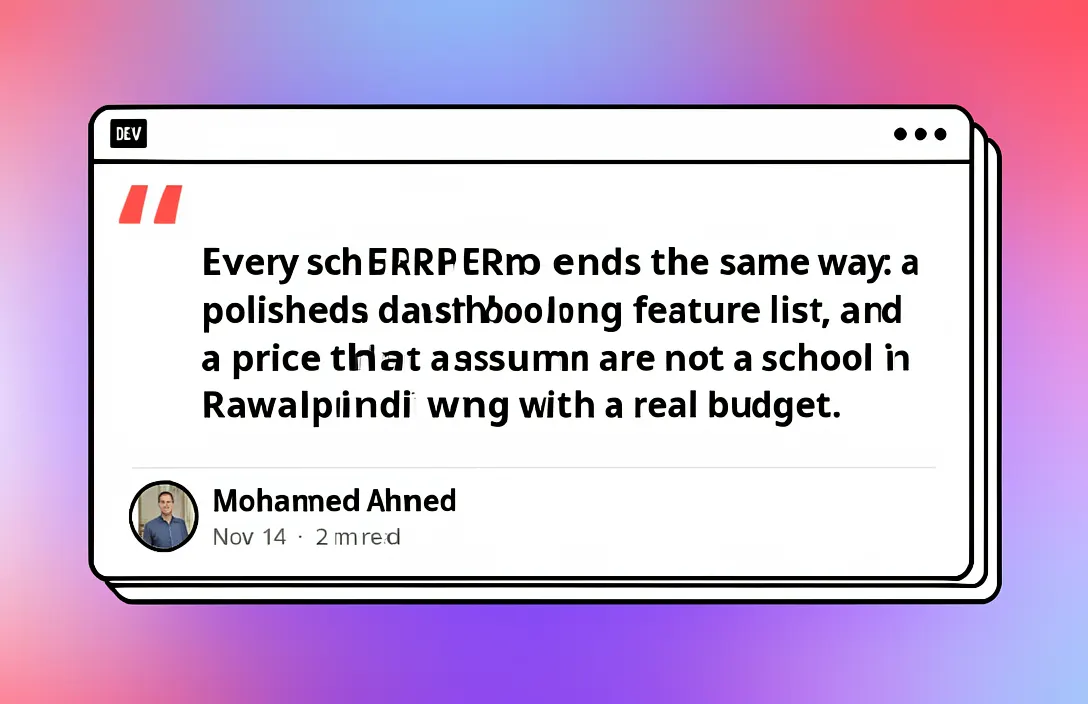

At Rhizome School in Rawalpindi, the decision to build a custom ERP system was driven by the lack of affordable commercial solutions. The system, developed in TypeScript, manages daily operations including student records, timetables, and examinations. It serves around 300 students and 34 staff, and is maintained by the school's IT director, Mohammed Ahmed. This approach was necessitated by the school's real budget constraints, which made existing ERP demos impractical (Dev.to, 2023). [1]
Mohammed Ahmed previously built a digital administration system at the Arfa Karim Technology Incubator using PHP and MySQL. This system streamlined document generation by allowing staff to input data once, reducing errors and eliminating queues for paperwork. Additionally, he implemented Python automation bots to handle repetitive tasks such as renaming, sorting, and generating files (Dev.to, 2023). [1]
Ahmed emphasized the importance of mapping honest workflows in institutional software development. He noted that a school’s needs are not dictated by architectural preferences but by its actual processes. One key lesson was the value of having a single source of truth to eliminate conflicts arising from duplicate records. A centralized database with clearly defined roles resolves such disputes permanently (Dev.to, 2023). [1]
Maintainability was prioritized over cleverness in the system's design, as Ahmed also serves as the network admin and projector technician. This required the use of reliable, straightforward technology. Infrastructure was as important as the software itself, with Ahmed building networks, systems, and Google Workspace administration from scratch at both institutions (Dev.to, 2023). [1]
Advertisement
The decision to build a custom ERP system at Rhizome School in Rawalpindi was driven by the lack of affordable commercial solutions that could meet the specific needs of the institution (1). Mohammed Ahmed, who serves as Director IT at the school, emphasized that the system was developed to replace paper registers and scattered spreadsheets with a centralized digital solution (1). The Rhizome ERP and learning management system, written in TypeScript, manages daily operations such as student records, timetables, examinations, and administrative workflows (1). [1]
Ahmed previously built a digital administration system at the Arfa Karim Technology Incubator using PHP and MySQL, which streamlined document generation and eliminated copy-paste errors (1). At both institutions, he also implemented Python automation bots to handle repetitive tasks such as renaming, sorting, and generating files (1). The development process prioritized process mapping over feature lists, ensuring that the system accurately reflected the school's workflows (1). [1]
Maintainability was a key design principle, as Ahmed also serves as the network admin and projector technician at the school (1). The system was built using deliberately chosen, boring technology to ensure it could be debugged quickly and efficiently, even during busy school mornings (1). The infrastructure, including networks and Google Workspace administration, was also developed from scratch to ensure the software functioned reliably on a solid foundation (1). [1]
Rhizome School in Rawalpindi chose to build a custom ERP system because existing commercial solutions were too expensive for the institution's budget (1). The system, developed by Mohammed Ahmed, is written in TypeScript and is used to manage daily operations such as student records, timetables, and examinations (1). Ahmed previously built a digital administration system at the Arfa Karim Technology Incubator using PHP and MySQL, which streamlined document generation and eliminated copy-paste errors (1). [1]
Advertisement
Maintainability was a key design principle for the Rhizome ERP system, as Ahmed also serves as the network admin and projector technician at the school (1). The system was built with the understanding that it must be debuggable at any time, especially during early morning hours before classes start (1). Ahmed emphasized the importance of mapping honest workflows in institutional software development, ensuring that the system aligns with the actual processes of the school (1). [1]
Ahmed's background in customer support and IT administration influenced the development approach, ensuring that the system is robust and functional in a busy school environment (1). The infrastructure was built from scratch, including networks and systems, to support the software effectively (1). This approach highlights the importance of a stable foundation for any institutional software project (1). [1]
Sources
Prepared with AI assistance from the cited sources.
The Cali Reporter newsletter
The stories worth your time.
California, the country, and what comes next. Join our free newsletter for reporting that keeps you informed.
More in Technology
- Modern Web Guidance 1.0 and Browser Compatibility
Modern Web Guidance 1.0, announced by Chrome for Developers on November 10, introduces browser compatibility data to assist coding agents in building web features. The initiative emphasizes the importance of fallback…
- Apache mod_http2 Vulnerability Detection with Nmap
A new Nmap scripting module has been developed to detect the Apache mod_http2 vulnerability (CVE-2026-119618), addressing the challenges of identifying affected systems accurately.
- Securing Remote Vendor Access in Industrial Networks
Best practices for managing remote vendor access in operational technology (OT) networks emphasize controlled access points, multifactor authentication, and time-bound sessions to reduce cybersecurity risks.