CAR T Cell Persistence Linked to Serious Gut Complication in Myeloma Patients
New research identifies a potential link between prolonged CAR T cell activity and a rare but severe gastrointestinal complication in patients undergoing treatment for multiple myeloma.

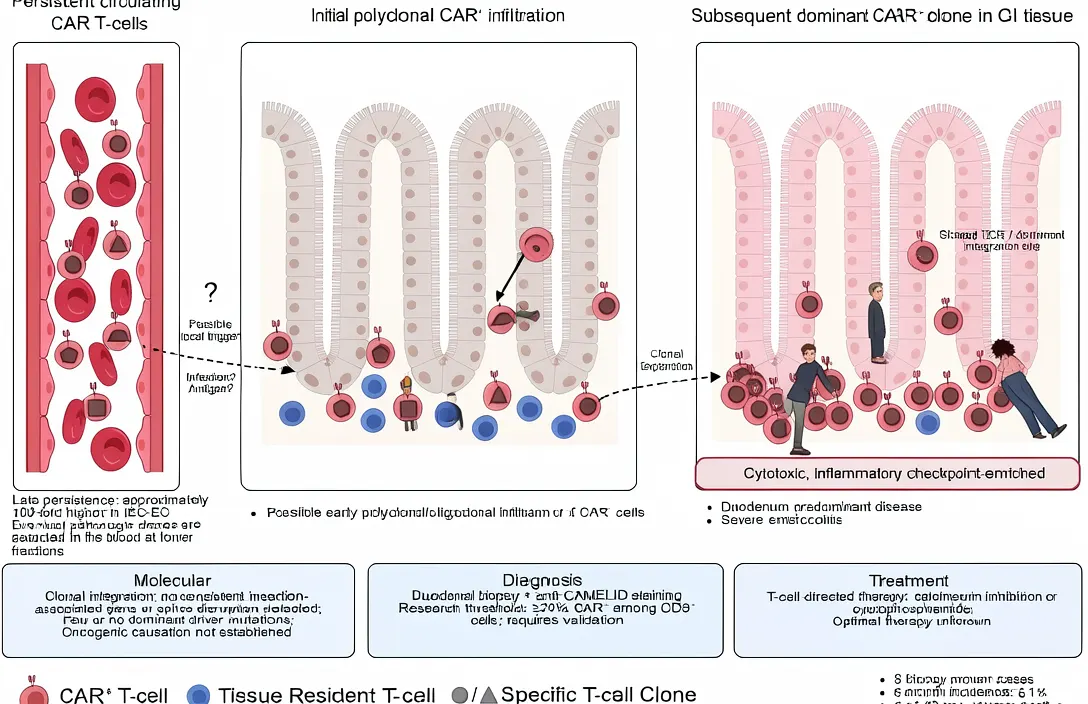

A study published in Nature Medicine found that patients with multiple myeloma who developed immune effector cell-associated enterocolitis (IEC-EC) after receiving chimeric antigen receptor (CAR) T cell therapy had significantly higher levels of CAR T cells persisting in their bloodstream compared to patients who did not develop the condition (source ID: 1). These findings suggest that IEC-EC is not merely an inflammatory response but a distinct immune cell disorder driven by CAR T cell therapy. The research analyzed nine cases of IEC-EC among 158 patients treated with cilta-cel, a specific CAR T cell therapy, and found that these patients had more than 100 times higher levels of CAR T cells in their blood long after treatment (source ID: 1). [1]
The study revealed that CAR T cells accumulated in the digestive tract, where they triggered persistent inflammation and damage, leading to symptoms such as prolonged diarrhea (source ID: 1). Tissue samples from patients with IEC-EC showed dense infiltrates of CAR+ cells in the duodenum, often in a periglandular distribution, as observed through multiparameter sequential immunofluorescent imaging (source ID: 1). This accumulation of CAR T cells in the gut may be a key factor in the development of this rare but potentially life-threatening complication (source ID: 1). [1]
Researchers suggest that routine monitoring of CAR T cell persistence could help identify patients at higher risk for IEC-EC, enabling earlier intervention (source ID: 1). Endoscopic evaluation of the duodenum and testing for CAR T cells in tissue samples may accelerate diagnosis and treatment for patients who develop gastrointestinal symptoms after therapy (source ID: 1). Further studies are needed to determine which patients are most likely to develop IEC-EC and how best to prevent it (source ID: 1). [1]
A study published in Nature Medicine found that patients with multiple myeloma who developed immune effector cell-associated enterocolitis (IEC-EC) after receiving chimeric antigen receptor (CAR) T cell therapy had significantly higher levels of CAR T cells persisting in their bloodstream compared to patients who did not develop the condition (source ID: 1). The study revealed that CAR T cells accumulated in the digestive tract, where they triggered persistent inflammation and damage, leading to symptoms such as prolonged diarrhea (source ID: 1). [1]
Advertisement
Researchers from The University of Texas MD Anderson Cancer Center analyzed nine cases of IEC-EC among 158 patients treated with the CAR T cell therapy ciltacabtagene autoleucel (cilta-cel). IEC-EC occurred in approximately 5% of patients who received treatment. The study found that these patients had roughly 100-fold higher levels of CAR T cells remaining in their bodies long after treatment compared to those in patients who did not develop the condition (source ID: 1). [1]
Multiparameter sequential immunofluorescent imaging of duodenum samples from post-cilta-cel patients with enterocolitis showed that nine patients had dense CAR+ infiltrates, which were defined as at least 20% of the CD3+ population in a single biopsy (source ID: 1). Researchers suggest that routine monitoring of CAR T cell persistence could potentially help identify patients who are at higher risk for IEC-EC, providing an opportunity for earlier intervention (source ID: 1). [1]
A study published in Nature Medicine found that patients with multiple myeloma who developed immune effector cell-associated enterocolitis (IEC-EC) after receiving chimeric antigen receptor (CAR) T cell therapy had significantly higher levels of CAR T cells persisting in their bloodstream compared to patients who did not develop the condition (source ID: 1). The study revealed that CAR T cells accumulated in the digestive tract, where they triggered persistent inflammation and damage, leading to symptoms such as prolonged diarrhea (source ID: 1). [1]
Researchers from The University of Texas MD Anderson Cancer Center analyzed nine cases of IEC-EC among 158 patients treated with the CAR T cell therapy ciltacabtagene autoleucel (cilta-cel). Multiparameter sequential immunofluorescent imaging of duodenum samples from post-cilta-cel patients with enterocolitis showed that nine patients had dense CAR+ infiltrates, which were defined as at least 20% of the CD3+ population in a single biopsy (source ID: 1). [1]
Advertisement
IEC-EC occurred in approximately 5% of patients who received treatment. The study found that these patients had roughly 100-fold higher levels of CAR T cells remaining in their bodies long after treatment compared to those in patients who did not develop the condition. IEC-EC caused persistent diarrhea and inflammation (source ID: 1). [1]
Researchers suggest that routine monitoring of CAR T cell persistence could potentially help identify patients who are at higher risk for IEC-EC, providing an opportunity for earlier intervention. According to the study, an endoscopic evaluation of the duodenum and testing for CAR T cells in a patient's tissue could accelerate diagnosis and treatment for patients who develop gastrointestinal symptoms after treatment (source ID: 1). [1]
A study published in Nature Medicine found that patients with multiple myeloma who developed immune effector cell-associated enterocolitis (IEC-EC) after receiving chimeric antigen receptor (CAR) T cell therapy had significantly higher levels of CAR T cells persisting in their bloodstream compared to patients who did not develop the condition (source ID: 1). The research, conducted by The University of Texas MD Anderson Cancer Center, analyzed nine cases of IEC-EC among 158 patients treated with the CAR T cell therapy ciltacabtagene autoleucel (cilta-cel). IEC-EC occurred in approximately 5% of patients who received treatment (source ID: 1). [1]
The study revealed that CAR T cells accumulated in the digestive tract, where they triggered persistent inflammation and damage, leading to symptoms such as prolonged diarrhea (source ID: 1). Multiparameter sequential immunofluorescent imaging of duodenum samples from post-cilta-cel patients with enterocolitis showed that nine patients had dense CAR+ infiltrates, defined as at least 20% of the CD3+ population in a single biopsy (source ID: 1). These findings indicate that IEC-EC is not merely inflammation but a distinct immune cell disorder driven by CAR T cell activity. [1]
Advertisement
Researchers suggest that routine monitoring of CAR T cell persistence could help identify patients at higher risk for IEC-EC, enabling earlier intervention (source ID: 1). The study highlights the importance of understanding the biology behind this complication to improve diagnosis and treatment strategies for affected patients (source ID: 1). [1]
Sources
Prepared with AI assistance from the cited sources.
The Cali Reporter newsletter
The stories worth your time.
California, the country, and what comes next. Join our free newsletter for reporting that keeps you informed.
More in Health & Medicine
- Understanding Fascia and the Evidence Behind Fascia Release
Fascia is a connective tissue that plays a structural role in the human body, but evidence supporting specific exercises or tools for 'fascia release' remains limited.
- Antidepressant Effectiveness and Long-Term Use
A new review suggests that some antidepressants may be more effective than others in helping people manage depression symptoms over the long term, according to a study published in The Lancet Psychiatry.
- Experimental Weight-Loss Drug Shows Promise for Knee Osteoarthritis Pain
A new study suggests that an experimental weight-loss drug, retatrutide, may significantly reduce knee pain in people with osteoarthritis and obesity.