Business Requirements Document: A Guide to Structure and Content
A business requirements document (BRD) is a critical tool for defining the purpose and scope of a project before development begins. It outlines the business problem, objectives, and success criteria, ensuring…

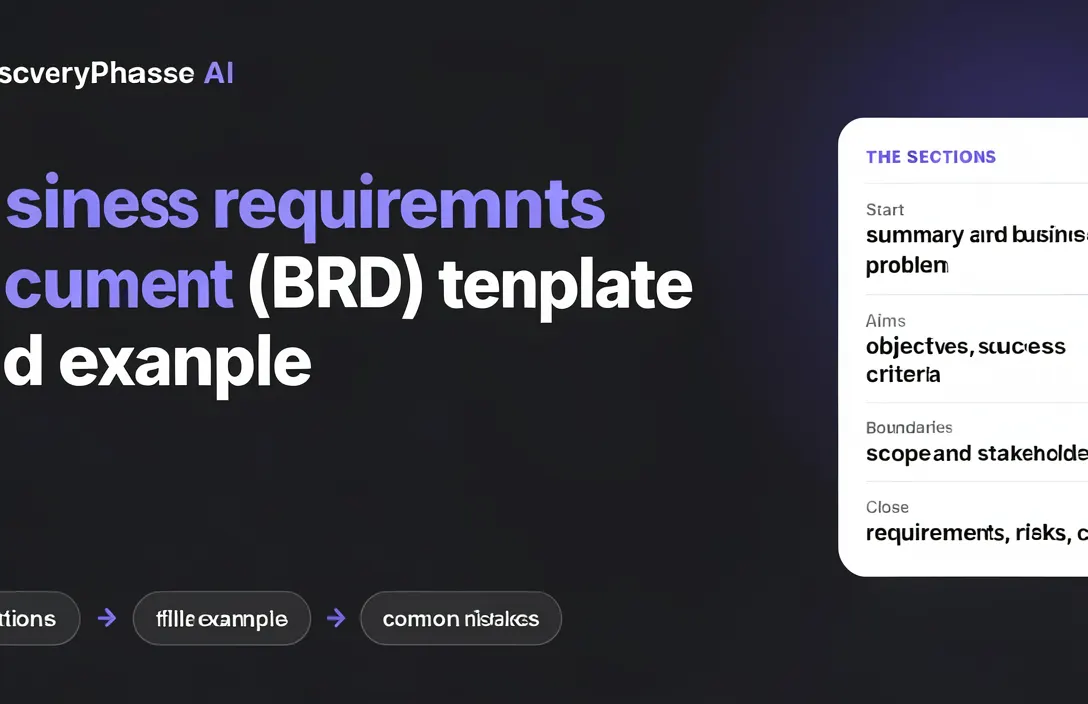

A business requirements document (BRD) records why a project exists and what the business needs from it, before anyone decides how to build it. It is written for the people who fund and approve the work and serves as a reference when someone later asks why a feature is there. The BRD focuses on business needs, rather than technical details, which are addressed in later documents such as the product requirements document (PRD) and software requirements document (SRS) (Dev.to, 2023). [1]
The BRD template includes sections such as document control, executive summary, business problem and opportunity, objectives and success criteria, scope, stakeholders, business requirements, assumptions and constraints, risks and open questions, cost and benefit overview, and approval. Each section has a specific purpose, such as defining the problem, setting measurable objectives, and identifying stakeholders and their level of influence (Dev.to, 2023). [1]
The BRD emphasizes the importance of writing requirements as business needs rather than features. For example, a requirement might state that 'Finance can reconcile a customer's invoices against payments without exporting data,' rather than specifying a feature such as 'add an export button.' Each requirement is assigned an ID, priority, and source, ensuring clarity and traceability when conflicts arise (Dev.to, 2023). [1]
The BRD template provided in the source includes a section for document control, which requires details such as version, date, author, approvers, and status. This ensures that the document remains up to date and traceable throughout the project lifecycle. The document control section is essential for maintaining clarity and accountability, particularly in larger or regulated projects where multiple stakeholders are involved. [1]
Advertisement
The executive summary in the BRD template is explicitly described as a single paragraph that outlines the problem, the proposed outcome, and the expected value. It is noted as the only part that some approvers may read, so it must be self-contained and clearly articulate the project's purpose and significance. The example given in the source discusses a customer portal that would allow wholesale customers to access order status and invoice information, thereby reducing the need for support team intervention. [1]
The business problem and opportunity section in the BRD template requires a description of the current situation, the stakeholders affected, and the cost of doing nothing. The source emphasizes the importance of presenting the problem without suggesting a solution, as doing so may confuse the purpose of the document. For instance, the example highlights the issue of customers requesting order status and invoice copies by email, which results in inefficiencies for the support team. [1]
The scope section of the BRD template is designed to clarify what is included and excluded from the project. This is crucial for setting clear expectations and preventing scope creep. The example in the source lists items in scope, such as order status and invoice download, and items out of scope, such as ordering, payment, and address changes. This delineation helps ensure that all stakeholders understand the boundaries of the project. [1]
The stakeholders section of the BRD template requires identifying the individuals or roles involved, their level of interest, their influence on the project, and whether their approval is needed. The source highlights that missing a stakeholder can lead to late changes and unexpected requirements. It is important to identify all relevant stakeholders early in the project to avoid delays and misunderstandings later on. [1]
Advertisement
The business requirements section of the BRD template includes a list of requirements with IDs, priorities, and sources. Each requirement should be stated as a business need rather than a feature. The example provided in the source includes requirements such as 'Customers can see the status of their orders' and 'Customers can download invoices,' each with a specific priority and source. [1]
The assumptions and constraints section of the BRD template is used to document fixed facts, such as deadlines, regulations, and existing systems that cannot be changed. Assumptions, on the other hand, are beliefs that have not been confirmed. The source emphasizes the importance of keeping these two categories separate, as assumptions may change over time, while constraints remain constant. [1]
The risks and open questions section of the BRD template requires identifying potential risks, their likelihood and impact, mitigation strategies, and the owner responsible for addressing them. The example in the source includes an open question about which system is the source of truth for order status, with the operations lead designated as the owner. This ensures that risks and questions are addressed by the appropriate individuals. [1]
The cost and benefit overview section of the BRD template provides a rough estimate of the investment required and the expected benefits. The source advises giving a range with assumptions rather than a precise number without context. This helps stakeholders understand the level of confidence in the estimates and prepares them for potential variations in cost and benefit outcomes. [1]
Advertisement
The approval section of the BRD template outlines who is responsible for signing off on the document, what they are approving, and when. This section is crucial for ensuring that all stakeholders are aligned and that the project has the necessary approvals to proceed. The source emphasizes that the BRD should be updated whenever a decision changes to maintain its accuracy and relevance. [1]
Sources
Prepared with AI assistance from the cited sources.
The Cali Reporter newsletter
The stories worth your time.
California, the country, and what comes next. Join our free newsletter for reporting that keeps you informed.
More in Technology
- Modern Web Guidance 1.0 and Browser Compatibility
Modern Web Guidance 1.0, announced by Chrome for Developers on November 10, introduces browser compatibility data to assist coding agents in building web features. The initiative emphasizes the importance of fallback…
- Apache mod_http2 Vulnerability Detection with Nmap
A new Nmap scripting module has been developed to detect the Apache mod_http2 vulnerability (CVE-2026-119618), addressing the challenges of identifying affected systems accurately.
- Securing Remote Vendor Access in Industrial Networks
Best practices for managing remote vendor access in operational technology (OT) networks emphasize controlled access points, multifactor authentication, and time-bound sessions to reduce cybersecurity risks.